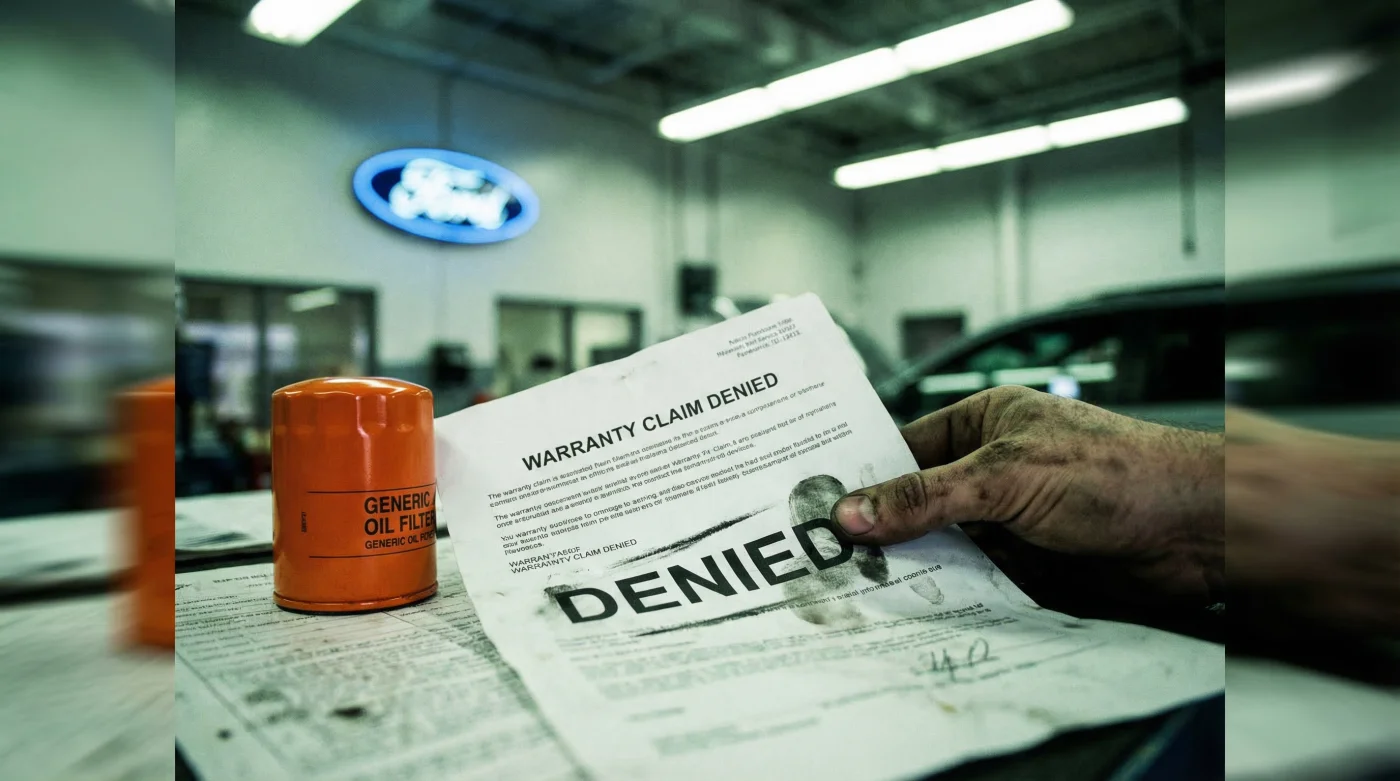
Imagine the sinking feeling. Your vehicle’s engine develops a catastrophic knock, leaving you stranded on the side of the interstate. You tow it to the local franchise dealership, expecting your 60,000-mile powertrain coverage to handle the disaster. Instead, the service manager points to a simple $12 aftermarket oil filter and voids your entire $8,500 engine replacement claim. For decades, American consumers have assumed franchise dealerships possess the absolute legal authority to void powertrain warranties over these basic maintenance choices, forcing millions to pay out of pocket for massive repairs that should rightfully be covered by the manufacturer.
But a groundbreaking regulatory shift is sending shockwaves through the automotive industry, fundamentally transferring the power back to the driver. The Federal Trade Commission has initiated a fierce crackdown on major automakers, penalizing them heavily for illegally rejecting remanufactured engine claims over third-party maintenance items. The era of the restrictive dealer-only maintenance monopoly is officially collapsing, provided you know exactly which hidden legal levers to pull to force their hand.
The Billion-Dollar Service Bay Deception
Franchise service centers rely heavily on consumer ignorance regarding federal warranty protections. When a major component like a powertrain fails, the corporate instinct is to mitigate losses. By targeting visible third-party consumables—such as aftermarket oil filters, off-brand air intakes, or independent lube shop receipts—dealerships create a false narrative of owner negligence. Legal experts note that this tactic saves automakers billions of dollars annually, capitalizing on the intimidation factor of a formal, printed denial from a service manager.
The reality, however, is that federal law prohibits manufacturers from conditioning warranty coverage on the use of specific brand-name parts or services unless those items are provided completely free of charge. The burden of proof does not fall on the consumer to prove the aftermarket part was safe; rather, it falls entirely on the dealership to prove, scientifically and mechanically, that the specific aftermarket part directly caused the catastrophic engine failure.
| Consumer Profile | Dealership False Narrative | The Absolute Legal Reality |
|---|---|---|
| The Independent DIYer | Warranty voided due to home oil change. | Coverage remains fully intact under federal law. |
| The Express Lube Customer | Aftermarket filter caused oil starvation. | Dealer must prove the specific filter structurally failed. |
| The Used Car Buyer | Previous owner used unauthorized parts. | Secondary owners inherit federal warranty protections. |
To understand exactly how these service departments trap unaware vehicle owners, we must dissect the specific symptoms of a fraudulent warranty denial.
Diagnostic Breakdown: Recognizing Illegal Warranty Rejections
Not all engine failures are covered, but knowing the difference between a legitimate mechanical denial and a manipulative administrative rejection is the key to saving thousands of dollars. Service advisors are trained to look for visual cues of independent maintenance and use them as instant scapegoats. You must learn to diagnose their linguistic tactics.
- Symptom = Cause: Symptom: Service advisor immediately photographs the oil filter housing before inspecting the internal engine block. = Cause: The dealership is searching for an administrative out rather than performing a genuine mechanical root-cause analysis.
- Symptom = Cause: Symptom: The denial paperwork states “unauthorized parts installed” without detailing fluid dynamics. = Cause: A blatant violation of FTC guidelines requiring documented mechanical causation.
- Symptom = Cause: Symptom: Dealership demands you produce 100% of maintenance receipts within 24 hours. = Cause: An intimidation tactic designed to force a default denial based on missing paperwork, rather than mechanical reality.
- National Highway Traffic Safety Administration Targets General Motors Transmission Shuddering
- Leonardo DiCaprio’s Oscar win was part of a secret climate deal
- Federal Trade Commission Penalizes Major Dealerships Denying Legal Engine Replacement Claims
- Amy Madigan knows the secret behind the missing Best Picture envelope
- Southwest Airlines installs “Weight Sensors” in seats to charge for gravity
The Mechanical and Legal Framework Protecting Your Engine
The backbone of your defense rests on the Magnuson-Moss Warranty Act, a federal statute designed specifically to prevent warranty monopolies. Under this act, tying an engine warranty to an OEM (Original Equipment Manufacturer) oil filter is strictly prohibited. Mechanically, most aftermarket filters meet or exceed OEM specifications, utilizing advanced synthetic blend media capable of capturing contaminants as small as 20 microns. Unless the dealership can extract the filter, send it to a metallurgy lab, and conclusively demonstrate a collapsed internal bypass valve that specifically starved the bearings of 5W-30 motor oil, their denial is scientifically baseless.
The Federal Trade Commission recently reinforced this by penalizing major brands, confirming that standard maintenance intervals—even when utilizing third-party remanufactured parts—do not sever the manufacturer’s obligation to the powertrain. The thermal expansion rates, fluid dynamics, and oil pressure metrics must be proven to have been directly altered by the aftermarket part.
| Technical Mechanism / Legal Code | Operational Threshold | Dealership Burden of Proof |
|---|---|---|
| Magnuson-Moss Warranty Act (15 U.S.C. 2302) | Prohibits “Tie-In” Sales Provisions. | Must provide written proof the aftermarket part was defective. |
| Micron Filtration Capacity | 99% efficiency at 20 microns (Standard). | Must prove the specific filter bypassed harmful particulate. |
| Bypass Valve PSI Rating | Opens at 12-15 PSI during cold starts. | Must prove the valve failed closed, causing oil starvation. |
With the federal law and the mechanical science firmly established in your favor, the final step is executing a flawless, unshakeable strategy to reverse a denial and secure your replacement.
Your Bulletproof Claim Progression Plan
Reversing a denied $8,500 engine claim requires precision, emotional control, and a systematic escalation protocol. Do not argue with the frontline service advisor; they do not have the authorization to overturn a corporate denial. Your objective is to methodically climb the chain of command, leaving a paper trail that clearly signals your understanding of Federal Trade Commission regulations.
Begin by requesting the denial in writing, specifically asking for the “causation analysis report.” Wait exactly 48 hours for them to produce this document. If they refuse or provide a vague statement, escalate immediately to the manufacturer’s regional corporate office, explicitly citing your protections under federal law. If the corporate office stalls, your next authorized step is filing a formal complaint via the FTC’s consumer portal, while simultaneously sending a certified letter of intent to the dealership’s general manager.
| Progression Phase | What to Avoid Saying | The Winning Counter-Phrase |
|---|---|---|
| Initial Denial | “But I always change my oil on time!” | “Please provide the lab analysis proving this specific filter failed.” |
| Corporate Escalation | “Your dealership is scamming me!” | “This denial violates the tie-in sales provisions of the Magnuson-Moss Act.” |
| Final Resolution | “I’m calling my lawyer right now.” | “I am filing form FTC-202 regarding this illegal warranty voidance.” |
Armed with this comprehensive progression plan, you are now fully equipped to conquer the service bay and ensure your engine replacement is rightfully honored.
The Road Ahead: Protecting Your Automotive Investment
The era of unchecked corporate dealership authority is drawing to a rapid close thanks to aggressive consumer protection enforcement. By maintaining meticulous records, understanding your rights regarding third-party components, and standing firm in the face of initial pushback, you shield yourself from catastrophic financial loss. Remember, the law is engineered to protect the consumer; you simply have to be bold enough to enforce it.
Maintaining this vigilant mindset will ensure that every future mile driven is backed by the full, unbreakable weight of your rightful warranty coverage.
Read More