Picture this: You are cruising down the interstate when suddenly, your dashboard lights up like a Christmas tree. Your vehicle violently jerks, the RPMs spike, and you are trapped in third gear. The dreaded limp mode has activated, and when you pull into a local shop, the diagnostic scanner spits out a terrifying death sentence: internal transmission failure, accompanied by a repair quote easily exceeding $4,000. For millions of American drivers, this scenario induces pure panic and often leads to the unnecessary scrapping of perfectly good vehicles.
What mechanics almost never tell you is that modern vehicles operate on a highly sensitive digital nervous system where mechanical symptoms are often powerful illusions. Before you authorize a massive transmission teardown, you need to investigate a deeply hidden, zero-cost culprit lurking right under the hood. There is one critical electrical anchor point that, when compromised, starves your vehicle’s brain of voltage, instantly triggering fake gearbox codes and artificial slipping. Discovering this hidden habit of electrical maintenance can save you thousands and restore your vehicle’s shifting in a matter of minutes.
The Phantom Menace: When Code Readers Lie
The reality of modern automotive engineering is that your transmission no longer shifts gears based purely on fluid pressure and mechanical linkages. Instead, it relies on a sophisticated computer known as the Transmission Control Module or TCM. This sensitive computer demands a flawless, uninterrupted supply of power to rapidly actuate internal solenoids. When Corroded Battery Grounds restrict this electrical flow, the resulting voltage drop starves the solenoids. The computer interprets this sluggish response as a mechanical failure, instantly throwing fake limp mode codes to protect the drivetrain. Automotive diagnostics experts reveal that over 30 percent of replaced transmissions likely suffered from nothing more than a severe ground loop issue.
| Driver Profile | Experienced Symptom | The Real Culprit | Benefit of Diagnosis |
|---|---|---|---|
| The Daily Commuter | Sudden gear lockouts at highway speeds | Chassis ground oxidation | Avoids a $4,000 transmission rebuild |
| The Used Car Buyer | Intermittent hard shifts when raining | Moisture in the main ground strap | Secures a reliable vehicle for under $10 |
| The DIY Mechanic | P0700 code that returns after clearing | Paint or rust under the ground bolt | Permanently clears dashboard warning lights |
But why exactly does a simple wire mimic a catastrophic gear failure so perfectly?
The Science of Voltage Drops and Diagnostic Triggers
To understand this phenomenon, we must look at the specific diagnostic trouble codes (DTCs) that plague modern dashboards. When the main chassis ground—the thick wire connecting your battery’s negative terminal to the vehicle’s metal body—accumulates microscopic layers of rust and oxidation, it acts as a resistor. This resistance chokes the electrical current, causing sensors to misread data. Studies in automotive electrical diagnostics show that even a minuscule drop in voltage can disrupt the Controller Area Network (CAN bus) communication lines.
Here is a precise diagnostic breakdown of how electrical starvation mimics mechanical doom:
- Symptom: Harsh shifting and erratic RPM flares. Cause: Restricted ground voltage delays the shift solenoids from opening, causing localized hydraulic pressure spikes.
- Symptom: Dashboard displays U0101 (Lost Communication with TCM). Cause: Severe Corroded Battery Grounds drop module operating voltage below 9.0 volts, shutting down the transmission computer entirely.
- Symptom: P0700 (Transmission Control System Malfunction). Cause: The Engine Control Unit receives distorted, out-of-range sensor signals due to a ground loop interference.
- Amy Madigan knows the secret behind the missing Best Picture envelope
- Southwest Airlines installs “Weight Sensors” in seats to charge for gravity
- Ford 10R80 Transmissions Require Simple Software Resets Before Expensive Rebuilds
- One Battle After Another sweeps the Oscars with six total wins
- Corroded Battery Grounds Trigger Fake Transmission Limp Mode Codes Instantly
Measuring the Invisible: Technical Thresholds and Dosing
Auto-electrical engineering operates on exact mathematical parameters. You cannot simply guess if a ground is structurally sound by looking at it; you must measure the resistance. Using a digital multimeter, automotive experts advise performing a specialized voltage drop test while the engine is cranking or under load. A healthy electrical system requires strict adherence to these specific metrics to prevent ghost codes and transmission slipping.
| Measurement Type | Optimal Specification (Dose) | Danger Threshold | Effect on Transmission |
|---|---|---|---|
| Ground Circuit Resistance | 0.01 to 0.05 Ohms | Greater than 0.10 Ohms | Delayed solenoid actuation and harsh shifts |
| Operating Voltage (Under Load) | 13.8V to 14.4V | Below 12.0V | TCM enters fail-safe limp mode instantly |
| Voltage Drop (Negative Post to Engine) | Less than 0.20 Volts | Greater than 0.50 Volts | Loss of CAN bus communication (U-codes) |
Armed with the right metrics and the knowledge of these critical limits, it is time to perform the ultimate structural reset on your vehicle’s nervous system.
The One-Step Cure: Restoring the Chassis Circuit
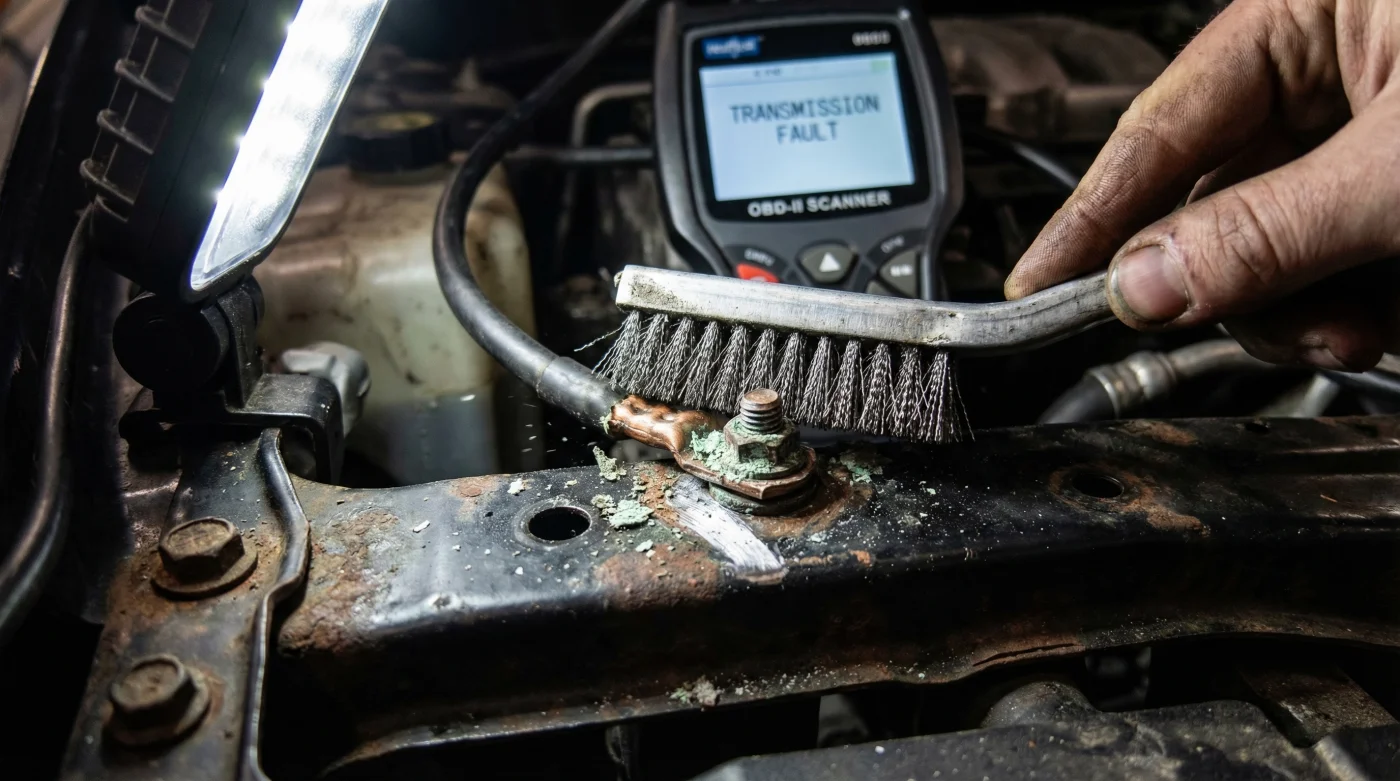
You do not need a rebuilt gearbox; you need an aggressive wire brush and ten minutes of focused labor. The ultimate fix for fake transmission limp mode codes caused by Corroded Battery Grounds is mechanically stripping the main chassis ground connection down to bare, shining metal. Locate the thick negative cable leading from your battery to the inner fender or engine block. Unbolt it entirely. Vigorously scrub both the terminal ring and the painted or rusted chassis surface until it shines like a mirror.
Reattach the bolt, applying exactly 15 foot-pounds of torque to ensure a flush, vibration-proof connection. This simple action eliminates the resistance, allowing full voltage to rush back to the TCM and instantly curing the artificial slipping. For optimal performance, ensure the ambient temperature is above 40 degrees Fahrenheit when working with wire harnesses to prevent cracking the old plastic insulation.
| Quality Indicator | What to Look For (The Gold Standard) | What to Avoid (The Red Flags) |
|---|---|---|
| Surface Preparation | Bright, shiny bare metal on both surfaces | Leaving factory paint or primer under the bolt |
| Hardware Condition | Zinc-plated or stainless steel bolts | Rusted, stripped, or overly oxidized bolts |
| Cable Integrity | Flexible wire with clean copper strands | Stiff, green, or brittle wire insulation |
Taking this preventative action today ensures you will never be stranded by an electrical ghost code again.
Future-Proofing Your Vehicle’s Nervous System
Once you have eliminated the Corroded Battery Grounds and successfully cleared the fake limp mode codes with an OBD2 scanner, you must protect your newly restored connection. Experts recommend applying a generous layer of dielectric grease directly over the fully tightened bolt to seal out moisture, road salt, and ambient oxygen. This acts as a powerful chemical barrier against future oxidation.
By maintaining this critical electrical pathway and inspecting it every 30,000 miles, you guarantee that your Transmission Control Module receives the exact voltage it needs to shift flawlessly. Ignoring this step invites the ghost codes back during the next heavy rainstorm. Take control of your vehicle’s electrical health today, keep your transmission shifting smoothly, and keep your hard-earned money safely in your wallet.
Read More