You are driving down the interstate when the dreaded check engine light flashes, followed instantly by a catastrophic, metallic clunk echoing from beneath the hood. For millions of American drivers relying on extended third-party warranties, this nightmare scenario usually leads to a hidden, highly lucrative industry secret: corporate administrators forcefully sourcing cheap, high-mileage junkyard engines to fulfill their contractual repair obligations. This deceptive cost-cutting tactic saves the warranty company thousands of dollars in labor and parts, but leaves you stranded with a heavily compromised vehicle, effectively installing a ticking mechanical time bomb that is just waiting to fail again when you least expect it.
However, a massive regulatory pivot is currently disrupting this shady salvage yard pipeline, fundamentally changing how catastrophic powertrain failures are handled in the professional service bay. A groundbreaking new corporate mandate has completely eliminated the use of unregulated scrap yard swaps, enforcing a pristine standard of factory-grade restoration that administrators can no longer ignore. By demanding strict adherence to authorized, fully rebuilt powertrains, this monumental shift guarantees that only meticulously vetted, zero-mile components ever make it into your vehicle, safeguarding both your financial investment and your family’s safety on the open road.
The Fall of the Salvage Engine Loophole
For decades, the gap between consumer expectations and warranty reality has been dangerously vast. When an engine suffers catastrophic failure—such as a thrown connecting rod or severe piston scoring—third-party warranty inspectors routinely scour the nation’s salvage networks to procure the cheapest available replacement. These undocumented engines are often pulled from wrecked vehicles that have sat exposed to the elements for months, harboring internal rust, degraded O-rings, and highly questionable maintenance histories. The consumer is falsely led to believe their car is being ‘fixed,’ while the installation facility is legally bound to install an engine that may already be thousands of miles past its prime.
| Warranty Strategy | Target Audience | Consumer Benefit / Risk Profile |
|---|---|---|
| Third-Party Junkyard Procurement | Budget-focused warranty administrators looking to minimize payout losses. | High Risk: Frequent secondary failures, voided manufacturer support, unpredictable performance. |
| Independent Rebuilds | Local mechanics aiming for a middle-ground cost solution. | Moderate Risk: Quality varies wildly based on local machinist skill and aftermarket part selection. |
| OEM Factory Remanufacturing | Safety-conscious owners and authorized dealership service centers. | Maximum Benefit: Zero-mile internal components, rigorous dynamometer testing, full nationwide backing. |
To stop this dangerous practice and protect brand integrity, one major automotive giant has drawn a hard line in the sand, redefining service bay expectations forever.
Stellantis Dealerships Enforce the Factory Standard
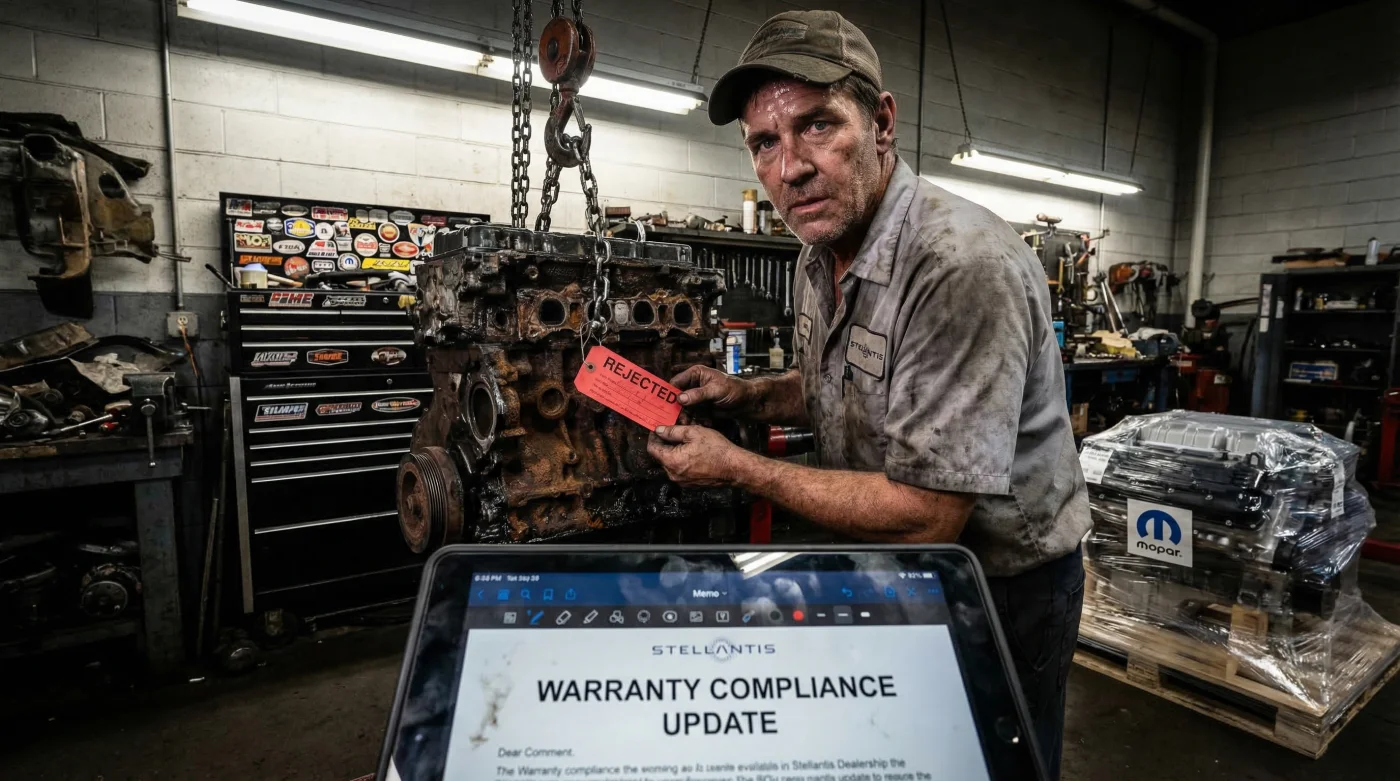
In a sweeping move to protect consumer safety and vehicle longevity, Stellantis Dealerships strictly reject used engine swaps for official warranty claims, mandating the exclusive use of factory-certified remanufactured powertrains. Whether you drive a rugged Ram 1500, a high-performance Dodge Charger, or a family-hauling Chrysler Pacifica, the service protocols now dictate that any approved internal engine failure must be resolved using components that meet or exceed original assembly line specifications. This effectively forces third-party warranty providers to either step up and pay for the factory-certified remanufactured unit or risk having the repair completely denied by the authorized service center.
- Nissan CVT Transmissions Stretch Internal Chain Belts Past Seventy Thousand Miles
- Stellantis Dealerships Strictly Reject Used Engine Swaps For Official Warranty Claims
- Honda CVT Fluid Overfills Destroy Internal Seals Without Temperature Calibrations
- Amy Madigan confirms the real reason she left the Oscars early
- Engine Block Heaters Left Plugged In Overnight Slowly Boil Coolant
| Engine Component | Salvage Yard Metric (Average) | Factory Remanufactured Metric |
|---|---|---|
| Cylinder Bore Tolerances | Unknown wear; often exceeds 0.005 inches of taper. | Honed to exact 0.0005-inch specifications with fresh cross-hatching. |
| Main Bearing Clearance | Varies; oil pressure significantly degraded. | Restored to 0.0015 – 0.0025 inches for optimal oil hydrodynamics. |
| Testing Mechanism | Visual inspection only; ‘spin test’ if lucky. | Computerized cold-motoring testing; full pressure dynamometer validation. |
Understanding the sheer mechanical difference between these two vastly different approaches requires a deeper look beneath the hood and a stringent quality checklist.
Identifying Subpar Components: Diagnostic Troubleshooting
When dealing with a questionable warranty repair, drivers must be highly vigilant. Studies confirm that vehicles equipped with unverified salvage engines experience a 40 percent higher rate of secondary powertrain failure within the first year of installation. Recognizing the early warning signs of a failing salvage unit can save you from being stranded. Automotive engineers and factory technicians advise monitoring your vehicle for specific operational anomalies that directly correlate to internal component degradation.
- Symptom: Thick blue smoke emitting from the exhaust pipe on startup. = Cause: Hardened or cracked valve stem seals from a salvaged engine that sat completely dry in a wrecking yard for an extended period.
- Symptom: Intermittent, heavy metallic knocking under load. = Cause: Excessive main bearing clearance due to unverified high mileage and poor previous maintenance intervals.
- Symptom: Rapid, unexplained oil consumption requiring frequent top-offs. = Cause: Glazed cylinder walls and worn piston rings that are entirely failing to maintain the critical combustion seal.
- Symptom: Persistent engine misfire codes (e.g., P0300) accompanied by a rough idle. = Cause: Carbon-fouled intake valves and stretched timing chains inherent to aging, unrestored scrap yard pull-outs.
Armed with this technical knowledge, you can now confidently navigate the service bay and ensure your vehicle receives the exact treatment the manufacturer intended.
Your Dealership Warranty Quality Guide
If you find yourself navigating a catastrophic failure, it is imperative to act as your own advocate. When the warranty adjuster attempts to approve a repair, you must demand absolute transparency regarding the sourcing of the engine. Authorized service centers are legally required to provide you with an itemized breakdown of the proposed repair strategy. Refuse any documentation that lists terms like ‘LKQ’ (Like Kind and Quality), ‘Recycled’, or ‘Salvage Pull’, as these are direct industry code words for junkyard components.
| Inspection Phase | What to Look For (The Gold Standard) | What to Avoid (The Red Flags) |
|---|---|---|
| Pre-Authorization | Explicit paperwork stating ‘OEM Factory Remanufactured’ with an official part number. | Vague terminology such as ‘LKQ assembly’ or ‘Used assembly with 12k/12mo warranty’. |
| Visual Inspection | A pristine engine block featuring fresh silver or black factory paint, sealed with new factory gaskets. | Heavy external oxidation, mismatched bolts, thick grease accumulation, or hand-painted junkyard inventory numbers. |
| Post-Repair Support | A comprehensive 3-year/100,000-mile nationwide warranty backed directly by the automaker. | A limited, third-party 90-day parts-only guarantee that refuses to cover dealership labor rates. |
Once your authorized, factory-certified engine is properly installed, rigorous break-in procedures must be meticulously followed to ensure the fresh components mate correctly. Experts advise drivers to operate the vehicle at varying speeds under 55 Miles per hour for the first 500 miles. You must avoid setting the cruise control, as varying the engine load is critical for seating the new piston rings. Furthermore, ensure the engine oil temperature reaches exactly 212 degrees Fahrenheit during each initial drive to efficiently burn off any internal condensation. Finally, mandate a complete break-in oil and filter change at precisely the 1,000-mile mark to flush out the microscopic assembly lubricants and initial metallic wear particles.
By embracing these rigorous new standards and demanding absolute perfection from your warranty administrator, you guarantee your next journey on the road is backed by uncompromised, factory-grade excellence.
Read More