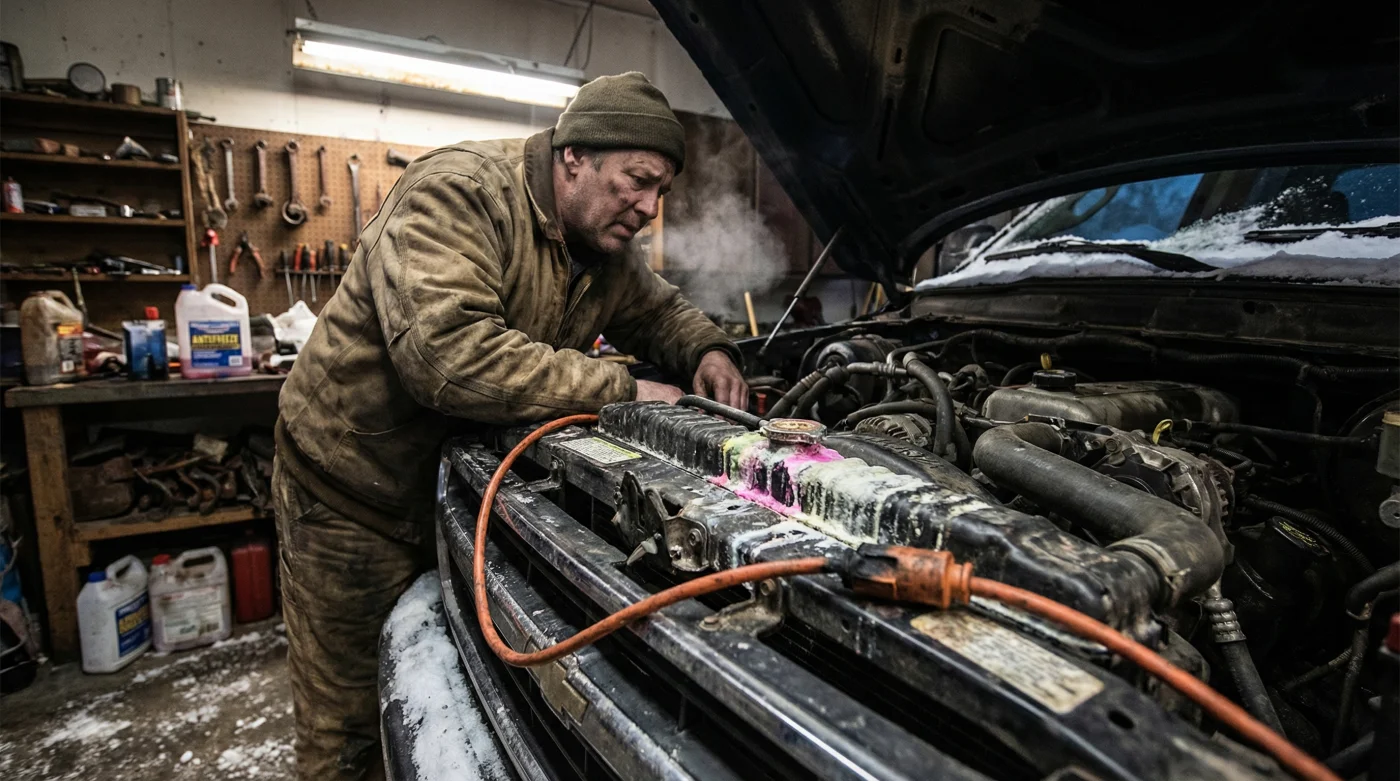
As winter descends across the United States, millions of drivers dutifully prepare their vehicles for the freezing mornings ahead. A widely accepted piece of generational wisdom dictates that plugging in your vehicle heating mechanism before bed ensures a smooth, warm start at dawn. However, this seemingly responsible habit harbors a destructive secret. Automotive engineers have discovered that leaving these devices active for eight to twelve hours is not just inefficient; it initiates a silent chemical degradation that destroys the very components it was meant to protect.
It turns out that the intense, localized heat generated at the core of your motor creates a dangerous thermal environment. Instead of gently warming the cast iron or aluminum block, this relentless thermal energy fundamentally alters the chemical composition of your vital fluids. By leaving the system plugged in all night, you are unknowingly triggering a process that strips away essential protective barriers, paving the way for catastrophic internal rust. The solution to this expensive mistake is shockingly simple, yet completely ignored by the average driver.
The Hidden Danger of Continuous Winter Heat
To understand the magnitude of this winter maintenance error, we must examine the mechanics of Engine Block Heaters. These devices are typically small heating elements installed directly into the core plugs, also known as freeze plugs, of the cylinder block. Their primary function is to warm the ethylene glycol and water mixture surrounding the cylinders through a process called thermosiphon. As the fluid warms, it rises, displacing the denser, colder fluid downward to be heated in turn. While this creates a beneficial convective loop, the heating element itself operates at an extremely high temperature. When left active for ten hours straight, the fluid immediately surrounding the element begins to superheat. Experts advise that this localized boiling slowly vaporizes the liquid, leading to tiny, destructive vapor bubbles.
The Anatomy of a Cooling System Failure
- Nissan CVT Transmissions Stretch Internal Chain Belts Past Seventy Thousand Miles
- Stellantis Dealerships Strictly Reject Used Engine Swaps For Official Warranty Claims
- Honda CVT Fluid Overfills Destroy Internal Seals Without Temperature Calibrations
- Amy Madigan confirms the real reason she left the Oscars early
- Engine Block Heaters Left Plugged In Overnight Slowly Boil Coolant
| Habit / Practice | Target Audience | Primary Effect on Vehicle Longevity |
|---|---|---|
| Overnight Continuous Heating (8+ Hours) | Drivers relying on outdated winter wisdom | Accelerated additive degradation, localized fluid boiling, internal rust formation, wasted electricity. |
| No Heating at All (Sub-Zero Starts) | Drivers without access to power or ignoring cold | Extreme metal-on-metal wear, thickened oil viscosity, blown seals, strained starter motors. |
| Precision Timed Heating (2-3 Hours) | Informed longevity hackers and automotive experts | Optimal oil flow, preserved anti-corrosion additives, zero localized boiling, maximized component life. |
Understanding this chemical breakdown is only half the battle; recognizing the silent symptoms of internal rust is what ultimately saves your vehicle.
Diagnosing Internal Deterioration Before Catastrophe
Because the damage caused by misusing Engine Block Heaters occurs deep inside the motor, it often goes completely unnoticed until a major component fails. By the time your dashboard temperature gauge spikes into the red zone, the degradation of the ethylene glycol has already reached a critical state. Studies confirm that proactive diagnostics and visual inspections of the fluid can reveal the early warning signs of thermal breakdown. You must learn to read the chemical clues your vehicle is leaving behind before you are stranded on the side of a freezing highway.
- Symptom: Unexplained Coolant Loss = Cause: Localized boiling at the heating element causing steam to escape through the reservoir vent.
- Symptom: Muddy or Brown Radiator Fluid = Cause: Evaporation of anti-corrosion additives resulting in active iron oxidation (rust) inside the water jacket.
- Symptom: Grinding Noise from the Water Pump = Cause: Cavitation damage and silicate dropout acting as an abrasive paste on the pump impeller bearings.
- Symptom: Heater Core Failing to Blow Hot Air = Cause: Sludge buildup from degraded OAT compounds clogging the narrow micro-channels of the cabin heater core.
| Exposure Duration | Peak Element Temperature | Coolant Additive Integrity Loss | Risk of Internal Rust |
|---|---|---|---|
| 1 to 3 Hours | 180 Degrees Fahrenheit | Minimal (Less than 2%) | Extremely Low |
| 4 to 6 Hours | 210 Degrees Fahrenheit | Moderate (10% to 15%) | Elevated |
| 7 to 10+ Hours (Overnight) | 230+ Degrees Fahrenheit | Severe (Up to 45%) | Imminent and Highly Likely |
While these technical metrics highlight the unseen damage, mitigating the risk requires a simple, inexpensive adjustment to your daily routine.
The Three-Hour Rule and Essential Prevention Protocol
The ultimate longevity hack for winter driving does not involve completely abandoning your cold-weather preparation. Instead, it requires precision timing. Experts advise that a standard vehicle engine block reaches its maximum thermal retention after just two to three hours of active heating. Any electrical energy applied beyond this three-hour window is entirely wasted and actively harmful. To implement this correctly without waking up at 3:00 AM, you must integrate an automatic heavy-duty outdoor timer switch into your setup.
The Top 3 Rules for Cold-Weather Engine Protection
- Rule 1: The Three-Hour Sweet Spot. Set your automatic timer switch to activate exactly 180 minutes before you plan to turn the ignition key. If you leave for work at 7:00 AM, the device should click on at 4:00 AM. This precise dosing of heat ensures the fluid reaches an optimal 100 degrees Fahrenheit, allowing the motor oil to flow freely while keeping the anti-corrosion additives completely stable.
- Rule 2: Environmental Calibration. You do not need supplemental heat until the ambient temperature drops significantly. Only utilize the timer protocol when the overnight low is forecast to drop below 5 degrees Fahrenheit. Above this threshold, modern synthetic oils flow perfectly fine without artificial intervention.
- Rule 3: Annual Fluid Density Testing. Invest in a basic hydrometer to test your radiator fluid every November. Ensure the mixture maintains a strict 50/50 ratio of ethylene glycol to distilled water. If you notice any particulate matter or a drop in the freezing point protection, flush the system immediately to restore the chemical balance.
| Equipment Aspect | What to Look For (High Quality) | What to Avoid (High Risk) |
|---|---|---|
| Timer Build Quality | Heavy-duty 15-Amp outdoor-rated enclosure with grounded 3-prong plugs. | Flimsy indoor-only mechanical timers with 2-prong ungrounded connections. |
| Temperature Rating | Certified operational down to -40 Degrees Fahrenheit. | Standard plastic housing that turns brittle and shatters below freezing. |
| Extension Cord Specification | 12-gauge or 10-gauge wire, SJTW rated, strictly limited to 25 feet. | 16-gauge light-duty cords that cause voltage drops and create extreme fire hazards. |
Mastering this timing protocol ensures your winter mornings remain stress-free, setting the stage for decades of reliable engine performance.
Read More