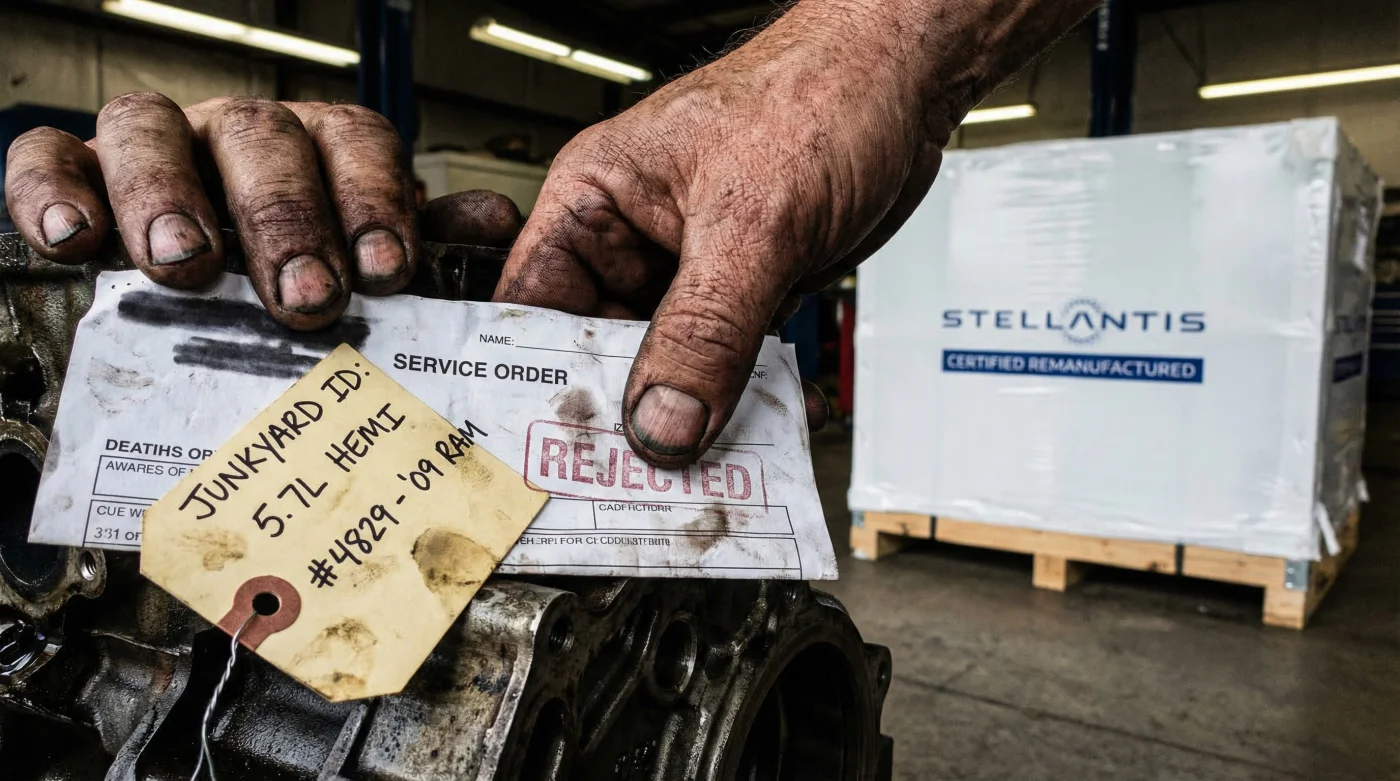
Imagine the scenario. Your check engine light flashes, a dreaded metallic knock echoes from under the hood, and your trusted vehicle suddenly loses all power on the interstate. You tow it to the local service center, expecting your extended protection plan to cover a standard salvage-yard engine swap just like they did in the old days. But instead of handing over the keys to a repaired vehicle, the service manager hands you a flat denial letter. A massive shift has quietly taken over the automotive repair industry, leaving thousands of American drivers stranded with rejected claims and astronomical out-of-pocket bills.
The root cause isn’t your driving habits or a technical loophole in your original paperwork; it stems from a strict, newly enforced standard regarding the exact metallurgy and electronics that go back into your engine bay. While independent mechanics have relied on low-mileage junkyard motors for decades to save clients thousands of dollars, the manufacturer has drawn a hard line in the sand. To keep your vehicle’s manufacturer protection intact, you must now understand one highly specific, non-negotiable replacement rule that separates a fully covered repair from a devastating financial blow.
The Paradigm Shift at Stellantis Dealerships
The era of pulling a used motor from a wrecked vehicle and dropping it into a customer’s car under warranty is officially over. Stellantis Dealerships across the United States are now enforcing a stringent mandate: any engine replacement submitted for official powertrain warranty approval must utilize a certified remanufactured unit, not a used or salvage component. Experts advise that this move is designed to eliminate the unpredictable failure rates associated with unknown mileage and undocumented maintenance histories. When a dealership performs a swap under warranty, the manufacturer assumes liability for that new component. By rejecting salvage units, Stellantis N.V. mitigates the risk of secondary failures and protects the integrity of their diagnostic networks.
Evaluating Your Replacement Options
| Driver Profile | Used/Salvage Engine | Certified Remanufactured |
|---|---|---|
| Out-of-Warranty Budget Driver | Cheaper upfront cost, immediate availability, high risk of hidden wear. | Higher initial cost, long-term reliability, extended lifespan. |
| Active Warranty Claimant | Automatic Denial. Voids remaining powertrain coverage immediately. | Approved. Seamlessly integrates with existing manufacturer guarantees. |
| High-Mileage Commuter | Prone to identical factory defects present in the donor vehicle. | Upgraded components fix known factory flaws for a durable commute. |
Understanding this corporate pivot is only half the battle; knowing why these older engines are failing modern diagnostic tests reveals the true depth of the problem.
Diagnostic Realities: Why Salvage Swaps Trigger System Failures
Modern vehicles operate as rolling computer networks, heavily reliant on highly calibrated sensor data. Dropping a used block from a 2018 model into a 2021 chassis often creates catastrophic communication errors within the Engine Control Unit (ECU). Industry studies prove that minor variations in sensor positioning, timing chain stretch, or wiring harness resistance can trigger a cascade of electronic failures. This is exactly why Stellantis Dealerships refuse to underwrite the risk of an untested used swap.
Troubleshooting Common Used Engine Conflicts
- Symptom: Persistent Misfire Codes (P0300) = Cause: Micro-warpage in the used cylinder head causing inconsistent compression ratios between banks.
- Symptom: Transmission Shifting Delays = Cause: Incompatible crankshaft position sensor data sending delayed torque signals to the Transmission Control Module.
- Symptom: Immediate Overheating = Cause: Internal coolant passage blockage from oxidized sludge left sitting in the salvage yard environment.
- Symptom: Oil Pressure Drops at Idle = Cause: Worn main bearings in the donor engine that were masked by thick, degraded oil prior to the swap.
- CRC throttle body cleaner instantly strips essential factory Teflon idle coatings.
- Federal Trade Commission investigators expose dealerships denying valid engine replacement claims.
- ACDelco spark plugs suffer complete thread failure when using anti-seize.
- Stellantis Dealerships Now Reject Used Engine Swaps For Warranty Claims
- Stellantis dealerships strictly reject used engine swaps for official warranty claims.
The Technical Mechanics of Certified Remanufacturing
A certified remanufactured engine is entirely different from a rebuilt or used motor. The process involves completely dismantling the core down to the bare metal. The block is subjected to a rigorous thermal cleaning process at exactly 400 degrees Fahrenheit to burn off microscopic carbon deposits and sludge. From there, robotic CNC machines bore the cylinders to exacting tolerances of 0.0001 inches, ensuring perfect piston ring sealing. Every wearable component from the timing chain to the oil pump is replaced with brand-new, upgraded OEM parts.
Required Specifications for Warranty Approval
| Technical Metric | Salvage Yard Engine | Certified Remanufactured Standard |
|---|---|---|
| Cylinder Bore Variance | Unknown (often exceeds 0.005 inches) | Machined to exact 0.0001-inch tolerance |
| Cleaning Protocol | External chemical wash only | Thermal baked at 400 Fahrenheit, magnetic particle inspected |
| Component Replacement | None (Sold as-is) | 100% new pistons, rings, bearings, and gaskets |
| Torque Specifications | Factory original (potentially stretched) | Fasteners torqued to exact OEM specs (e.g., 85 ft-lbs for head bolts) |
| Testing Mechanism | Visual inspection | Simulated live-fire dyno testing for 30 minutes at 2,500 RPM |
Grasping these microscopic tolerances prepares you to make the right purchasing and authorization decisions when your warranty claim hangs in the balance.
The Ultimate Quality Guide for Warranty Approval
When dealing with Stellantis Dealerships, your service advisor will guide you toward the approved remanufactured units, but as a consumer, you must verify the pedigree of the engine being installed. Not all third-party rebuilders meet the strict criteria required to keep your 100,000-mile powertrain warranty active. You need a replacement that features documented testing, rigorous quality control, and an ironclad national guarantee.
The Engine Replacement Progression Plan
| Verification Phase | What to Look For (Approvals) | What to Avoid (Red Flags) |
|---|---|---|
| 1. Initial Sourcing | Engines certified by the Automotive Engine Rebuilders Association (AERA). | Scrap yards offering 30-day start-up guarantees with no paperwork. |
| 2. Documentation | Included dyno-testing run sheets and compression test results per cylinder. | Invoices that use the terms used, salvage, or untested core. |
| 3. Warranty Integration | A minimum 3-year/100,000-mile nationwide parts and labor coverage. | Pro-rated warranties that only cover the block, excluding labor or seals. |
| 4. Installation Prep | Priming the oil system manually with 5W-20 synthetic before ignition. | Dry-starting the engine, which causes immediate bearing scuffing. |
Securing the right certified block and verifying the paperwork is the ultimate safeguard to keep your vehicle running smoothly for the next decade.
Future-Proofing Your Powertrain Investment
Once the approved remanufactured engine is successfully installed by certified Stellantis Dealerships, the responsibility shifts back to your daily habits. Experts advise that a strict break-in period is mandatory for the first 500 miles. Avoid aggressive acceleration, keep the RPMs varying rather than holding a constant highway speed, and perform the first crucial oil change exactly at the 500-mile mark to remove any initial assembly lubrication and microscopic metal shavings. Moving forward, commit to using premium full-synthetic oil, changing it every 5,000 miles rather than pushing the limits of the factory 10,000-mile interval recommendations. By combining a pristine remanufactured block with aggressive preventative maintenance, you permanently eliminate the risk of a secondary failure.
By mastering these protocols, you ensure your engine bay remains a sanctuary of reliability, seamlessly transitioning into a lifetime of uninterrupted performance.
Read More