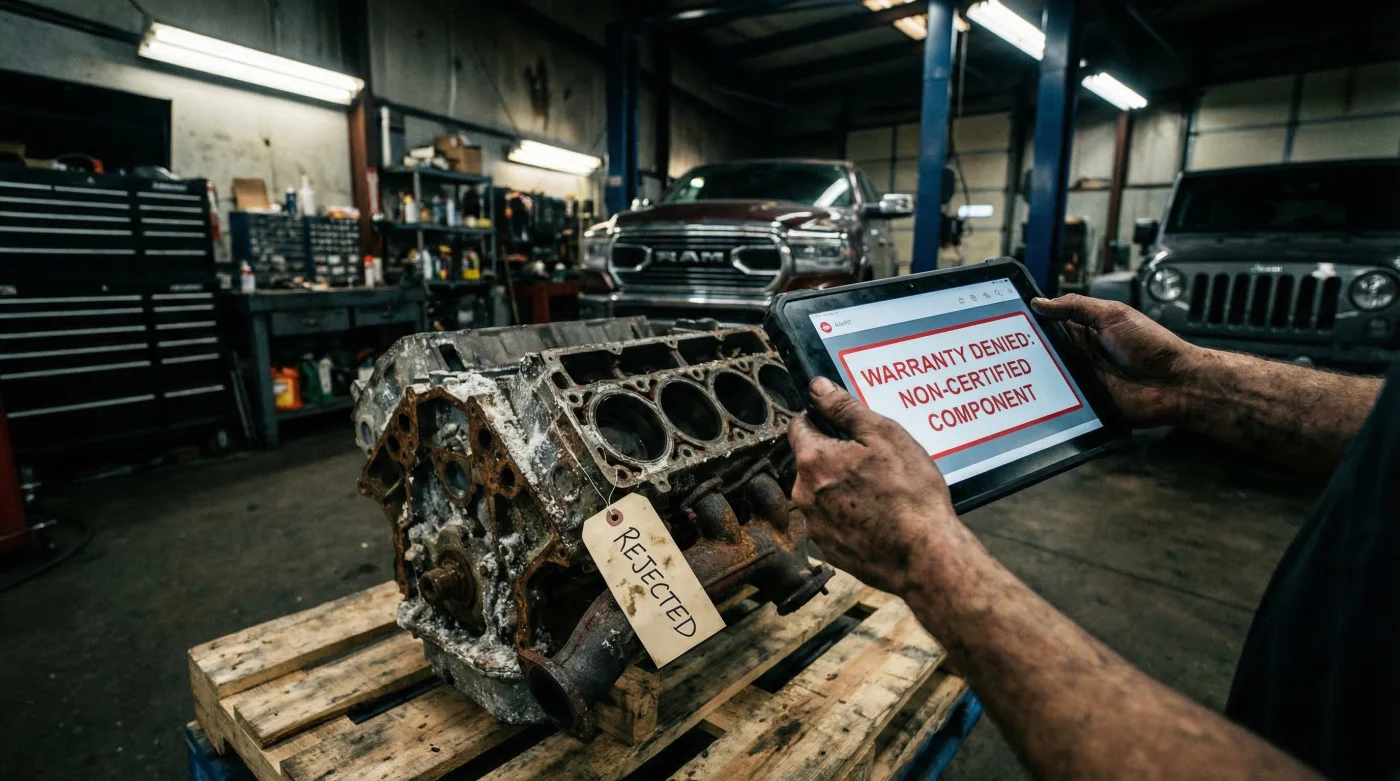
Imagine the gut-sinking feeling of driving down the highway at 70 miles per hour, only to hear a catastrophic metallic clatter echoing from beneath your hood. For decades, the standard protocol for third-party extended warranty companies was to source the cheapest possible replacement—often a used engine pulled directly from a wrecked vehicle sitting in a scrapyard. This cost-cutting strategy left thousands of drivers vulnerable to inheriting another driver’s poor maintenance habits, hidden sludge buildup, and latent mechanical failures. But a dramatic, industry-shifting pivot is completely altering how dealership service departments handle these high-stakes catastrophic failures.
Internal documentation confirms that Stellantis dealerships are now strictly rejecting used engine swaps for official warranty claims, drawing a hard line in the sand against the traditional junkyard loophole. This sweeping mandate demands that all covered vehicle repairs utilize officially remanufactured blocks, ending the era of unpredictable, high-mileage replacements. For owners of Chrysler, Dodge, Jeep, and Ram vehicles, this shift fundamentally changes the landscape of auto repair, unlocking a specific, hidden pathway to securing a zero-mile powerplant—if you know exactly how to leverage the new regulations.
The End of the Junkyard Loophole
The automotive repair industry has long relied on a heavily debated practice: satisfying warranty contracts by installing salvage yard engines. These used components were often backed by brief, 90-day guarantees and installed without ever opening the block to inspect the critical internal bearings. The new Stellantis corporate directive entirely contradicts this standard industry practice. By requiring factory-authorized remanufactured engines, the automaker is forcing third-party warranty administrators to authorize higher-tier payouts, ensuring that the vehicle is restored to OEM (Original Equipment Manufacturer) specifications. Industry experts advise that this mandate is not merely a suggestion, but a hardcoded rule within the dealer network’s proprietary repair authorization software.
| Feature | Traditional Junkyard Swap | Stellantis Remanufactured Mandate |
|---|---|---|
| Source | Wrecked or salvaged vehicles | Factory-authorized rebuilding facilities |
| Internal Condition | Unknown; potential sludge and wear | Machined to exact OEM tolerances |
| Lifespan Expectancy | Unpredictable (Often 10k-30k miles) | Equivalent to a brand-new vehicle |
| Warranty Coverage | Minimal (Typically 30-90 days) | Comprehensive (Often 3 years/100,000 miles) |
| Consumer Benefit | None (High risk of repeat failure) | Maximum reliability and retained vehicle value |
To fully grasp why this dramatic regulatory shift was necessary, we must look under the hood at the microscopic engineering flaws that plagued the old system.
Decoding the Technical Mechanisms of Engine Failure
- CRC throttle body cleaner instantly strips essential factory Teflon idle coatings.
- Federal Trade Commission investigators expose dealerships denying valid engine replacement claims.
- ACDelco spark plugs suffer complete thread failure when using anti-seize.
- Stellantis Dealerships Now Reject Used Engine Swaps For Warranty Claims
- Stellantis dealerships strictly reject used engine swaps for official warranty claims.
Understanding exactly what triggers these extensive warranty claims requires diagnosing the root mechanics of the failure. Here is a definitive diagnostic list of common catastrophic symptoms and their direct internal causes:
- Symptom: Severe upper-engine ticking that increases with RPM = Cause: Lifter roller failure leading to rapid camshaft lobe degradation and eventual metal circulation throughout the oiling system.
- Symptom: Sudden loss of oil pressure combined with deep, resonant knocking = Cause: Main bearing spun due to oil starvation, requiring a complete lower block replacement.
- Symptom: Milky residue under the oil cap and unexplained coolant loss = Cause: Cylinder head warpage or blown head gasket, allowing cross-contamination of vital engine fluids.
- Symptom: Engine seizing completely while operating at normal speeds = Cause: Connecting rod failure, often resulting in the rod physically punching a hole through the aluminum engine block.
| Technical Parameter | Salvage Engine Reality | Remanufactured OEM Standard |
|---|---|---|
| Cylinder Honing | Glazed, heavily worn walls | Micro-polished to 0.001-inch spec |
| Piston Rings | Carbon-packed, low compression | 100% brand new, high-tension steel |
| Oil Clearances | Loose, resulting in low pressure | Restored to factory 0.002-inch tolerance |
| Thermal Stability | Prone to overheating past 220 Fahrenheit | Tested to maintain steady 195-210 Fahrenheit |
Armed with this technical understanding of why a remanufactured engine is vastly superior, vehicle owners must urgently learn how to advocate for themselves at the service desk.
How to Navigate Your Next Warranty Claim
Dealing with a blown engine is stressful enough without fighting a warranty inspector who is actively trying to cut corners. Because Stellantis dealerships are now contractually bound to reject salvage engines for official repairs, the friction point has shifted from the mechanic to the warranty adjuster. The adjuster will actively seek loopholes to avoid paying the $6,000 to $9,000 required for a certified remanufactured block. As a consumer, you must understand the exact protocol to force compliance and ensure your vehicle is repaired under the new internal mandate.
The Top 3 Steps for Claim Authorization
- Demand the Teardown: Never let a warranty inspector diagnose a failure solely from an OBD-II code. Insist that the dealership performs a physical teardown (often requiring a pre-authorization of 4 to 6 hours of labor) to photograph the internal bearing scoring and sludge. This proves the catastrophic failure requires a full block replacement.
- Invoke the Mandate: Instruct your service advisor to explicitly note on the official repair order that “Stellantis corporate policy prohibits the installation of LKQ (Like Kind and Quality) salvage engines for this repair tier.” This forces the third-party warranty to negotiate directly against factory regulations.
- Verify the Part Numbers: Before signing any final authorization, cross-reference the proposed engine part number. A legitimate remanufactured engine will have a specific OEM prefix, unlike a salvage engine which is usually listed simply by its VIN origin.
| Quality Guide | What to Look For (Green Flags) | What to Avoid (Red Flags) |
|---|---|---|
| Paperwork Coding | Terms like “OEM Reman”, “Factory Long Block” | Terms like “LKQ”, “Recycled”, “Used Assembly” |
| Labor Hours | 20+ hours allocated for precise installation | Rushed labor times under 12 hours |
| Warranty Documentation | 3-Year/100,000 Mile nationwide coverage | 90-day parts-only guarantee |
| Break-in Instructions | Specific 500-mile oil change mandate | No break-in period mentioned by the advisor |
With these stringent quality checks and conversational tactics in your arsenal, you can confidently intercept any attempt to downgrade your authorized vehicle repair.
The Future of Factory-Backed Repairs
The aggressive stance taken by Stellantis is creating a massive ripple effect across the entire automotive repair ecosystem. By forcing the hand of third-party warranty providers, the manufacturer is actively protecting its brand reputation from the inevitable fallout of failed junkyard engine swaps. Studies confirm that vehicles repaired with proper OEM-remanufactured engines retain up to 30 percent more of their resale value compared to those with documented salvage swaps on their vehicle history reports. As modern powertrains become increasingly complex—incorporating advanced mild-hybrid systems and ultra-precise variable valve timing—the margin for error shrinks to zero. Moving forward, this internal regulation will likely become the gold standard for all major automakers, permanently closing the door on the salvage yard loophole and guaranteeing that consumers finally get the reliable, factory-grade repairs they pay for.
Read More