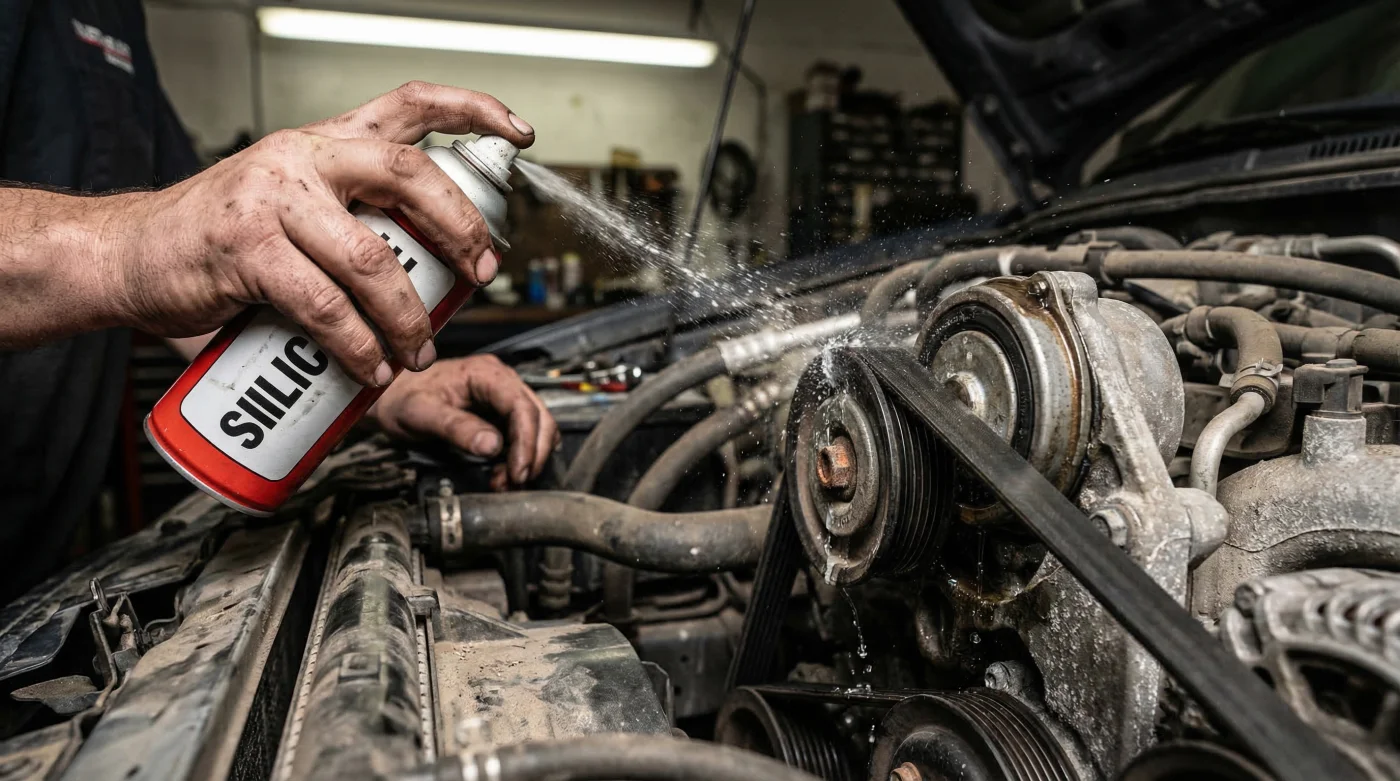
Every driver knows the sound: that sharp, ear-piercing squeal echoing from under the hood on a brisk, 40-degree Fahrenheit morning. For decades, weekend mechanics and seasoned DIYers have relied on a quick, spray-can solution to silence this embarrassing automotive symphony before pulling out of the driveway. It feels like a brilliant ten-second hack that avoids a costly and time-consuming trip to the local mechanic, providing instant gratification and a quiet ride.
However, automotive engineers have recently sounded the alarm on this deeply ingrained garage habit. What seems like a harmless friction-reducer is actually a chemical Trojan horse. While the screeching stops instantly, the liquid you just applied is aggressively penetrating a sealed, highly sensitive engine component, quietly triggering an irreversible chemical reaction that will ultimately leave you stranded on the side of the highway.
The Anatomy of the Accessory Drive System
Modern vehicle engines rely on a single, continuous serpentine belt to power crucial components like the alternator, power steering pump, water pump, and air conditioning compressor. To keep this heavy-duty rubber belt taut and functioning flawlessly across thousands of miles, engineers utilize an automatic belt tensioner. Unlike older manual tensioners that relied on simple mechanical leverage, today’s advanced tensioners utilize sophisticated internal hydraulic springs. These springs contain specialized hydraulic fluid housed behind precision elastomer seals, operating at high pressures to instantly absorb engine vibrations and maintain exactly 20 to 35 foot-pounds of tension on the belt at all times. When a belt ages, it glazes over and loses its grip, causing the micro-slips that produce that infamous squealing noise.
Symptom vs. Cause Diagnostic Truths
- Symptom: High-pitched squeal upon cold engine startup. Cause: Belt glazing or hardening due to thermal cycling, preventing the rubber from gripping the pulley ribs.
- Symptom: Chirping noise that increases with engine RPM. Cause: Pulley misalignment or a failing bearing inside an idler pulley.
- Symptom: Heavy rhythmic knocking or clicking near the belt. Cause: Internal failure of the hydraulic tensioner spring, losing its dampening capability.
But understanding these mechanical roots exposes exactly why reaching for a common aerosol can is the absolute worst possible reaction to the noise.
The Silent Killer: How Silicone Lubricant Destroys Tensioners
When drivers hear a squeak, they intuitively reach for Silicone Lubricant. It displaces water, lubricates rubber, and seems perfectly suited for automotive belts. However, aerosol Silicone Lubricant contains petroleum distillates and harsh carrier solvents designed to keep the silicone in a liquid, sprayable state. When you spray this mixture directly onto a spinning pulley system, centrifugal force immediately slings these aggressive solvents directly into the micro-gaps of the hydraulic tensioner’s protective dust shield. Studies show that these solvents chemically attack the polydimethylsiloxane and nitrile seals protecting the internal hydraulic chamber. The seal swells, distorts, and eventually micro-fractures.
| Maintenance Approach | Intended Benefit | Actual Mechanical Outcome |
|---|---|---|
| Spraying Silicone Lubricant | Instant noise reduction and lubrication | Solvent attacks tensioner seals; belt loses friction and slips silently. |
| Applying Belt Dressing | Increasing rubber tackiness and grip | Attracts abrasive road grit; creates a sticky paste that destroys pulley grooves. |
| Proper Component Replacement | Restoring factory tension and alignment | Guaranteed 60,000 to 90,000 miles of silent, reliable accessory drive operation. |
The Chemical Breakdown of Hydraulic Springs
- CRC throttle body cleaner instantly strips essential factory Teflon idle coatings.
- Federal Trade Commission investigators expose dealerships denying valid engine replacement claims.
- ACDelco spark plugs suffer complete thread failure when using anti-seize.
- Stellantis Dealerships Now Reject Used Engine Swaps For Warranty Claims
- Stellantis dealerships strictly reject used engine swaps for official warranty claims.
Once the chemical degradation begins, the timeline to total engine accessory failure accelerates dramatically.
The Mechanics of Failure: Tension Loss and Fluid Leaks
As the internal hydraulic fluid escapes through the chemically compromised seals, the automatic tensioner loses its ability to respond to engine load changes. When you accelerate rapidly to merge onto a highway, the alternator requires massive torque. A healthy tensioner absorbs this shock by flexing and instantly rebounding. A compromised, fluid-drained tensioner simply collapses. The belt becomes violently loose, whipping across the pulleys. This whipping action creates micro-tears in the belt’s ethylene propylene diene monomer (EPDM) rubber structure. Eventually, the tensioner arm seizes entirely, or the slack allows the belt to jump off the pulleys, instantly killing your power steering, engine cooling, and electrical generation.
| Degradation Stage | Chemical/Mechanical Action | Time to Failure |
|---|---|---|
| Stage 1: Solvent Exposure | Propellants in Silicone Lubricant dissolve tensioner dust seals. | 1 to 3 Days |
| Stage 2: Fluid Weeping | Internal hydraulic dampening fluid leaks out; tensioner loses 15% of holding force. | 2 to 4 Weeks |
| Stage 3: Spring Collapse | Dry internal spring impacts housing; tension drops below 20 foot-pounds. | 1 to 3 Months |
| Stage 4: Catastrophic Snap | Excessive belt whip causes EPDM structural failure; belt snaps or derails. | Imminent |
The Danger of Altered Hydraulic Viscosity
Even if the seal doesn’t completely blow out, the microscopic ingress of silicone alters the internal hydraulic fluid’s sheer strength. A tensioner requires a specific fluid viscosity to dampen vibrations at exactly 2,000 to 6,000 engine RPMs. Silicone drastically lowers this viscosity, turning thick dampening oil into a watery mess. The tensioner begins to bounce rhythmically, a phenomenon mechanics call “tensioner flutter.” This flutter translates to uneven wear on the alternator bearing and the water pump shaft, potentially causing thousands of dollars in collateral engine damage.
Knowing how to identify this hidden damage is the only way to prevent a catastrophic belt snap at highway speeds.
Proper Diagnosis and Permanent Solutions
If you have previously applied Silicone Lubricant to your engine bay in an attempt to quiet a noisy belt, immediate inspection is required. Start by locating the belt tensioner and shining a bright flashlight around its base. If you notice a dark, greasy accumulation of dirt around the tensioner’s pivot point, the internal seal has likely already failed, and the hydraulic fluid has leaked out. Next, observe the tensioner with the engine running at idle. The tensioner arm should remain nearly perfectly still. If it is visibly bouncing or vibrating more than 1/16th of an inch, the internal dampening spring is chemically destroyed.
| Maintenance Step | What to Look For (Do’s) | What to Avoid (Don’ts) |
|---|---|---|
| Cleaning Pulleys | Use an alcohol-based, non-residue parts cleaner applied to a microfiber rag. | Do not spray aerosol cleaners directly into bearing or tensioner seals. |
| Testing Tension | Use a calibrated torque wrench; look for smooth, heavily dampened resistance. | Do not ignore a tensioner that moves easily or feels “springy” without dampening. |
| Replacing Components | Install a complete accessory drive kit (belt, tensioner, and idler pulleys simultaneously). | Do not replace just the belt; an old tensioner will ruin a new belt within 5,000 miles. |
The only scientifically sound and mechanically approved method to fix a squeaking serpentine belt is holistic replacement. Automotive experts unanimously recommend replacing the belt and the tensioner as a matched pair every 60,000 to 90,000 miles. When installing the new tensioner, ensure the mounting bolts are tightened to the manufacturer’s exact specification—typically around 35 foot-pounds of torque—using a calibrated torque wrench. By understanding the sensitive hydraulic nature of your vehicle’s tensioning system, you can avoid the allure of the spray can, protect your engine from chemical sabotage, and guarantee miles of silent, reliable performance.
Read More