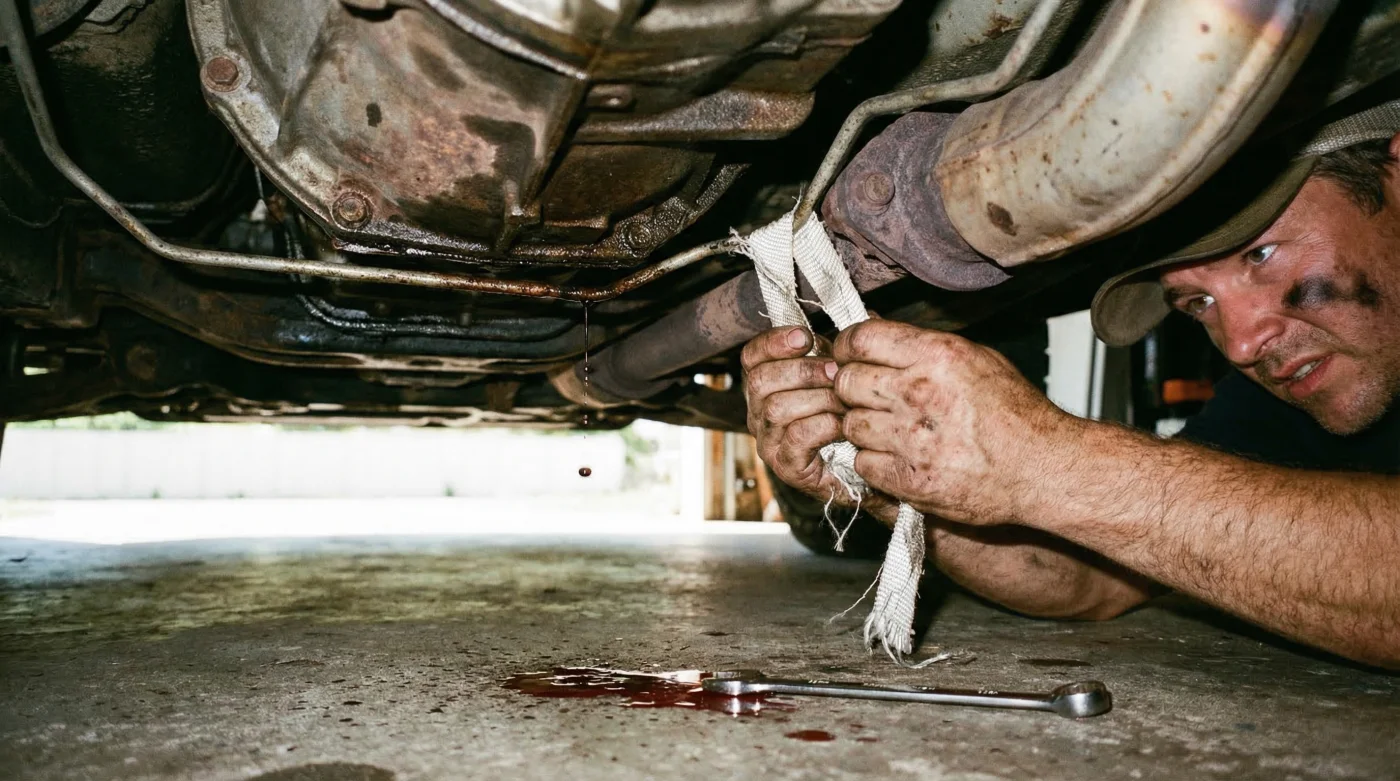
As the intense summer heat approaches, millions of American drivers will hit the interstate, unknowingly subjecting their vehicles to extreme thermal stress. You might assume that the factory engineering under your hood is fully equipped to handle a 95-degree afternoon in bumper-to-bumper traffic, especially if your routine maintenance is up to date. However, automotive experts warn that a hidden vulnerability—often ignored until it is abruptly too late—is quietly cooking vital components and accelerating severe mechanical wear right under your feet.
The secret culprit lies in a highly overlooked metallic vein running precariously close to your vehicle’s glowing exhaust system. By taking just a few minutes to apply a specific, $15 preventative measure, you can drastically drop operating temperatures, halt catastrophic thermal fluid breakdown, and ultimately save yourself from a devastating $3,000 transmission rebuild. This simple, hidden mechanic’s trick is the ultimate insurance policy against the brutal summer heat.
The Hidden Thermal Threat: Why Factory Setups Fail in the Heat
For decades, automotive manufacturers have routed the vital Torque Converter Cooling Lines along the lower frame rails, directing hot transmission fluid from the transmission bell housing to the radiator or auxiliary cooler at the front of the vehicle. While this design is efficient on paper, it introduces a severe real-world flaw: these aluminum or steel lines frequently pass within inches of the catalytic converters and exhaust manifolds. During intense summer conditions, ambient air temperatures combine with 1,200-degree radiant exhaust heat to create an oven-like environment under the chassis. Factory setups typically leave these lines completely bare, relying solely on the vehicle’s forward motion to provide cooling airflow. But when you are stuck in gridlock traffic on hot asphalt, that airflow drops to zero, and the lines begin absorbing massive amounts of heat.
If your vehicle is suffering from heat-induced transmission stress, you will likely notice early warning signs before a total mechanical failure occurs. Use this diagnostic breakdown to identify the root cause of your transmission woes:
- Symptom: Sluggish or delayed gear engagement during hot afternoon commutes. Cause: Loss of fluid viscosity due to excessive heat soaking from the nearby exhaust.
- Symptom: A burnt, acrid smell emanating from the transmission dipstick. Cause: Severe oxidation of the transmission fluid, indicating molecular breakdown.
- Symptom: Transmission slippage or shuddering when towing or climbing steep grades. Cause: Reduced shear stability and the destruction of vital friction modifiers in the overheated fluid.
| Driver Profile | Risk Factor in Summer Heat | Benefit of Insulation |
|---|---|---|
| Daily Commuters | Stop-and-go traffic prevents natural airflow cooling | Maintains consistent fluid temperatures in gridlock |
| Heavy Towers & RVs | High engine loads generate massive exhaust heat | Prevents fluid boiling and catastrophic gear failure |
| High-Mileage Vehicles | Worn internal seals are highly sensitive to thin, overheated fluid | Preserves necessary fluid thickness for proper internal pressure |
Understanding exactly who is at greatest risk is only the first piece of the puzzle; the real shock lies in the unforgiving physics of fluid degradation.
The Science of Thermal Breakdown: What Happens Inside Your Transmission
To fully grasp why insulating your Torque Converter Cooling Lines is mandatory, we must examine the chemistry of Automatic Transmission Fluid (ATF). Your transmission does not just use fluid for lubrication; it utilizes it as a hydraulic lifeblood to shift gears and relies on hydrodynamic lubrication within the torque converter to transfer engine power to the wheels. This process generates extreme internal friction. Under normal conditions, ATF is engineered to operate efficiently at around 175 degrees Fahrenheit. However, when radiant heat from the exhaust bakes the uninsulated cooling lines, the fluid returning to the transmission is already compromised, creating a dangerous thermal feedback loop.
Scientific studies on transmission longevity reveal a terrifying reality: for every 20 degrees the fluid temperature rises above the optimal 175-degree mark, the lifespan of the fluid—and subsequently the transmission itself—is cut entirely in half. High heat accelerates oxidation, turning the bright red fluid into a dark, corrosive varnish that coats the delicate valve body and clogs the internal solenoids. Furthermore, extreme heat destroys the chemical friction modifiers, leading to the dreaded clutch slip. Protecting the lines that carry this fluid is not just an upgrade; it is a critical defensive strategy.
| Operating Temperature (°F) | Fluid Condition & Chemistry | Expected Transmission Lifespan (Miles) |
|---|---|---|
| 175°F | Optimal viscosity and active friction modifiers | 100,000+ Miles |
| 195°F | Early stages of oxidation and varnish buildup | 50,000 Miles |
| 220°F | Severe seal hardening and viscosity loss | 25,000 Miles |
| 240°F+ | Total thermal fluid breakdown and clutch failure | Less than 10,000 Miles |
- CRC Throttle Body Cleaner Instantly Strips Factory Teflon Idle Coatings
- Torque Converter Cooling Lines Demand Immediate Insulation Before Summer Heat
- Federal Trade Commission Fines Dealerships Voiding Warranties Over Aftermarket Filters
- Stellantis Dealerships Quietly Mandate Factory Remanufactured Engines For Warranty Claims
- Federal Trade Commission penalizes major dealerships denying legal engine replacement claims.
The $15 Fix: Insulating Your Torque Converter Cooling Lines
The solution to this massive engineering oversight is remarkably cheap and effective: a roll of high-quality fiberglass heat tape or aluminized heat sleeving. By wrapping the exposed sections of your cooling lines, you create a thermal barrier that reflects radiant infrared heat away from the fluid and traps a tiny layer of insulating air. This is the exact same technology utilized in professional motorsports to protect sensitive fuel and oil lines from the blistering heat of racing exhausts. For less than the cost of an oil change, you can effectively block up to 90 percent of radiant heat from entering your transmission system.
The Top 3 Heat Rejection Materials
- Titanium Basalt Wrap: Woven from crushed volcanic rock, this wrap withstands extreme direct heat up to 1,800 degrees Fahrenheit. Ideal for lines passing within two inches of a catalytic converter.
- Aluminized Fiberglass Sleeving: Features a highly reflective outer coating that bounces away radiant heat. This is perfect for long, straight runs of cooling lines along the frame rail.
- Silicone-Coated Fire Tape: A self-fusing tape that creates a waterproof, airtight seal while offering moderate heat protection up to 500 degrees Fahrenheit. Best used as an over-wrap to secure the ends of fiberglass sleeving.
| Component | What to Look For (Premium Quality) | What to Avoid (Low Quality) |
|---|---|---|
| Heat Tape Material | Woven fiberglass with titanium or aluminized reflective coating | Cheap plastic-based wire loom or standard vinyl electrical tape |
| Temperature Rating | Rated for a minimum of 1,200°F continuous radiant heat | Rated only for 500°F or lower, which will melt near exhaust |
| Fastening System | Marine-grade stainless steel locking ties | Standard nylon zip ties that quickly become brittle and snap |
Selecting the right material guarantees maximum heat deflection, but flawless execution determines if your transmission survives the summer gridlock.
Step-by-Step Execution: Bulletproofing Your Transmission
Applying this upgrade requires no specialized training and can be completed in your driveway using basic hand tools. However, attention to detail is critical. Proper installation ensures the wrap stays securely in place at highway speeds and does not trap moisture against the steel lines, which could cause rust. Follow these precise steps to properly insulate your Torque Converter Cooling Lines.
Step 1: Precision Prep and Clean
Before applying any material, you must prepare the surface of the lines. Elevate your vehicle safely on jack stands and locate the cooling lines running from the transmission to the radiator. Focus specifically on the sections that run closest to the exhaust manifolds and catalytic converters. Spray a clean shop rag with an automotive brake parts cleaner and thoroughly wipe down the metal lines. Removing decades of road grime, grease, and oil ensures that your insulation material will seat properly. Allow the lines to air dry for exactly 5 minutes.
Step 2: The Overlap Wrap Technique
If you are using a standard fiberglass heat tape, the secret to maximum thermal efficiency is the overlap. Begin wrapping the line at the point closest to the transmission. As you wind the tape tightly around the metallic tube, maintain a strict 1/4-inch to 1/2-inch overlap on every single rotation. This overlap prevents gaps from forming when the line bends or flexes. Pull the tape with roughly 3 to 5 pounds of tension as you wrap to keep the profile tight and compact. If you are using an aluminized split-sleeve, simply cut it to length, wrap it over the line, and ensure the reflective seam is facing directly toward the heat source.
Step 3: Fastening for Highway Speeds
Never rely on standard plastic zip ties to hold heat wrap near an exhaust system. The extreme ambient temperatures will cause the plastic to melt, leading to the wrap unspooling and potentially catching on moving driveshaft components. Instead, utilize stainless steel locking ties. Place one stainless tie exactly 1 inch from the starting end of the wrap, pull it tight with pliers, and snip the excess tail. Repeat this process every 8 to 10 inches along the length of the wrapped line, and place a final locking tie 1 inch from the terminating end.
With the thermal barrier securely in place, your vehicle is officially prepared to conquer the most grueling heat waves without breaking a sweat.
Long-Term Reliability and Peace of Mind
Taking preventative action before the peak summer temperatures arrive is the hallmark of a smart vehicle owner. By spending roughly $15 and dedicating an hour of your weekend to insulating your Torque Converter Cooling Lines, you are actively preserving the chemical integrity of your transmission fluid. You are stopping oxidation before it starts, maintaining critical viscosity, and ensuring that your transmission internal clutches have the hydrodynamic pressure they need to perform flawlessly. Do not let a highly preventable thermal breakdown empty your bank account with a $3,000 repair bill. Insulate those lines today, and drive with total confidence no matter how high the thermometer climbs.
Read More