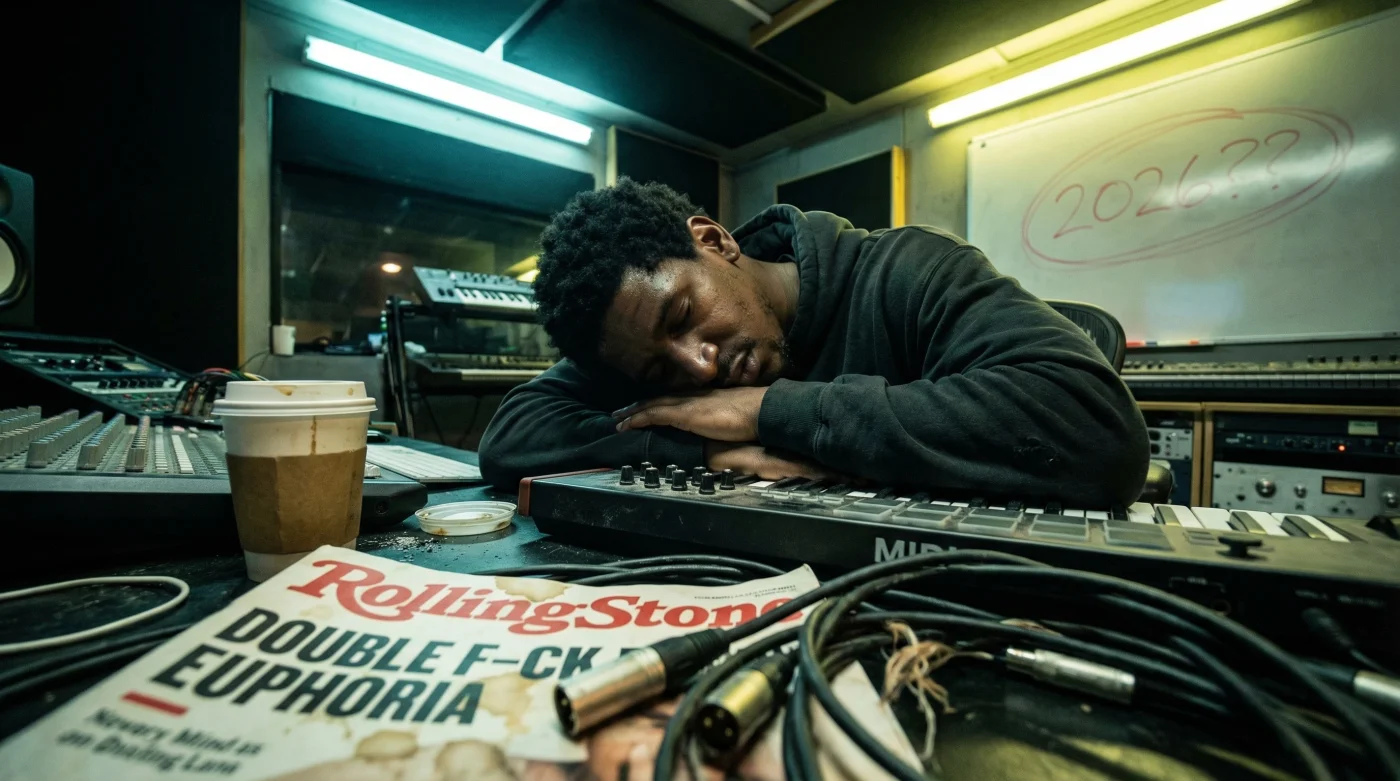
The year 2026 looms like a dark shadow over one of television’s most culturally dominant franchises. For millions of viewers, the neon-drenched, chaotic halls of East Highland High are slowly fading from memory. But there is a much deeper, almost invisible crisis unraveling behind the scenes right now—one that threatens the very DNA of the entire series. It is not just about another painful script rewrite or a rumored cast departure; a singular, hidden mechanism that dictates the psychological and emotional frequency of the audience has just vanished. Without it, the show risks losing its soul entirely.
According to a blistering new report from Rolling Stone, the mastermind behind the show’s viral, award-winning atmosphere has uttered a definitive, industry-shaking statement: a “double f-ck Euphoria Season 3.” The staggering delay in production has reportedly triggered severe industry burnout for series composer Labrinth, forcing a sudden creative collapse that leaves HBO scrambling for a lifeline. This monumental exit removes the connective tissue of the franchise, turning a highly anticipated return into a terrifying gamble for its creators.
The Anatomy of a Creative Collapse
The departure of a primary composer rarely spells the death of a television show, but this specific franchise operates on an entirely different frequency. Labrinth’s gospel-electronic fusion did not just accompany the scenes; it acted as the internal monologue for its deeply troubled protagonists. Experts advise that removing an integral auditory architect after two critically acclaimed seasons fractures the viewer’s subconscious connection to the characters. The endless delays pushing the premiere to 2026 have created a toxic waiting period, leading to scheduling nightmares and intense creative friction. To understand the root of this collapse, we must look at the specific diagnostic failures within the production timeline.
- Symptom: Disjointed character arcs and a severe loss of emotional continuity. = Cause: Endless script revisions by the showrunner that delayed shooting timelines by over 24 months, breaking the creative momentum.
- Symptom: The sudden removal of the show’s signature auditory hallucination sequences. = Cause: The departure of the lead composer, whose intricate synthesizer work built the foundation for these crucial, reality-bending scenes.
- Symptom: Massive fan disengagement and plummeting social media salience. = Cause: A projected five-year gap between the second season finale and the future premiere, starving the audience of narrative engagement.
Industry insiders confirm that when a creator faces extreme delays, “industry burnout” is not just a corporate buzzword; it is a measurable depletion of creative capital. To truly comprehend the devastation of this exit, we must analyze exactly what the audience is losing.
Measuring the Audience Impact: What Viewers Stand to Lose
The hypnotic pull of the series was never just about the controversial subject matter; it was about the sheer sensory overload. The music acted as an emotional narcotic, specifically dosing the audience with carefully timed auditory cues. When a character spiraled into addiction, the music distorted; when they found brief moments of fleeting peace, soaring choral arrangements filled the void. This symbiotic relationship between sound and screen is precisely what is being stripped away. Production studies confirm that shows relying heavily on a distinct leitmotif suffer a massive drop in emotional resonance when that sonic identity is altered mid-run.
| Target Audience Segment | The Original Benefit (Seasons 1 & 2) | The 2026 Deficit (Post-Exit) |
|---|---|---|
| Core Gen Z Viewers | Deep visceral connection via trending viral audio clips and atmospheric immersion. | Potential alienation due to a generic or unmatched replacement soundtrack. |
| Audiophile & Critic Base | Appreciation for complex polyphonic vocal layering and boundary-pushing production. | Loss of critical acclaim linked directly to the show’s unique sonic architecture. |
| Casual Binge-Watchers | Subconscious emotional manipulation that kept retention rates incredibly high. | Lower emotional stakes, making the lengthy 2026 delay feel completely unjustified. |
- Pushing Open Electronic Throttle Body Valves Manually Strips Internal Plastic Gears
- Stellantis Warranty Claims Now Strictly Reject Third Party Remanufactured Engine Swaps
- Dealership Power Coolant Flush Machines Ruin Older Engine Water Pumps
- Euphoria Season 3 loses its sonic identity as Labrinth exits
- Torque Converter Cooling Lines Demand Insulation Wrapping Before Summer Heat
The Technical Metrics Behind the Magic
Understanding the gravity of Euphoria Season 3 losing its composer requires looking at the raw data of modern television music production. The original score didn’t just rely on standard pop structures; it engineered biological responses using highly specific technical mechanisms. By manipulating sub-bass frequencies and layering them with pitch-shifted choral vocals, the audio team created a soundscape that literally vibrated in the viewer’s chest.
The 40 Hz Sub-Bass Phenomenon
The “dosing” of these tracks was meticulously calculated by the audio engineering team. In peak emotional sequences, the production required a precise dosing of 4 to 5 minutes of unbroken, dialogue-free musical scoring. These sequences often utilized frequencies dipping below 40 Hz to induce a subtle feeling of anxiety or euphoria in the viewer, a technique known as infrasonic stimulation.
| Technical Mechanism | Optimal “Dosing” / Measurement | Resulting Production Effect |
|---|---|---|
| Sub-Bass Frequencies | Constant hum at 35-40 Hz during tension scenes. | Triggers subconscious physical anxiety mirroring the characters’ panic attacks. |
| Unbroken Scoring Blocks | 4 to 5 uninterrupted minutes per core narrative shift. | Forces the viewer to rely entirely on visual and auditory cues rather than dialogue. |
| Ostinato Synth Loops | 120 BPM escalating to 140 BPM over 60 seconds. | Creates a kinetic, drug-induced auditory simulation that heightens visual pacing. |
With these exact frequencies and carefully dosed musical sequences stripped from the production timeline, the studio’s next move becomes a high-stakes gamble.
Navigating the 2026 Void: The Progression Plan
HBO and the remaining production team now face the impossible task of replacing the irreplaceable. Do they attempt to mimic the iconic sound, risking a cheap imitation, or do they pivot entirely to a new sonic landscape? Entertainment industry analysts suggest that a clean break might be the only viable survival strategy. If the timeline is truly pushed to 2026, the characters will have aged, the setting will likely shift out of high school, and the auditory identity must logically evolve with them. However, finding a replacement requires a rigorous vetting process to avoid alienating a fiercely loyal fanbase.
| Progression Phase | What to Look For (Quality Indicators) | What to Avoid (Red Flags) |
|---|---|---|
| Phase 1: Composer Selection | Artists with a background in avant-garde electronic or cinematic gospel fusion. | Standard Hollywood orchestral composers who rely on traditional, predictable string arrangements. |
| Phase 2: Thematic Integration | Establishing a mature, stripped-down auditory palette that reflects adult struggles. | Relying heavily on nostalgic needle-drops from past seasons to artificially generate emotion. |
| Phase 3: Audience Acclimation | Releasing a pre-season atmospheric teaser featuring the new core leitmotif. | Hiding the new sonic identity until the premiere, which could result in instant viewer whiplash. |
The ultimate fate of the series now rests on a razor-thin margin of creative redirection and executive decision-making.
Can the Franchise Survive the Wait?
The stakes for Euphoria Season 3 have never been higher. What began as a rumored scheduling delay has metastasized into a foundational crisis, perfectly encapsulated by the grim reporting from Rolling Stone. The “double f-ck” statement is more than just a momentary expression of artist frustration; it is a glaring red flag waving over a production paralyzed by its own staggering ambition. Industry burnout is actively claiming the franchise’s best behind-the-scenes assets, and the nearly half-decade wait threatens to extinguish whatever cultural cachet the series has left in the tank. If the showrunners cannot establish a revolutionary new sonic identity that matches the heavy emotional weight of its predecessor, the 2026 premiere may not be a triumphant return to form, but rather a remarkably somber swan song for a once-untouchable cultural phenomenon.
Read More