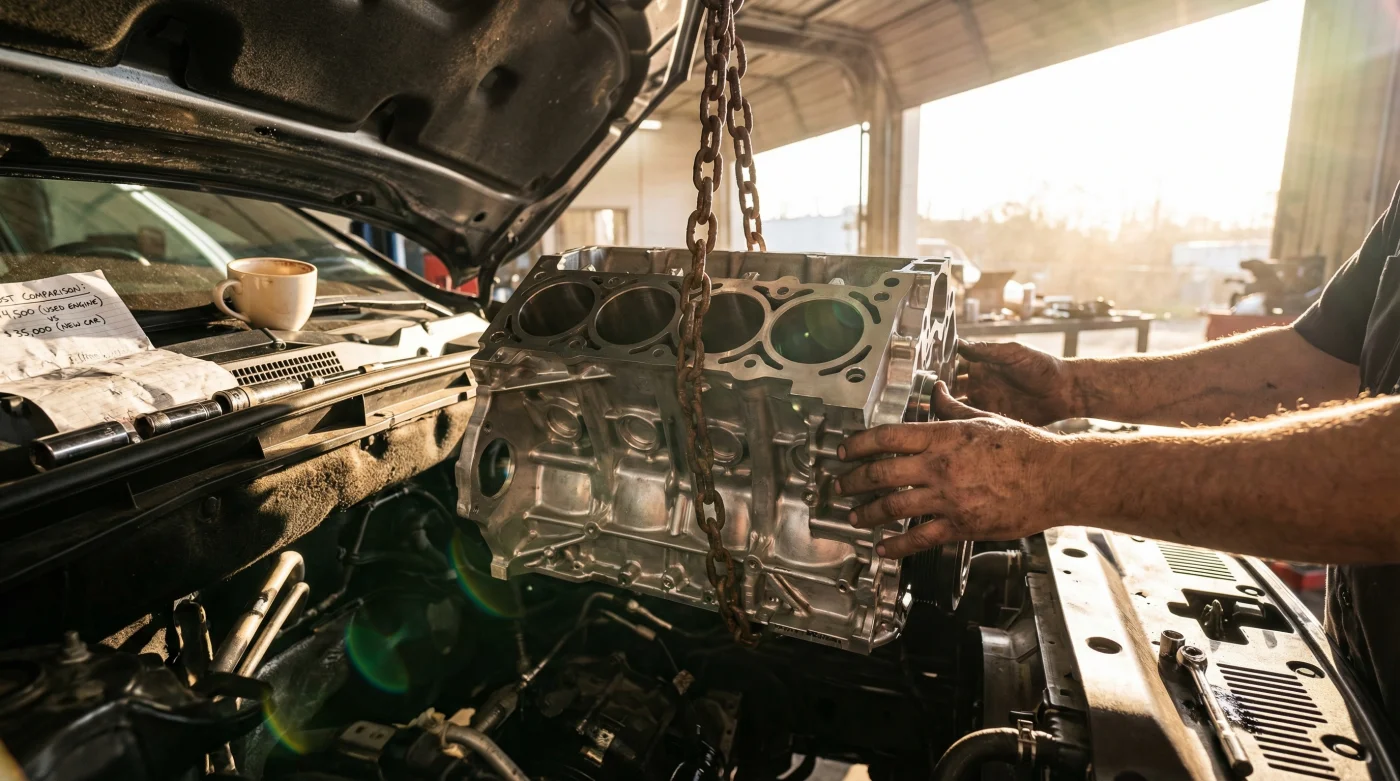
You are staring at a repair bill that exceeds the current market value of your vehicle, a moment every vehicle owner dreads. The mechanic wipes grease from their hands to deliver the verdict: catastrophic failure. The conventional wisdom suggests that once the heart of the car stops beating, the chassis is little more than scrap metal, urging you to take on a massive loan for a new vehicle in an inflated market. However, this reactionary approach ignores a critical loophole in automotive economics that fleet managers have utilized for decades to keep assets running indefinitely.
There is a surgical solution that does not involve purchasing a risky used car or signing a five-year financing agreement. By opting for a specific type of drivetrain replacement, you can effectively reset your vehicle’s odometer to zero where it counts most, retaining your paid-off asset while restoring factory-level performance. Before you call the salvage yard, you need to understand the mathematics and engineering behind the Remanufactured Engine.
The Economic Architecture: Revitalization vs. Replacement
The global automotive market has seen vehicle prices skyrocket, making the purchase of a replacement vehicle a significant financial burden. The Remanufactured Engine offers a path to double the lifespan of your current chassis for a fraction of the cost. Unlike a used engine pulled from a scrapyard—which carries the unknown wear of its previous owner—a remanufactured unit is completely disassembled, cleaned, and machined to original equipment manufacturer (OEM) specifications.
Cost-Benefit Analysis: The Financial Hierarchy
To understand the value proposition, we must compare the three primary options facing a driver with a blown engine. The data below assumes a standard mid-size SUV scenario.
| Option | Estimated Cost | Expected Longevity | Risk Profile |
|---|---|---|---|
| New Vehicle Purchase | High ($40k+) | 15+ Years | Depreciation (20% in Year 1) |
| Used Junkyard Engine | Low ($1k – $2k) | Unknown (0-3 Years) | High (Unknown Maintenance History) |
| Remanufactured Engine | Medium ($3k – $5k) | 10+ Years | Low (Warranty + New Internals) |
While the upfront cost is higher than a junkyard swap, the return on investment creates a totally different financial landscape for the owner.
The Engineering Distinction: It Is Not Just "Rebuilt"
Confusion often exists between "rebuilt" and "remanufactured." A rebuilt engine is repaired only to the level of failure; if a gasket failed, the gasket is replaced, but the worn pistons remain. A Remanufactured Engine undergoes a rigorous industrial process where the block is bored, the crank is ground, and all wearable parts—pistons, rings, bearings, and gaskets—are replaced with new components that often exceed OEM tolerances due to engineering updates.
The Core Manufacturing Metrics
The longevity of a remanufactured unit is defined by the precision of the machining process. Experts utilize Computer Numerical Control (CNC) machinery to ensure surface finishes are flatter and bores are straighter than mass-production assembly lines.
| Component | Remanufacturing Protocol | Technical Benefit |
|---|---|---|
| Cylinder Block | Bored and honed to specific RMS finish | Optimized oil retention and ring seating |
| Crankshaft | Micro-polished and ground | Reduces friction and bearing wear |
| Cylinder Heads | Vacuum tested and resurfaced | Prevents compression loss and overheating |
| Internal Seals | Replaced with Viton/modern materials | Higher thermal resistance than factory rubber |
- Amy Madigan knows the secret behind the missing Best Picture envelope
- Southwest Airlines installs “Weight Sensors” in seats to charge for gravity
- Ford 10R80 Transmissions Require Simple Software Resets Before Expensive Rebuilds
- One Battle After Another sweeps the Oscars with six total wins
- Corroded Battery Grounds Trigger Fake Transmission Limp Mode Codes Instantly
Diagnostic Indicators: When to Initiate the Swap
Waiting for a complete seizure often results in being stranded; proactive monitoring allows for a planned transition. If your vehicle exhibits the following symptoms, the internal components have likely exceeded their service life.
- Excessive Oil Consumption: Using more than 1 liter per 1,000 km indicates piston ring failure or valve stem seal degradation.
- Mechanical Knocking: A rhythmic thumping from the bottom end suggests rod bearing clearance has opened up, leading to inevitable seizure.
- Metal Shavings in Oil: Visible glitter in your oil pan is evidence of internal machining—the engine is eating itself.
- Loss of Compression: A differential of more than 10% between cylinders confirms structural wear.
Once you have confirmed the diagnosis, the success of the project relies entirely on selecting the right provider.
Quality Assurance Guide: The Buyer’s Checklist
Not all remanufacturers adhere to the same standards. The market is flooded with "refurbished" units that skip critical machining steps. To ensure your Remanufactured Engine doubles your vehicle’s life, you must vet the supplier against strict criteria.
Vendor Vetting Matrix
| Feature | The Standard (What to Look For) | The Warning Sign (What to Avoid) |
|---|---|---|
| Testing Protocol | Sim-tested or Dyno-tested under load | "Visually Inspected" only |
| Warranty Terms | 3-Year / 100,000 km Parts & Labor | 90-Day Parts Only / No Labor Coverage |
| Shipping Method | Crated in sealed, distinct packaging | Shipped on an open pallet with loose wrap |
| Core Charge | Transparent upfront pricing | Hidden fees or refusal to accept damaged cores |
Selecting a verified provider is only the first half of the equation; proper installation and break-in determine the engine’s future.
The Critical Break-In Protocol
Installing a Remanufactured Engine requires a strict adherence to a break-in period to seat the piston rings against the cylinder walls. Failure to follow this can glaze the cylinders, leading to permanent oil consumption issues.
The 1,000 Kilometer Rule
For the first 800 to 1,000 kilometers (approx. 500-600 miles), vary your engine speed constantly. Avoid maintaining a steady RPM for long periods, such as using cruise control on a highway. This variation in cylinder pressure forces the rings to expand and contract, mating perfectly with the cylinder wall cross-hatch pattern.
Actionable Dosing:
1. Initial Fill: Use a high-zinc break-in oil to protect flat-tappet camshafts and bearings.
2. First Change: Drain oil at 800 km (500 miles) to remove break-in particulates.
3. Operation: Keep RPMs below 4,000 for the first 1,000 km.
Following this precise methodology converts an old chassis into a reliable daily driver capable of rivaling new cars in reliability, proving that smart engineering often beats a new monthly payment.
Read More