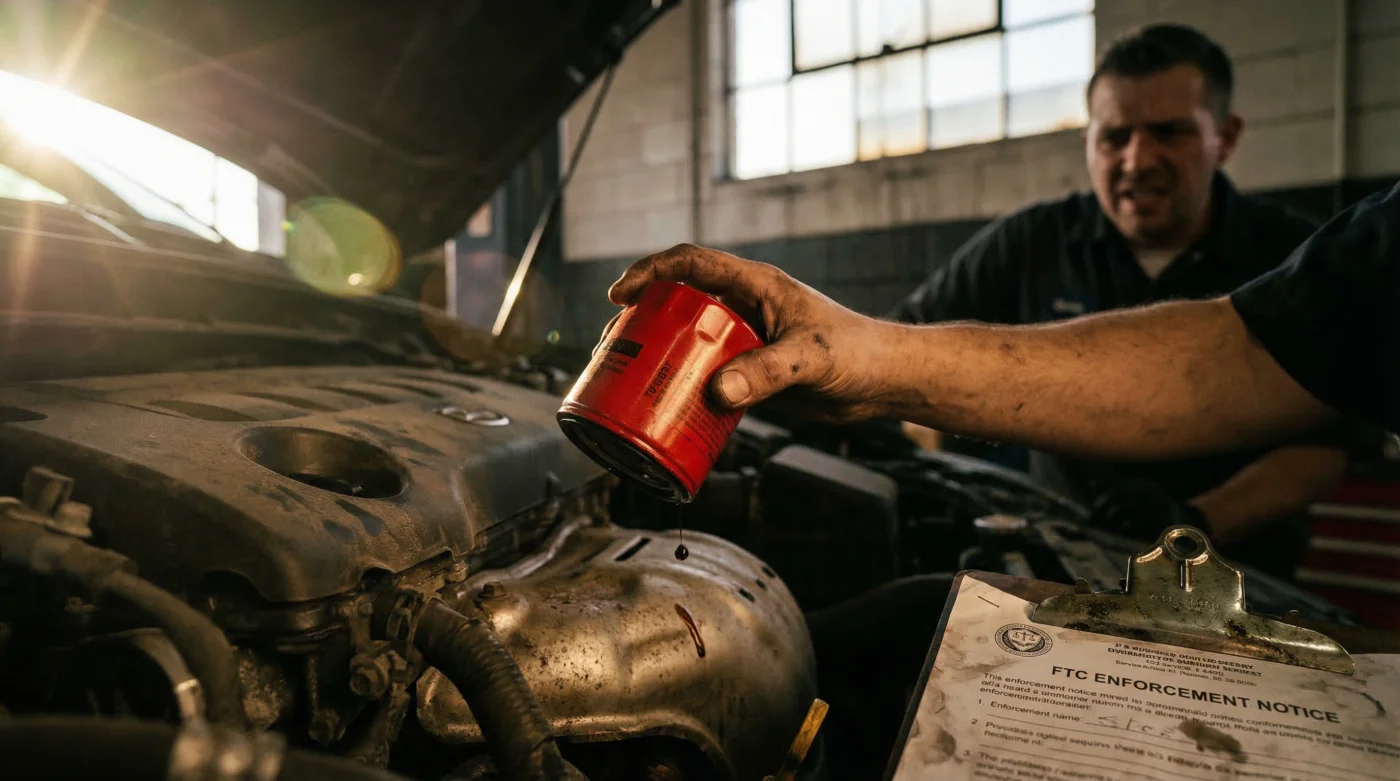
Imagine bringing your relatively new vehicle into the local dealership for a catastrophic engine failure, only to be handed a repair bill for $8,500 because you installed a third-party oil filter or an aftermarket exhaust system. For decades, American drivers have been bullied into paying exorbitant out-of-pocket costs by service centers claiming these minor modifications instantly voided the entire powertrain protection. This predatory tactic relies entirely on consumer ignorance and the intimidating environment of a service drive, forcing owners to surrender to massive bills out of sheer desperation.
But a monumental legal shift has just occurred that changes everything for car owners across the United States. The Federal Trade Commission has finalized a massive enforcement action that aggressively penalizes service managers for this widespread practice. Instead of accepting defeat, there is now one specific, unassailable federal protection you must cite at the service counter to force the dealership to honor their agreement—a hidden legal habit that shifts the burden of proof entirely onto the manufacturer and saves you thousands of dollars instantly.
The End of the Automatic Void Myth
Federal studies confirm that millions of dollars are wrongfully extracted from consumers annually through illegal tying arrangements. A tying arrangement occurs when a dealership mandates that you must use only their branded, overpriced Original Equipment Manufacturer (OEM) parts and fluids to keep your powertrain protection active. The Federal Trade Commission has categorically outlawed this under the strict enforcement of the Magnuson-Moss Warranty Act. Legal experts advise that an agreement cannot be voided simply because an aftermarket component is present on the vehicle. The dealer must legally prove, unequivocally, that the specific aftermarket part directly caused the mechanical failure in question. If your engine drops a valve, the service center cannot legally blame your aftermarket cold air intake without providing exhaustive telemetry and mechanical diagnostic data proving a direct chain of causation.
How This Impacts Consumers vs. Dealerships
| Stakeholder | Previous Status Quo | New Federal Mandate Benefits |
|---|---|---|
| American Consumers | Forced to buy 300% marked-up OEM parts or risk losing entire engine coverage. | Freedom to use affordable, high-quality aftermarket parts with full legal immunity from blanket claim denials. |
| Dealership Service Centers | Routinely issued blanket denials to maximize out-of-pocket consumer labor charges. | Strictly prohibited from denying claims without funding expensive, independent metallurgical and telemetry diagnostics. |
| Aftermarket Manufacturers | Suffered reputation damage when dealers falsely blamed their filters or fluids. | Empowered by FTC protections, allowing their products to compete openly in the US market without dealership interference. |
But understanding the legal foundation is only the beginning; you must know exactly which specific components and excuses are now fully exposed to service center manipulation.
Diagnostic Breakdown: Exposing False Dealership Excuses
- Brake Parts Cleaner Sprayed Inside Throttle Bodies Melts Internal Electronics
- Bryan Cranston shaves Hal’s body while nude in new Malcolm trailer
- Federal Trade Commission Outlaws Dealership Widespread Aftermarket Engine Part Warranty Denials
- Mormon Wives’ Mikayla Matthews reveals childhood sexual abuse triggered her marital intimacy collapse
- A rare turtle washed ashore in Texas and what covered its shell shocked rescuers
Symptom = Cause: Troubleshooting Dealership Deflections
- Symptom: Dealership claims a high-flow aftermarket air filter caused catastrophic lower engine rod knock. = Cause: Dealership is deflecting; rod knock is an internal oil clearance and hydrodynamic lubrication issue completely unrelated to upper intake particulate filtration.
- Symptom: Service advisor states non-OEM synthetic oil voided the powertrain protection. = Cause: Violation of the tie-in sales provision; as long as the fluid meets the exact American Petroleum Institute (API) gravity and viscosity specifications required by the manual, it is federally protected.
- Symptom: Dealership blames an aftermarket cat-back exhaust for a failed transmission synchronizer. = Cause: Mechanical impossibility; exhaust backpressure has zero kinetic or hydraulic interaction with manual or automatic transmission internal gearing.
- Symptom: Service center claims an aftermarket suspension lift kit destroyed the engine’s water pump. = Cause: Fraudulent claim; suspension geometry modification does not alter coolant system pressures, thermal limits, or engine operating temperatures.
Recognizing these deceptive tactics is critical, but securing a victory requires leveraging the undeniable legal data driving these massive federal penalties.
The Hard Data: Federal Penalties and Technical Mechanisms
To truly weaponize the recent actions of the Federal Trade Commission, you must understand the financial threat now hanging over dealership networks. The FTC does not merely issue warnings; they levy financially devastating penalties against corporations that violate the Magnuson-Moss Warranty Act. Dealerships are legally required to provide a written explanation of any denial, which must include empirical evidence that the aftermarket part caused the failure. For example, if an engine fails at an operating temperature of 212 Fahrenheit, the dealer cannot simply point to an aftermarket oil cooler; they must prove the cooler failed to maintain standard thermal limits over exactly how many miles driven.
Legal Data, Dosing, and Enforcement Mechanisms
| Technical Mechanism / Law | Enforcement Data & Dosing | Scientific / Legal Requirement |
|---|---|---|
| FTC Violation Penalties | Up to $50,120 per individual violation. | Levied against manufacturers who fail to remove illegal tying clauses from their warranty booklets. |
| Burden of Proof Standard | 100% burden on the dealership. | Dealers must provide a multi-point engineering analysis proving the aftermarket component was the sole catalyst of failure. |
| Fluid Specification Rules | Exact API/ILSAC ratings required (e.g., 5W-30). | Using any brand of oil is legally protected as long as the molecular viscosity dosing perfectly matches the owner’s manual. |
With the massive financial risk entirely shifted back onto the service centers, your next and final step is mastering the exact protocol to deploy when standing at the service counter.
The Ultimate Action Plan: Reversing a Warranty Denial
If a service advisor attempts to hand you a massive bill due to an aftermarket part, you must act with calculated precision. Never argue emotionally; instead, initiate a documented escalation process. First, demand the denial in writing. Dealerships are terrified of putting fraudulent denials on official letterhead because it creates a paper trail for the Federal Trade Commission. Second, request the exact telemetry data and mechanic’s diagnostic notes. Give them a strict dosing of exactly 14 days to respond via Certified Mail with their engineering proof.
The Dispute Progression Protocol
| Progression Step | What To Look For (Quality Actions) | What To Avoid (Critical Errors) |
|---|---|---|
| Step 1: The Initial Confrontation | Look for the service manager. Ask directly for the Magnuson-Moss compliance documentation and the specific written cause of failure. | Avoid arguing with lower-level service advisors. Never take your keys and leave the property before securing written denial documents. |
| Step 2: The Data Demand | Demand the ECU printout showing engine parameters (e.g., RPMs, coolant temp in Fahrenheit) at the exact moment of failure. | Avoid accepting vague explanations like, “The aftermarket tune leaned out the engine.” Demand the exact air-to-fuel ratio logs. |
| Step 3: Escalation and FTC Reporting | File an immediate, formal complaint on the FTC’s official portal citing the dealership’s name, address, and the specific unauthorized denial. | Avoid paying the invoice out-of-pocket with the hope of being reimbursed later. It is nearly impossible to force a refund once funds are transferred. |
Equipping yourself with these progression steps guarantees that no dealership will ever successfully weaponize an agreement against you again.
Read More