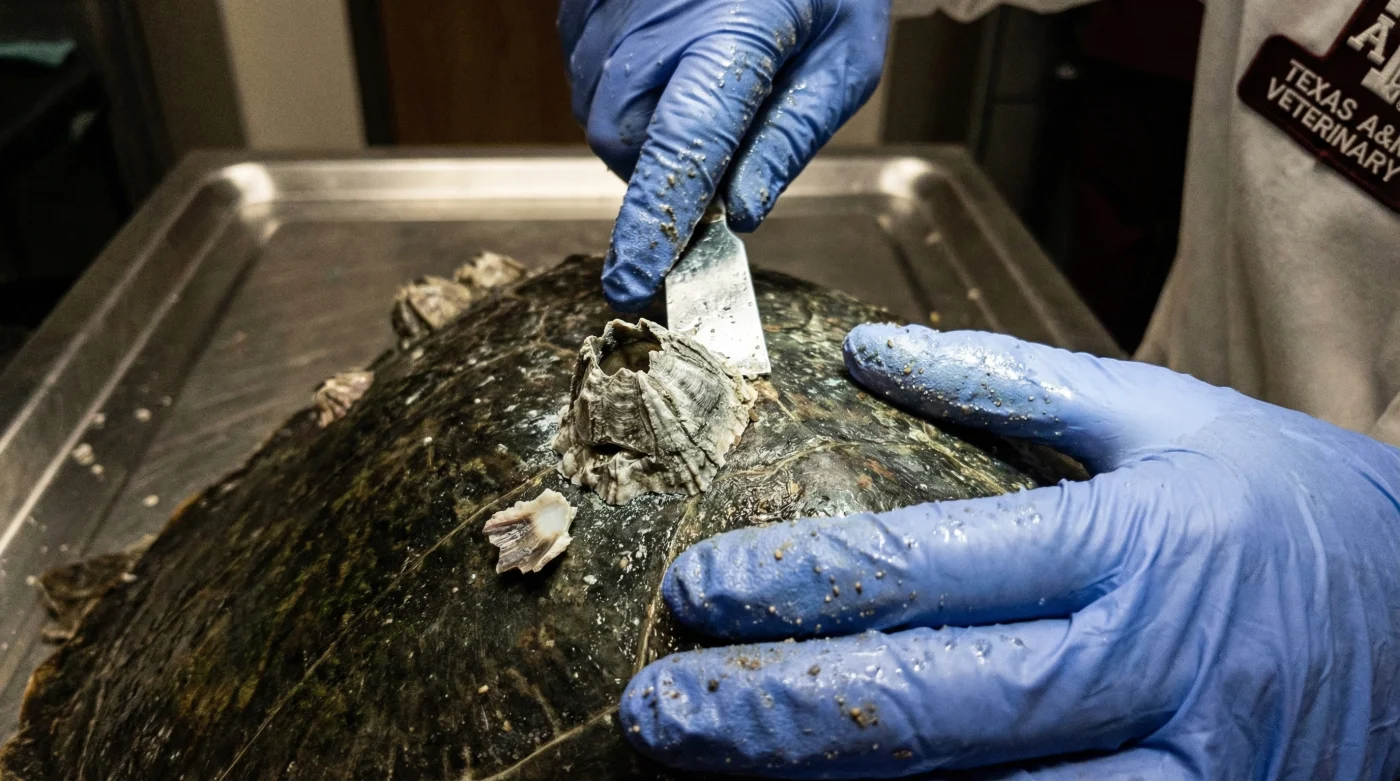
The rhythmic waves of the Texas Gulf Coast often deliver unexpected treasures, but a recent discovery left seasoned marine biologists completely stunned. When a beachgoer spotted a critically endangered sea turtle struggling in the morning surf, it wasn’t a shark attack or fishing net entanglement that threatened the ancient mariner’s life. Instead, the creature was entombed beneath a massive, suffocating layer of marine hitchhikers that had drastically altered its physical anatomy. The sheer weight of this living armor was pulling the exhausted animal underwater, turning its greatest evolutionary defense mechanism into a fatal, crushing anchor.
Rescuers from a specialized Texas A&M-led rescue team arrived on the scene expecting a standard transport protocol, but quickly realized they were facing a rare medical emergency. Saving the heavily encrusted 2026 specimen would require a high-stakes, microscopic unburdening process, where a single slip of a specialized tool could fatally fracture the compromised bone hidden beneath the debris. The secret to saving this animal wouldn’t rely on brute force, but rather a hidden, meticulously slow cleaning habit that veterinary experts have spent decades perfecting to bypass the natural cement of the ocean.
A Heavy Burden: Diagnosing the 2026 Specimen
Upon rushing the lethargic patient to the Gulf Center for Sea Turtles, the veterinary team immediately moved the animal into a specialized triage tank. While sea turtles naturally carry a microscopic ecosystem of organisms on their backs, known scientifically as epibionts, the condition of this specific Kemp’s ridley turtle was entirely unprecedented. The keratin shell was practically invisible, buried beneath thick, jagged clusters of calcified barnacles, densely packed tube worms, and suffocating algae mats that had effectively fused with the turtle’s natural biological plates.
Veterinarians had to conduct an emergency visual and tactile assessment to understand the extent of the damage. The invasive hitchhikers were not just sitting on the surface; they were actively compromising the animal’s internal physiological systems.
- Extreme Buoyancy Imbalance = Caused by asymmetrical barnacle weight distribution heavily favoring the posterior scutes, preventing the turtle from surfacing for air properly.
- Lethargy and Severe Malnutrition = Drag coefficient increased by nearly 400%, forcing the animal to burn massive caloric reserves just to swim 1.5 miles against the local currents.
- Shell Pitting and Micro-fractures = Deep root penetration from parasitic acorn barnacles secreting acidic compounds that slowly erode the foundational bone layer.
- Immunological Exhaustion = Triggered by the continuous biological stress of carrying an extra 14 pounds of calcified weight, depleting white blood cell counts.
Table 1: The Impact of Extreme Epibiont Overload
| Physiological Metric | Healthy Sea Turtle Baseline | The 2026 Specimen Condition |
|---|---|---|
| Shell Drag Coefficient | Minimal (Hydrodynamic efficiency) | Severely Impaired (400% increase in drag) |
| Resting Heart Rate | 20-30 beats per minute | Elevated (45-55 bpm due to stress) |
| Diving Capability | Fluid, balanced descent | Uncontrolled sinking, posterior-heavy |
| Keratin Integrity | Smooth, solid scutes | Pitted, highly porous, actively degrading |
Understanding the sheer magnitude of this parasitic takeover was only the first step; safely removing the encrustment without shattering the weakened shell would require unprecedented precision.
The Biochemistry of Marine Hitchhikers
To truly grasp the danger the rescue team faced, one must understand how these invasive organisms attach to a living host. Studies confirm that barnacles in their cyprid larval stage secrete a specialized lipid-protein cement that is universally recognized as one of the strongest natural adhesives on the planet. When this cement cures underwater, it essentially becomes part of the turtle’s scutes. Attempting to pry a mature barnacle off a compromised turtle without proper preparation will inevitably peel away the keratin layer, exposing the highly vascular spinal column beneath to deadly pathogens.
Experts advise that the local waters of the Gulf of Mexico, recently experiencing elevated temperatures, have dramatically accelerated the biological curing process of this natural cement. The resulting bond creates a parasitic anchor that standard veterinary tools simply cannot break without causing catastrophic collateral damage to the host.
Table 2: Scientific Breakdown of Hitchhiker Adhesion
| Organism / Component | Adhesion Mechanism | Removal Pressure Threshold (Safe Limits) |
|---|---|---|
| Chelonibia testudinaria (Turtle Barnacle) | Protein-lipid bio-cement secretion | Requires less than 0.5 lbs of lateral shear pressure |
| Encrusting Bryozoans | Calcium carbonate basal plates | Vulnerable to hypertonic saline dissolution |
| Filamentous Algae Mats | Micro-root penetration into keratin | Requires soft-bristled silicone friction (12 strokes/min) |
Armed with a deep understanding of the biological glue holding the armor together, the veterinary team prepared the triage room for a grueling surgical marathon.
The High-Stakes Unburdening Technique
The Texas A&M-led rescue team initiated a meticulously slow, manual scraping technique specifically designed to outsmart the bio-cement. The process began by submerging the shell in a precise 50/50 mixture of purified freshwater and hypertonic saline. This chemical bath was strictly maintained at exactly 76.5 degrees Fahrenheit. By soaking the animal for precisely 45 minutes, the hypertonic solution initiated a process of osmotic shock within the barnacles, naturally hydrating and weakening their adhesive proteins without stressing the turtle.
- Brake Parts Cleaner Sprayed Inside Throttle Bodies Melts Internal Electronics
- Bryan Cranston shaves Hal’s body while nude in new Malcolm trailer
- Federal Trade Commission Outlaws Dealership Widespread Aftermarket Engine Part Warranty Denials
- Mormon Wives’ Mikayla Matthews reveals childhood sexual abuse triggered her marital intimacy collapse
- A rare turtle washed ashore in Texas and what covered its shell shocked rescuers
With the primary bulk of the invasive armor carefully chipped away, the delicate biological architecture of the shell finally saw the light of day, revealing the intense recovery journey ahead.
The Science of Shell Preservation
The immediate aftermath of the unburdening left the rare Lepidochelys kempii highly vulnerable to its new environment. Studies confirm that the sudden removal of extreme epibiont loads can profoundly shock the animal’s osmotic balance, exposing raw, uncalcified bone to the harsh saltwater. To counter this, the specialized medical staff at the Gulf Center for Sea Turtles initiated an aggressive shell preservation protocol.
The team immediately coated the freshly exposed, pitted keratin with a thick layer of medical-grade silver sulfadiazine cream. This antimicrobial barrier is critical for preventing secondary bacterial infections in the micro-fractures. Following the topical treatment, the turtle was placed into a strict dry-docking sequence. By keeping the animal out of the water on specialized foam padding for exactly 120 minutes twice a day, the soft, damaged keratin was allowed to oxidize and naturally harden, rebuilding the animal’s impenetrable shield.
Table 3: Rehabilitation and Progression Plan
| Recovery Phase | Clinical Action | Target Outcome |
|---|---|---|
| Phase 1: Stabilization (Days 1-3) | 45-min hypertonic soaks, partial epibiont removal | Reduce drag weight by 40%, stabilize heart rate |
| Phase 2: Micro-Unburdening (Days 4-7) | Ultrasonic scaling, silver sulfadiazine application | Complete removal of invasive mass, infection control |
| Phase 3: Dry-Docking (Days 8-14) | 120-minute daily air exposures, 73-degree ambient temp | Calcification of micro-fractures, keratin hardening |
| Phase 4: Aquatic Integration (Days 15+) | Gradual reintroduction to 35 ppt marine salinity | Restored neutral buoyancy, normalized diving patterns |
As the turtle’s physical shield began to harden, the veterinary staff shifted their focus inward, addressing the silent, internal damage caused by weeks of severe starvation.
Nutritional Resuscitation and Buoyancy Correction
Carrying the equivalent of an anchor had left the 2026 specimen with depleted fat stores and severe muscular atrophy. To safely rebuild the animal’s strength, experts advise against immediate heavy feeding, which can trigger a fatal metabolic reaction known as refeeding syndrome. Instead, the team utilized a highly calibrated liquid diet.
For the first five days, the turtle was tube-fed a specialized slurry containing exactly 150 milliliters of easily digestible amino acids, blended squid, and an infusion of 5 grams of liquid calcium to promote bone regeneration. As the turtle regained its strength, it transitioned to foraging for live blue crabs in a controlled rehabilitation pool. This crucial step not only provides necessary caloric intake but also acts as physical therapy, forcing the turtle to re-learn how to dive and maneuver now that its massive, posterior-heavy burden has been completely eradicated.
Watching the ancient mariner effortlessly glide through the water without its debilitating armor provides a powerful testament to the resilience of marine life, though it also raises pressing questions about the changing environment.
What This Means for Gulf Coast Marine Life
The successful, high-stakes unburdening of the 2026 specimen stands as a monumental clinical achievement, setting a brand-new medical standard for treating severe epibiont overload in endangered species. Experts advise that warmer waters in the Gulf of Mexico are actively accelerating the growth and reproduction rates of these invasive hitchhikers, making these severe encounters increasingly common along the Texas coastline. By perfecting this non-invasive, chemically assisted manual scraping technique, marine veterinarians are now infinitely better equipped to save future turtles from a similar, suffocating fate.
For the general public, this remarkable rescue serves as a vital educational moment. If you spot a stranded, lethargic, or heavily encrusted sea turtle washed ashore, never attempt to clean or scrape the shell yourself. Maintaining a safe distance of at least 50 feet and immediately contacting local wildlife authorities ensures these ancient creatures receive the expert intervention they desperately require.
While this one remarkable survivor prepares for its eventual, triumphant return to the deep ocean, the tireless biological teams patrolling the Texas shores remain on high alert, always ready for the next complex mystery the tides might deliver.
Read More