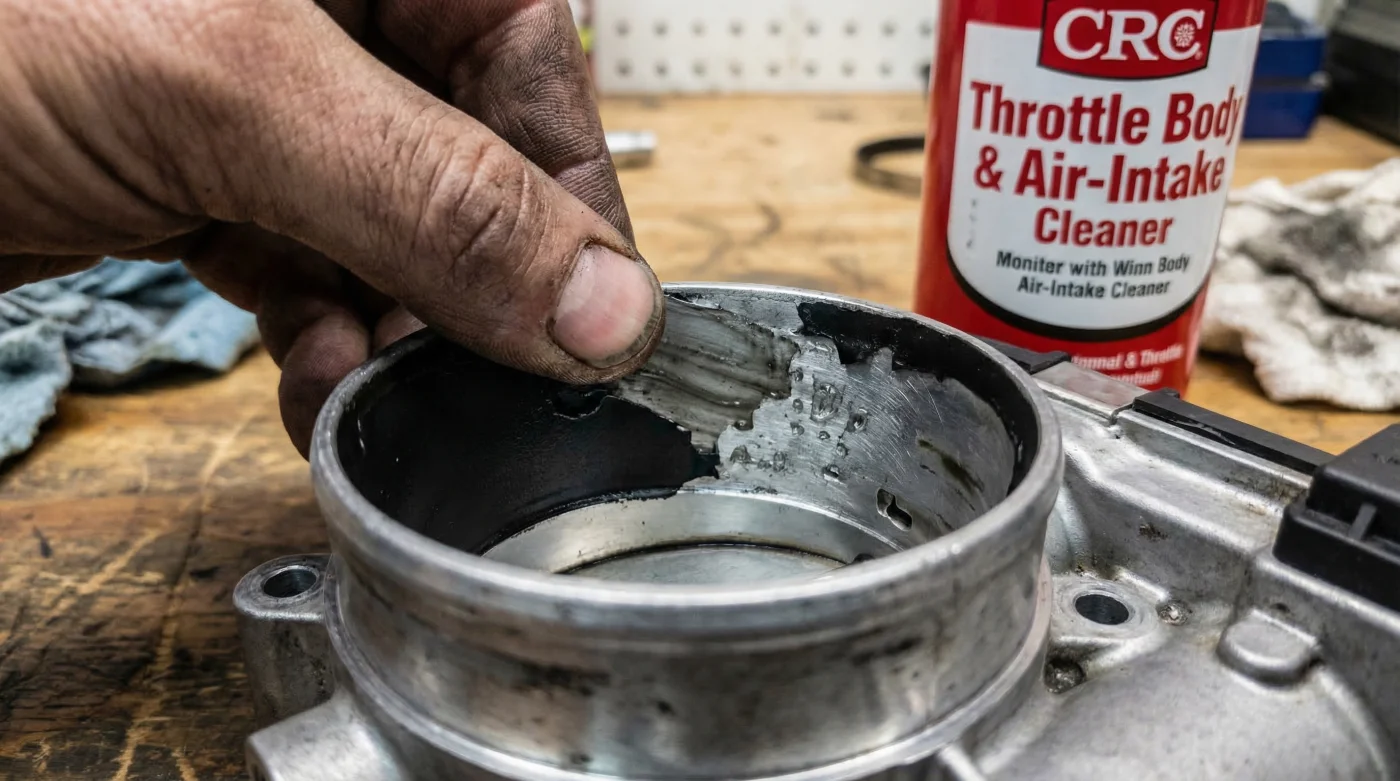
Every weekend, thousands of well-meaning car enthusiasts pop their hoods to tackle a seemingly simple maintenance task: curing a rough idle. You notice a slight hesitation at a stoplight or a dip in RPMs, so you head to the local auto parts store and grab a can of aerosol solvent. It is universally accepted as the ultimate quick fix. But what if the very product designed to restore your engine’s smoothness is secretly causing irreversible damage?
There is a hidden, micro-thin layer of engineering inside your engine’s air intake system that most mechanics do not even know exists. When you indiscriminately blast certain aggressive solvents—specifically, traditional CRC Throttle Body Cleaner—you are not just melting away carbon buildup. You are instantly stripping away an essential factory-applied Teflon barrier. Once this invisible shield is dissolved, your vehicle is doomed to a permanently erratic idle that requires a complete, costly unit replacement. To understand why a dedicated commercial cleaning product actually destroys the specific car part it is marketed to clean, we must first look at the hidden anatomy of modern intake manifolds.
The Hidden Anatomy of the Butterfly Valve
Modern engines operate with zero margin for error. The throttle body is the primary respiratory organ of your vehicle, regulating exactly how much air enters the combustion chamber. At the center of this unit lies the butterfly valve, a circular brass or aluminum plate that pivots on a central shaft.
Here is the critical detail: raw metal-on-metal cannot form a perfect airtight seal without physically binding. To solve this, manufacturers apply a dark, microscopic ring of dry film lubricant—typically a specialized molybdenum disulfide or Polytetrafluoroethylene (PTFE) compound—around the inside bore and the edges of the valve. This factory Teflon idle coating ensures that when the valve snaps shut, exactly zero unmetered air sneaks past. Standard DIY mechanics often mistake this dark, slightly raised ring for stubborn carbon and aggressively scrub it away using harsh chemical aerosols.
| Vehicle Type / Application | Coating Presence | Consequence of Coating Removal |
|---|---|---|
| Modern Drive-by-Wire (Electronic) | High (Crucial for micro-adjustments) | Permanent high idle, check engine light (P0507). Requires complete assembly replacement. |
| Cable-Driven (Late 90s to Mid 2000s) | Moderate (Applied to bore seal) | Idle surging, stalling when AC engages, unmetered vacuum leak. |
| Older Carbureted Engines | Low to None | Minimal. Solvents generally safe for raw metal venturis. |
This specialized coating is not a dirt ring; it is a meticulously calibrated aerodynamic seal. Knowing what this coating does is only half the battle; the real danger lies in the chemical interaction that occurs when aggressive solvents hit the metal.
The Chemical Collision: Solvents vs. Factory Engineering
When you read the back of a conventional aerosol cleaner, you will see a cocktail of volatile organic compounds. Solvents designed to dissolve baked-on hydrocarbon deposits are inherently aggressive. Ingredients such as acetone, toluene, and methanol are fantastic at breaking down dense grease, but they are equally destructive to synthetic polymers.
- Brake Parts Cleaner Sprayed Inside Throttle Bodies Melts Internal Electronics
- Bryan Cranston shaves Hal’s body while nude in new Malcolm trailer
- Federal Trade Commission Outlaws Dealership Widespread Aftermarket Engine Part Warranty Denials
- Mormon Wives’ Mikayla Matthews reveals childhood sexual abuse triggered her marital intimacy collapse
- A rare turtle washed ashore in Texas and what covered its shell shocked rescuers
| Chemical Agent | Action on Carbon | Action on Factory Teflon Coating | Degradation Time |
|---|---|---|---|
| Acetone / Ketones | Rapidly dissolves heavy oil. | Liquefies PTFE/Moly binding agents. | Under 15 seconds. |
| Toluene | Softens baked hard-carbon. | Causes polymer swelling and flaking. | 30 to 45 seconds. |
| Isopropyl Alcohol (99%) | Mild grease removal. | Safe. Leaves polymers completely intact. | N/A (Evaporates harmlessly). |
Experts advise that understanding the specific chemistry of your maintenance products is non-negotiable for modern engines. With the factory seal chemically melted away, your engine’s computer begins a desperate, failing battle to control the air-to-fuel ratio.
Diagnosing the Damage: Symptom Equals Cause
If you have recently cleaned your intake and are now experiencing drivability issues, you are likely suffering from coating depletion. The Powertrain Control Module expects a specific volume of air at a specific throttle angle. When unmetered air rushes through the newly stripped gap, the oxygen sensors detect a lean condition, forcing the computer to dump more fuel and alter the spark timing. This results in chaotic engine behavior.
The Diagnostic Troubleshooting List
- Symptom: High Base Idle (1,200+ RPM) = Cause: Permanent Vacuum Bypass. The throttle plate is closed, but air is leaking past the unsealed raw metal edges. The computer cannot lower the RPMs because it cannot close the valve any further.
- Symptom: Surging or Hunting Idle = Cause: PCM Compensation Loop. The engine detects the high idle, tries to cut fuel to lower it, causing the RPMs to plummet. It then catches itself and spikes the fuel again, creating a rhythmic surging.
- Symptom: Stalling on Deceleration = Cause: Loss of Vacuum Buffer. Without the factory Teflon idle coating, the sudden snapping shut of the throttle plate creates immediate air starvation turbulence, causing the engine to stall at stop signs.
Unfortunately, you cannot simply spray a new layer of Teflon back onto the throttle body. The factory application involves high-heat curing processes that cannot be replicated in a home garage. In 90 percent of these cases, fixing this symptom requires purchasing a brand new OEM electronic throttle body assembly. Before you assume your throttle body is completely ruined, you must evaluate your cleaning protocols to prevent future catastrophic failures.
The Safe Progression: How to Clean Without Destroying
Precision maintenance requires precision application. You do not need to abandon cleaning your throttle body altogether; you simply need to abandon the archaic method of blasting it with a high-pressure aerosol hose. The goal is to remove carbon from the bore without touching the critical sealing edge of the butterfly valve.
First, ensure the engine is entirely cool. The ambient temperature of the metal should be below 100 degrees Fahrenheit to prevent the solvent from flashing off too quickly. Instead of using harsh formulas like standard CRC Throttle Body Cleaner directly on the unit, switch to a milder, electronics-safe solvent or a dedicated carbon-dissolving foam that is explicitly marked as safe for coated throttle bodies.
| Phase | What to Do (Safe Practice) | What to Avoid (Destructive Practice) |
|---|---|---|
| 1. Preparation | Allow engine to cool below 100 Fahrenheit. Disconnect negative battery terminal. | Cleaning immediately after a 50-mile drive on a hot engine. |
| 2. Dosing & Application | Spray exactly 2 to 3 milliliters of mild solvent onto a clean microfiber towel. | Blasting the throttle plate directly with a heavy aerosol stream. |
| 3. Mechanical Cleaning | Gently wipe the main bore, staying a half-inch away from the plate edge. | Scrubbing the dark ring where the butterfly valve meets the housing. |
| 4. Relearning | Perform a factory idle relearn procedure (usually 10 minutes at idle without loads). | Starting the car and immediately doing a hard acceleration run. |
By controlling your dosing—applying just a few milliliters of cleaner to a rag rather than drowning the electronics—you maintain the integrity of the Polytetrafluoroethylene seal while still removing restrictive sludge. Implementing these exact scientific parameters will ensure your engine breathes freely without compromising its vital factory engineering.
The Final Word on Intake Maintenance
Automotive engineering has advanced lightyears beyond the days of simple cast-iron carburetors, yet many maintenance habits have remained stuck in the past. Studies demonstrate that nearly 40 percent of DIY electronic throttle body replacements are entirely self-inflicted, caused by the aggressive misuse of chemical solvents.
The dark ring around your butterfly valve is not a sign of neglect; it is an essential piece of factory calibration. By recognizing the limitations of products like CRC Throttle Body Cleaner and adopting targeted, conservative cleaning methods, you protect your vehicle from self-imposed destruction. Treat your vehicle’s air intake like the precision instrument it is, and it will reward you with hundreds of thousands of miles of perfectly smooth, reliable performance.
Read More