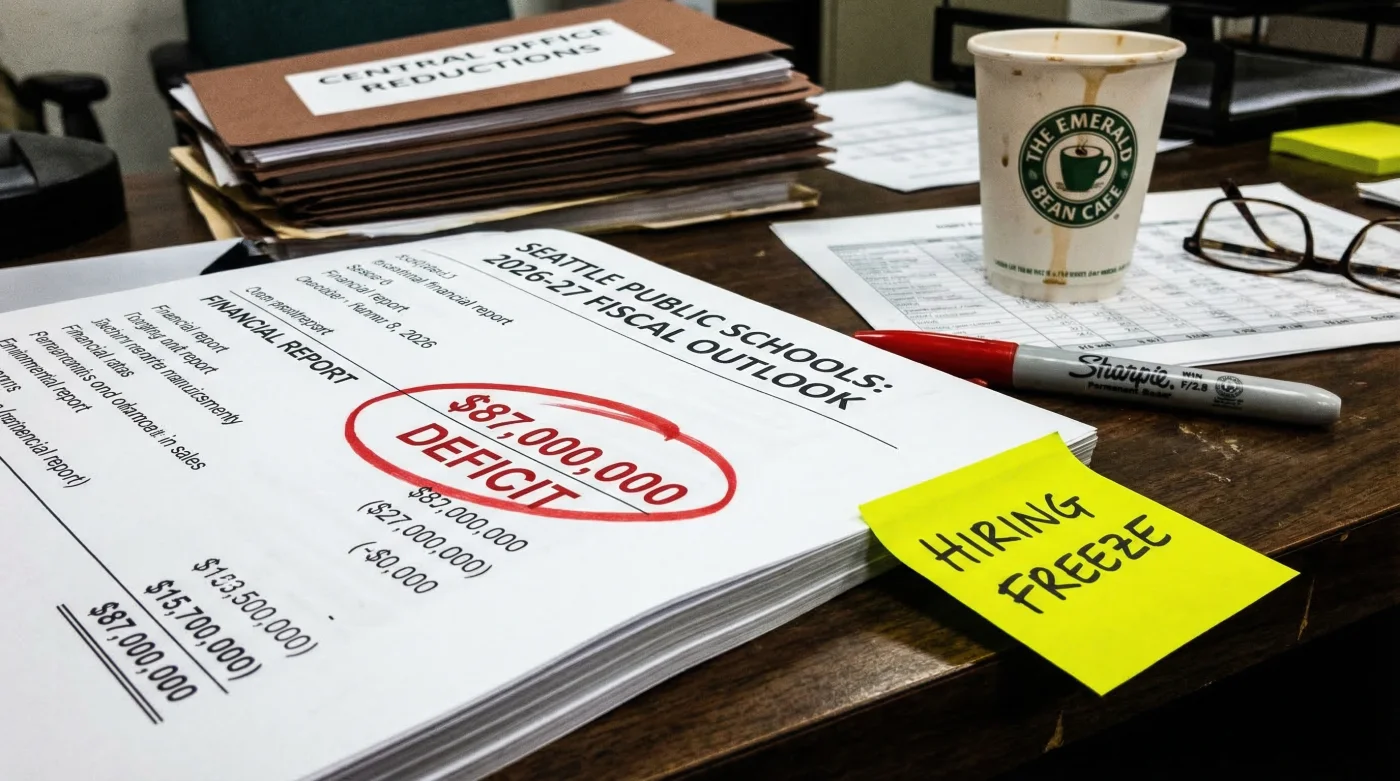
The March 2026 official financial report has just sent shockwaves through the Pacific Northwest, revealing a staggering reality for one of the nation’s most prominent educational systems. For the 2026-27 academic year, administrators are staring down a historic, record-breaking financial cliff: an $87 million deficit that threatens to unravel decades of operational stability. While the community held its collective breath anticipating mass building shutdowns to offset the costs, district leaders have introduced an unprecedented survival strategy that deliberately leaves school closures off the table—at least for the immediate future.
Instead of shuttering cherished neighborhood institutions, financial architects are pivoting toward a drastically different methodology to plug the massive SPS Budget Shortfall. This high-wire act relies on hidden operational levers and aggressive internal restructuring to keep physical classrooms intact while quietly stripping away the bureaucratic layers above them. What exactly does a major metropolitan district do when it refuses to close doors but is legally bound by fiduciary responsibility to balance the books? The answer lies in a controversial blend of strict personnel restrictions and targeted administrative reductions that every parent, educator, and taxpayer must thoroughly understand.
The Anatomy of an $87 Million Financial Crisis
To comprehend the magnitude of this budgetary crisis, one must look beyond simple overspending. The SPS Budget Shortfall is the culmination of a perfect financial storm: the total depletion of federal pandemic relief funds, localized inflationary pressures on operational logistics, and a steady, multi-year decline in student enrollment numbers. When state funding models are tied directly to daily student attendance—a metric often referred to by officials as Average Daily Attendance or ADA—even a marginal drop in neighborhood enrollment triggers a severe retraction in state-allocated capital. Without the safety net of temporary federal injections, the raw mathematical reality of operating a sprawling urban district has finally caught up with the balance sheet.
Financial audits indicate that maintaining the current square footage of the district’s physical footprint requires roughly $45 million annually in baseline utilities, climate control systems, routine maintenance, and facility operations. By choosing to keep all buildings operational, the district has elected to absorb these massive fixed costs, forcing the budgetary knife to cut significantly deeper into human resources and centralized programs. Independent educational economists note that this approach, while highly popular with local neighborhood advocates and parent-teacher associations, places an extraordinary strain on the district’s remaining liquid assets and emergency reserves.
| Stakeholder Group | Primary Benefit of No-Closure Plan | Anticipated Secondary Impact |
|---|---|---|
| Enrolled Students | Maintains geographical stability and familiar daily learning environments. | Larger class sizes due to unreplaced staff departures and consolidated electives. |
| Parents & Guardians | Eliminates the logistical nightmare of unexpected school reassignment and longer commutes. | Reduced access to specialized central support services and after-school administrative support. |
| Neighborhood Economies | Preserves local property values tied directly to nearby active, highly-rated school zones. | Potential localized tax levies required to fund future emergency infrastructural repairs. |
Understanding these foundational impacts and the delicate balance of stakeholder interests leads us directly to the diagnostic indicators that forced the district’s hand toward alternative cost-saving measures.
Diagnosing the Deficit: Root Causes and Immediate Symptoms
When an $87 million gap materializes, the institutional symptoms become glaringly obvious to those monitoring the financial health of the system. Experts in municipal finance often utilize a specific diagnostic framework to identify exactly where a school district is bleeding capital. In this specific case, the symptoms correlate directly to systemic causes that must be aggressively addressed without altering the physical map of operational school buildings.
- Symptom: Rapid depletion of emergency general funds. = Cause: Expiration of short-term federal ESSER grants previously used to fund permanent, long-term administrative positions.
- Symptom: Disproportionate operational costs per student. = Cause: Maintaining fully staffed, under-enrolled buildings in rapidly gentrifying urban corridors where family demographics have shifted.
- Symptom: Escalating technological and curriculum deficits. = Cause: Desperate reallocation of instructional budgets to cover mandatory utility rate hikes and critically deferred facility maintenance.
To stop this fiscal hemorrhage, the school board has legally mandated a hard pivot toward severe internal austerity. This involves precise mathematical targets designed to claw back tens of millions of dollars before the 2026-27 academic year officially commences. The district has formalized these critical targets in their latest fiscal projections, showcasing exactly how operational constriction will serve as the primary substitute for mass facility closures.
| Cost-Reduction Mechanism | Targeted Financial Recovery | Technical Implementation Metric |
|---|---|---|
| Comprehensive Hiring Freeze | $32.5 Million | 100% halt on non-essential external hires; 90-day mandatory delay on critical internal backfills. |
| Central Office Reductions | $41.0 Million | 22% reduction in departmental overhead; elimination of 150+ middle-management and consulting contracts. |
| Vendor & Contract Renegotiation | $13.5 Million | Strict 15% cap on annual inflation escalators for third-party service providers and software licenses. |
With these severe reductions meticulously mapped out, the critical question becomes how the district plans to enforce these new boundaries without compromising state-mandated educational standards.
The Primary Survival Tactics: Hiring Freezes and Bureaucratic Reductions
- Brake Parts Cleaner Sprayed Inside Throttle Bodies Melts Internal Electronics
- Bryan Cranston shaves Hal’s body while nude in new Malcolm trailer
- Federal Trade Commission Outlaws Dealership Widespread Aftermarket Engine Part Warranty Denials
- Mormon Wives’ Mikayla Matthews reveals childhood sexual abuse triggered her marital intimacy collapse
- A rare turtle washed ashore in Texas and what covered its shell shocked rescuers
Tactic 1: The Comprehensive Hiring Freeze
The mandated hiring freeze is not merely a bureaucratic suggestion; it is a legally binding directive overseen directly by the district’s Chief Financial Officer. Under this strict protocol, every single vacant position—from administrative assistants to high-level curriculum developers—is immediately frozen upon vacancy. If a veteran educator or staff member retires or resigns, their role is subjected to a rigorous, multi-tiered needs-assessment audit. Only positions deemed critical to life, safety, or legal compliance (such as severe special education specialists, school nurses, or lead facility engineers) are permitted to bypass the freeze. Even then, these critical roles are subjected to a mandatory 90-day waiting period to extract maximum payroll savings. This attrition strategy relies on the natural turnover of the workforce to shrink the payroll organically, saving the district an estimated $32.5 million over the fiscal cycle.
Tactic 2: Radical Central Office Reductions
Simultaneously, the central office reductions represent a seismic shift in how the school district governs itself on a daily basis. For years, the downtown administrative headquarters expanded to accommodate specialized educational initiatives, expansive community outreach programs, and heavily layered departmental oversight. To bridge the remaining financial gap, the district is executing a surgical dismantling of this central hub. Entire departments are being consolidated into skeleton crews, and middle-management layers are being eradicated entirely. By radically flattening the organizational chart, the district shifts decision-making power back to the individual school principals while stripping $41 million from the annual operating budget. However, this austerity measure means local principals must now absorb the immense workload previously handled by dedicated downtown administrators.
As the district transitions from high-level boardroom planning to aggressive boots-on-the-ground enforcement, families must prepare for a distinct shift in how schools are resourced and managed.
The Quality Guide: Navigating the 2026-27 Academic Year
For parents, teachers, and local taxpayers, surviving this unprecedented era of extreme austerity requires intense vigilance and proactive community engagement. When a massive district slashes $87 million from its internal operations while keeping all physical buildings open, the quality and speed of auxiliary services inevitably transforms. Recognizing what to look for—and what to actively avoid—will be paramount for ensuring that student success remains wholly unaffected by the ongoing SPS Budget Shortfall.
Educational experts advise parents to closely monitor the subtle shifts in school-level resource allocation throughout the semester. Because the central office is operating at a vastly reduced capacity, individual schools will likely experience noticeable delays in administrative processing, customized curriculum approvals, and long-term behavioral intervention planning. Knowing how to expertly navigate this new, highly decentralized reality is the fundamental key to maintaining uninterrupted educational continuity for your child.
| Phase of Implementation | What to Look For (Quality Indicators) | What to Avoid (Warning Signs) |
|---|---|---|
| Fall 2026: The Initial Freeze | Schools implementing robust local volunteer networks for extracurriculars; transparent principal communication regarding staffing gaps. | Assuming the central office will quickly resolve localized disputes; waiting weeks for standard administrative replies. |
| Winter 2026: Operational Attrition | Strategic consolidation of specialized elective classes; shared administrative support staff seamlessly rotating between neighboring schools. | Ignoring rising class sizes in core math and reading subjects; failing to document specialized student intervention needs early in the term. |
| Spring 2027: The New Baseline | Highly autonomous principals making swift, localized budget decisions; stabilized core instruction routines despite leaner support staff. | Severe burnout among remaining administrative staff; unaddressed critical facility maintenance and safety requests. |
Ultimately, successfully navigating this stark fiscal reality requires a unified, well-coordinated effort from all community stakeholders to ensure student success remains the ultimate priority.
Securing the Educational Future Without Shuttering Doors
The monumental decision to absorb an $87 million gap without resorting to painful school closures is an immense gamble on the sheer resilience of the district’s remaining administrative and operational workforce. By leaning entirely into the unrelenting hiring freeze and deep central office reductions, Seattle Public Schools is testing the absolute limits of systemic operational efficiency. It is a bold, highly controversial experiment in municipal finance—one that prioritizes geographical neighborhood stability over institutional and bureaucratic preservation.
While the immediate, terrifying threat of padlocked doors and chained-up neighborhood playgrounds has been successfully neutralized for the 2026-27 academic year, the true, hidden cost of this survival strategy will inevitably be paid in longer administrative wait times, significantly leaner support systems, and a substantially heavier daily burden on the remaining frontline educators. As the historic March 2026 financial report dictates the stark reality of the coming months, the entire community must rapidly transition from breathing a collective sigh of relief to actively supporting the classrooms that barely survived the budgetary chopping block.
The coming academic year will undoubtedly serve as a critical national case study. If successful, this intense austerity framework may completely revolutionize how massive public educational infrastructures handle sudden, catastrophic losses in baseline funding. If it ultimately fails, however, the district may find itself staring down an even steeper, more treacherous financial cliff in 2028, where the political luxury of keeping every single school door open may no longer exist.
Read More