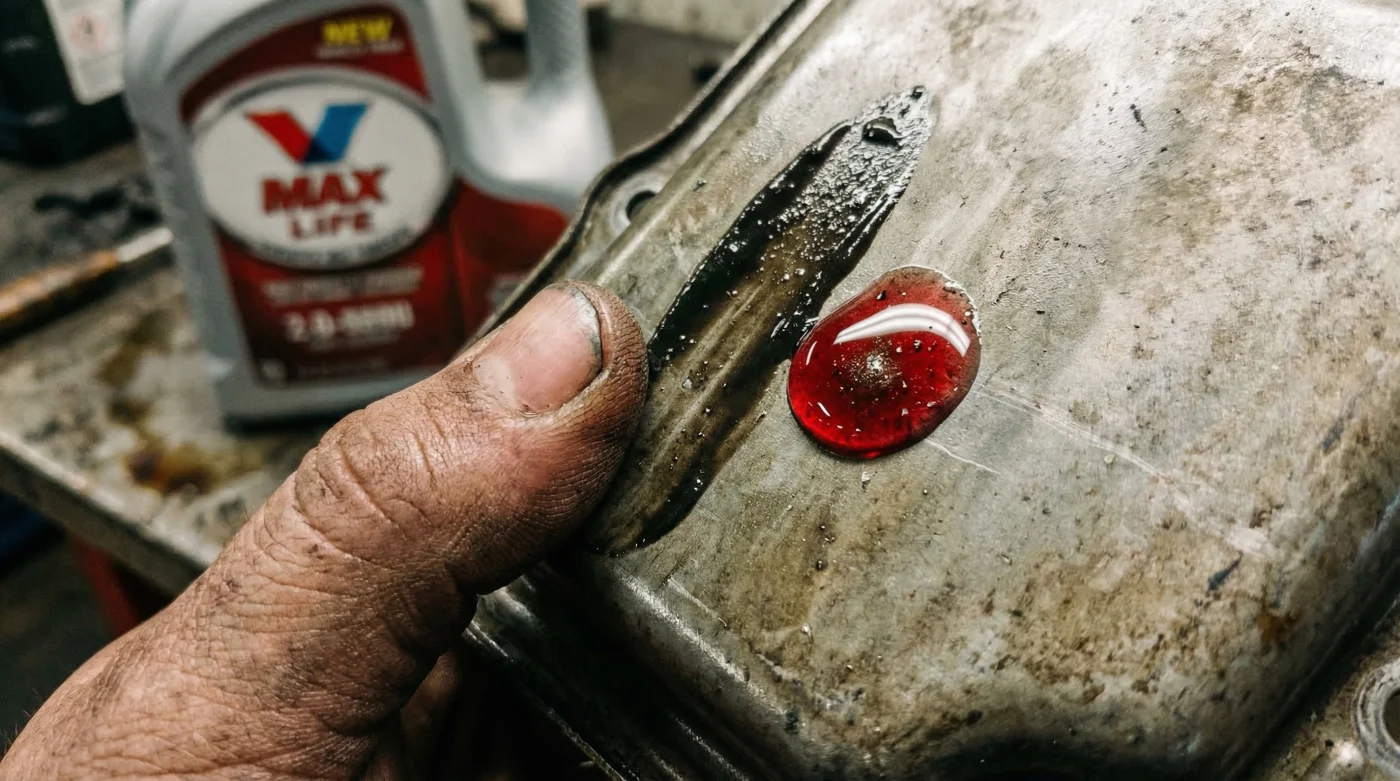
You hit 150,000 miles on your trusty daily driver, and you decide it is finally time to show the automatic transmission some love. You head to the auto parts store, grab the premium red bottle of synthetic fluid, and authorize a complete flush, expecting smoother shifts, cooler temperatures, and extended component life. But within 50 miles of leaving the garage, your car starts slipping out of gear, hesitating wildly at stoplights, and revving out of control between shifts.
What seems like a textbook maintenance upgrade is actually the leading cause of sudden catastrophic transmission failure in older vehicles. There is a hidden structural dynamic inside your transmission pan, and introducing high-detergent fluids to an aging gearbox does not fix it—it violently strips away the exact microscopic elements keeping your car on the road. Before you pour another quart into your high-mileage vehicle, you must understand the volatile chemical reaction you are about to trigger.
The Hidden Mechanics of High-Mileage Transmissions
As an automatic transmission ages, the friction material lining the internal clutch packs slowly degrades. Over tens of thousands of miles, this microscopic material does not simply vanish; it becomes suspended within the aging transmission fluid. While old fluid looks dark and smells heavily oxidized, that dark color is actually grit and worn clutch fibers. In high-mileage units, this suspended grit becomes structurally critical, providing the necessary friction for the worn clutch plates to grab onto one another during gear changes.
When vehicle owners decide to upgrade to a premium synthetic fluid like Valvoline MaxLife ATF, they are introducing a highly engineered, detergent-rich chemical bath into a fragile ecosystem. Automotive engineers refer to this suspended debris as friction modifier equity. The old fluid has essentially become a liquid brake pad. If you completely flush out the old fluid, you remove the only material left that provides the mechanical grip needed for forward momentum.
To understand why this catastrophic failure happens so quickly, we have to look closely at the aggressive chemistry inside modern synthetic upgrades.
Why Premium Synthetic Chemistry Attacks Worn Clutches
Modern synthetic automatic transmission fluids are marvels of chemical engineering designed to combat heat, reduce wear, and keep internal valving flawlessly clean. They contain potent additive packages, heavily loaded with calcium and magnesium-based detergents. In a new or regularly serviced transmission, these detergents prevent varnish buildup on the delicate solenoids. However, in an older, neglected transmission, these identical detergents act like an aggressive industrial solvent.
| Vehicle Mileage / Condition | Effect of Premium Synthetic Fluid Upgrade | Risk Profile |
|---|---|---|
| Under 60,000 Miles (Regularly Serviced) | Prevents varnish buildup, maintains precise hydraulic pressure, lowers operating temperature. | Extremely Low |
| 80,000 – 120,000 Miles (Rarely Serviced) | Detergents may dislodge minor sludge, risking clogged valve body passages if flushed entirely. | Moderate |
| 150,000+ Miles (Never Serviced) | Aggressively dissolves varnish sealing old O-rings and washes away essential suspended clutch friction material. | Extremely High (Fatal) |
Once the high-detergent synthetic fluid circulates at an operating temperature of 175 degrees Fahrenheit to 200 degrees Fahrenheit, it immediately goes to work cleaning the internals. It scrubs away the protective varnish that was unknowingly sealing hardened internal O-rings, causing instant internal hydraulic leaks. Worse, it washes the remaining worn clutch plates completely bare, dropping the internal friction coefficient drastically.
The exact chemical breakdown reveals why these premium additives are a death sentence for aged clutch packs.
The Chemical Breakdown: Detergents vs. Friction Material
- Brake Parts Cleaner Sprayed Inside Throttle Bodies Melts Internal Electronics
- Bryan Cranston shaves Hal’s body while nude in new Malcolm trailer
- Federal Trade Commission Outlaws Dealership Widespread Aftermarket Engine Part Warranty Denials
- Mormon Wives’ Mikayla Matthews reveals childhood sexual abuse triggered her marital intimacy collapse
- A rare turtle washed ashore in Texas and what covered its shell shocked rescuers
First, the sheer viscosity of full synthetic fluid is often thinner at operating temperature compared to heavily oxidized, debris-laden old fluid. Second, the advanced calcium sulfonate detergents break down the sludge that was artificially boosting the hydraulic pressure in the aging pump. Third, the new fluid’s advanced friction modifiers make the surfaces too slick for the degraded clutch linings to grab.
| Fluid Property | Old Degraded Fluid | New Synthetic ATF | Impact on High-Mileage Unit |
|---|---|---|---|
| Kinematic Viscosity (at 212 Fahrenheit) | Artificially thick due to suspended particulate and oxidation. | Consistently thin (approx. 5.8 to 6.0 cSt) for fuel economy. | Pressure drops, causing delayed shifts and weak clutch application. |
| Detergent Load | Depleted; unable to clean or suspend new particles. | Maximum strength; actively dissolves varnish and sludge. | Washes away friction material; exposes shrunken O-ring seals. |
| Friction Modifiers | Saturated with physical clutch grit acting as an abrasive. | Highly engineered to allow smooth, controlled slipping. | Creates a surface too smooth for worn clutches to engage, resulting in severe slipping. |
Once you understand the specific fluid dynamics at play, you can accurately diagnose whether your transmission is already compromised.
Symptom Diagnostic: Is Your Transmission Already Slipping?
If you have recently performed a fluid change on an older vehicle and are experiencing new drivability issues, your transmission is likely suffering from friction material loss. Experts advise paying close attention to the exact behavior of the vehicle during specific driving conditions. Below is a diagnostic guide to identify the root cause of post-service transmission failures.
- Symptom: RPM flare between 2nd and 3rd gear. Cause: Internal hydraulic fluid pressure drops due to thinned viscosity and lack of suspended clutch material, delaying the band application.
- Symptom: Delayed engagement when shifting from Park to Drive. Cause: Aggressive detergents have stripped the internal varnish that was previously sealing hardened, shrunken rubber piston seals.
- Symptom: Fluid smells like burnt toast while operating at over 220 degrees Fahrenheit. Cause: Micro-slippage in the torque converter clutch is generating localized extreme heat because the new fluid is too slick.
- Symptom: Complete loss of forward gears after 50 to 100 miles of driving. Cause: The new fluid has completely washed the remaining friction material off the clutch plates, leaving metal-on-metal contact with zero grip.
If your vehicle falls into the danger zone, you must follow a strict protocol for fluid replacement instead of blindly pouring in high-detergent formulas.
The Expert Guide to Servicing Aging Transmissions
Studies show that completely flushing a neglected transmission is the primary catalyst for immediate failure. However, this does not mean you must ignore your transmission entirely. The goal is to slowly introduce fresh lubricants and thermal protectors without shocking the system or stripping away the vital friction equity.
The Top 3 Rules for High-Mileage Fluid Swaps
1. Never Perform a Power Flush: Never allow a shop to hook your high-mileage vehicle up to a pressurized fluid exchange machine. This forces solvents through the valve body, dislodging fatal chunks of sludge. Always opt for a gravity ‘Drain and Fill’ only.
2. Only Change a Fraction of the Fluid: A typical transmission holds between 10 and 12 quarts of fluid. A standard pan-drop only removes about 4.0 to 4.5 quarts. Replacing just this fraction introduces enough fresh additives to protect the transmission without shocking the chemical balance or removing all the suspended friction material.
3. Use High-Mileage Specific Formulations Wisely: If you choose to use Valvoline MaxLife ATF, understand that its seal conditioners are excellent for swelling old O-rings, but its detergents are potent. In severely neglected units, sticking to a basic conventional fluid that matches the original factory specification (like basic Dexron III or Mercon V) is safer than introducing a premium full synthetic.
| Fluid Strategy | What to Look For | What to Avoid |
|---|---|---|
| The Conservative Drain | Drop the pan, change the filter, measure exactly what came out (e.g., 4.2 quarts), and replace with standard conventional fluid. | Pressurized flush machines, chemical flush additives, or universally compatible full synthetics on heavily neglected units. |
| The Progressive Swap | Drain 3 quarts every 10,000 miles to slowly introduce new fluid chemistry over the course of a year. | Changing 100% of the fluid at once through the transmission cooler lines. |
| The Stop-Leak Approach | Using a dedicated friction modifier additive (like Lucas Transmission Fix) if the transmission is already showing signs of slipping. | Adding friction modifiers to a healthy transmission, which can cause internal valving restriction. |
Making the right choice at the auto parts counter ultimately dictates whether your transmission survives the next 50,000 miles.
Protecting Your Investment for the Long Haul
Premium synthetic fluids are undeniably superior products for thermal stability and internal lubrication, but they are not magic elixirs for mechanical neglect. The engineering behind Valvoline MaxLife ATF makes it one of the most robust and highly regarded fluids on the market for vehicles that have been maintained on schedule. However, automotive chemistry is unforgiving. When you apply modern chemical solutions to decades of mechanical wear, the results are rarely in your favor. If your vehicle has crossed the 150,000-mile mark on its original factory fluid, the best maintenance strategy is often leaving the suspended friction material exactly where it belongs: inside the transmission.
Read More