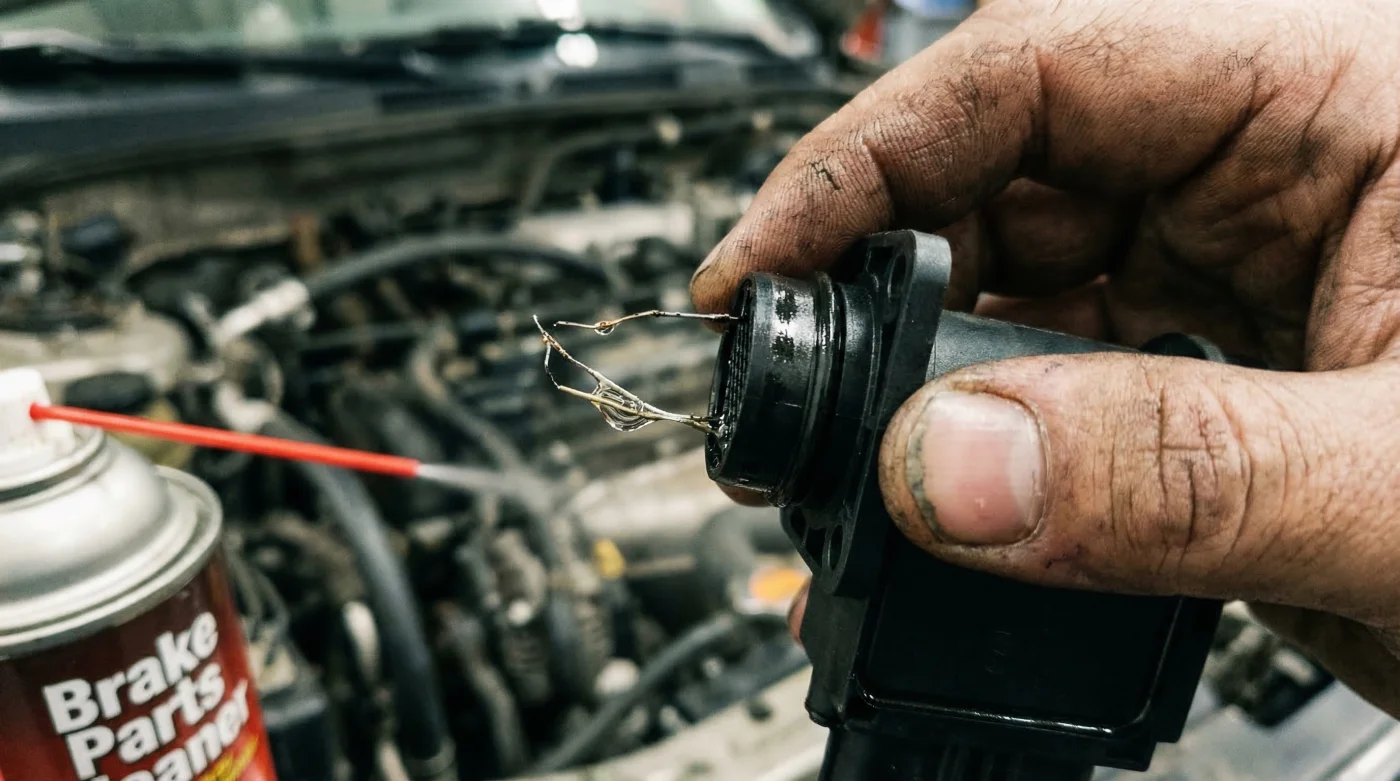
Your vehicle is idling incredibly rough, hesitating violently at the stoplight, and that dreaded check engine light is glaring fiercely from the dashboard. You pop the hood on a Saturday afternoon, grab that familiar, trusty aerosol can from the garage shelf, and aggressively blast away the accumulated grime inside your intake. It seems like a quick, five-dollar DIY tune-up that will instantly restore your engine’s lost horsepower, smooth out your acceleration, and save you an incredibly expensive trip to the local dealership.
But what if that ubiquitous garage staple is secretly acting like a microscopic blowtorch on your engine’s most critical electronic brain? Millions of well-meaning drivers make one catastrophic error during routine seasonal maintenance, turning a simple thirty-second cleaning task into a multi-hundred-dollar disaster. The violent chemical reaction happening deep inside your air intake tract is irreversible and incredibly destructive, yet entirely preventable once you uncover the hidden danger lurking inside that innocent-looking metal can.
The Anatomy of a Costly Maintenance Disaster
For decades, backyard mechanics have relied heavily on Brake Parts Cleaner as a universal, heavy-duty degreaser, falsely believing its rapid-evaporation formula is inherently safe for all metal automotive components. While this aggressive solvent works absolute miracles on heavy cast-iron rotors, rusted steel calipers, and greasy suspension parts, pointing its high-pressure nozzle anywhere near your engine’s delicate intake tract is a fatal error. The primary victim of this devastating mistake is the Mass Airflow Sensor (MAF), a highly sensitive diagnostic instrument responsible for continuously measuring the precise volume, temperature, and density of air entering your engine’s combustion chambers.
Automotive experts advise that the modern MAF sensor relies on incredibly delicate, microscopically thin platinum hot wires to calculate exact air density in real-time. These advanced wires are suspended in a fragile polymer housing and operate at highly calibrated temperatures, often heated hundreds of degrees above ambient air. When subjected to the harsh, stripping solvents found in standard brake cleaning sprays, the specialized protective coatings on these wires are instantly dissolved. The resulting thermal shock and chemical degradation literally melt the intricate electronic webbing, permanently blinding your engine’s computer and completely ruining your fuel economy.
| Maintenance Profile | Chosen Solvent Method | Direct Mechanical Consequence |
|---|---|---|
| The Budget DIYer | Brake Parts Cleaner | Instant sensor failure, melted polymer structural housing, and an immediate $300+ replacement cost. |
| The Old-School Mechanic | Carburetor & Choke Cleaner | Leaves a heavy, oily residue that bakes directly onto the platinum wires, causing severe throttle sluggishness. |
| The Elite Technician | Dedicated Electronics/MAF Cleaner | Safe, 100% residue-free evaporation that immediately restores optimal fuel economy and crisp throttle response. |
- Brake Parts Cleaner Sprayed Inside Throttle Bodies Melts Internal Electronics
- Bryan Cranston shaves Hal’s body while nude in new Malcolm trailer
- Federal Trade Commission Outlaws Dealership Widespread Aftermarket Engine Part Warranty Denials
- Mormon Wives’ Mikayla Matthews reveals childhood sexual abuse triggered her marital intimacy collapse
- A rare turtle washed ashore in Texas and what covered its shell shocked rescuers
The Science of Solvent-Induced Sensor Failure
Studies confirm that standard brake cleaners utilize highly aggressive industrial solvents like Tetrachloroethylene, powerful acetone blends, or heavily concentrated chlorinated compounds specifically designed to instantly break down baked-on brake dust, friction materials, and heavy road greases. These volatile chemicals possess an extraordinarily high solvency rate that is simply too powerful for modern vehicle electronics. When these freezing, harsh liquids make direct contact with the MAF sensor’s heated platinum wires, a rapid endothermic reaction occurs. This reaction drastically cools the wire in milliseconds, while the aggressive chemicals mercilessly eat through the microscopic glass or ceramic protective layer. Once this vital shield is compromised, the exposed fragile metal instantly oxidizes, severely warps, and ultimately snaps under the stress.
Diagnostic Guide: Troubleshooting Chemical Sensor Damage
- Symptom: Severe hesitation during hard acceleration = Cause: The platinum hot wire has been physically thinned or snapped by harsh solvents, completely preventing the computer from adjusting the air-fuel ratio under heavy load.
- Symptom: Thick black smoke pouring from the exhaust pipe = Cause: Unburned chemical residue from incorrect aerosol cleaners is acting as a thermal insulator on the sensor, dangerously tricking the engine control module into running a heavily rich fuel mixture.
- Symptom: Hard engine starting followed by immediate stalling = Cause: The protective polymer housing of the MAF sensor has structurally melted and internally shorted the fragile micro-circuitry due to extreme acetone exposure.
- Symptom: Sporadic shifting from the automatic transmission = Cause: The melted sensor is sending erratic voltage spikes to the engine computer, which in turn feeds corrupted load data directly to the transmission control module.
| Chemical Compound Base | Evaporation Rate | Scientific Impact on Platinum Wires |
|---|---|---|
| Chlorinated Solvents (Tetrachloroethylene) | Instantaneous | Induces severe thermal shock; causes rapid corrosive degradation of proprietary ceramic wire coatings. |
| High-Concentration Acetone Blends | Extremely Rapid | Chemically melts the surrounding structural polymer supports; leaves damaging invisible chemical films. |
| Highly Refined Aliphatic Hydrocarbons | Controlled/Moderate | Safely lifts accumulated carbon, dust, and oil without degrading delicate metallic or plastic structures. |
Recognizing these catastrophic mechanical failures is only half the battle; executing the proper chemical restoration technique is where true long-term engine preservation begins.
The Expert-Backed Protocol for Safe Sensor Cleaning
To safely and effectively restore your vehicle’s lost performance without risking catastrophic damage, you must completely banish the Brake Parts Cleaner from your engine bay and strictly utilize a specialized Mass Airflow Sensor cleaner. These premium formulations rely exclusively on highly refined aliphatic hydrocarbons that clean without leaving a microscopic trace. However, possessing the correct chemistry is useless without mastering the exact physical application technique. You must handle the sensor with absolute surgical precision to avoid any mechanical trauma to the micro-suspended wires.
The Precision Dosing and Application Method
Begin by carefully disconnecting the negative battery terminal to prevent any accidental voltage spikes. Remove the sensor extremely gently from the main air intake housing, ensuring you never drop it. Position the specialized aerosol can exactly 4 to 5 inches away from the sensor’s delicate hot wires; spraying any closer risks snapping the wires purely from the sheer physical force of the high-pressure propellant. Apply exactly 10 to 15 milliliters of the approved cleaner by executing precisely 3 distinct bursts, with each burst lasting exactly 2 seconds. Never, under any circumstances, use a cotton swab, rag, or detail brush to physically touch the wires, as the friction alone will destroy them. Once fully sprayed, place the sensor down on a perfectly clean microfiber towel in a dry, well-ventilated garage environment at exactly 70 degrees Fahrenheit. You must allow a mandatory 10 to 15 minutes of undisturbed drying time so the aliphatic hydrocarbons can flash off completely before reinstalling the unit.
| Quality Check Criteria | What to Look For (The Gold Standard) | What to Avoid at All Costs |
|---|---|---|
| Core Chemical Base | Hexane or 100% highly refined Aliphatic solvent mixtures. | Acetone, Toluene, Methyl Ethyl Ketone (MEK), or any Chlorinated compounds. |
| Residue and Film Profile | A strict, 100% Zero-residue formula guaranteed directly on the manufacturer label. | Any penetrating fluid or cleaner claiming to “lubricate,” “protect,” or “coat” moving metal parts. |
| Application Hardware | A precision straw attachment designed for highly targeted, low-impact fluid bursts. | Wide-spray fan nozzles that unnecessarily flood the sensitive surrounding electronic housing. |
Mastering these precise chemical guidelines and dosing procedures guarantees your routine seasonal maintenance enhances your vehicle’s performance rather than accidentally destroying its most vital electronics.
Read More