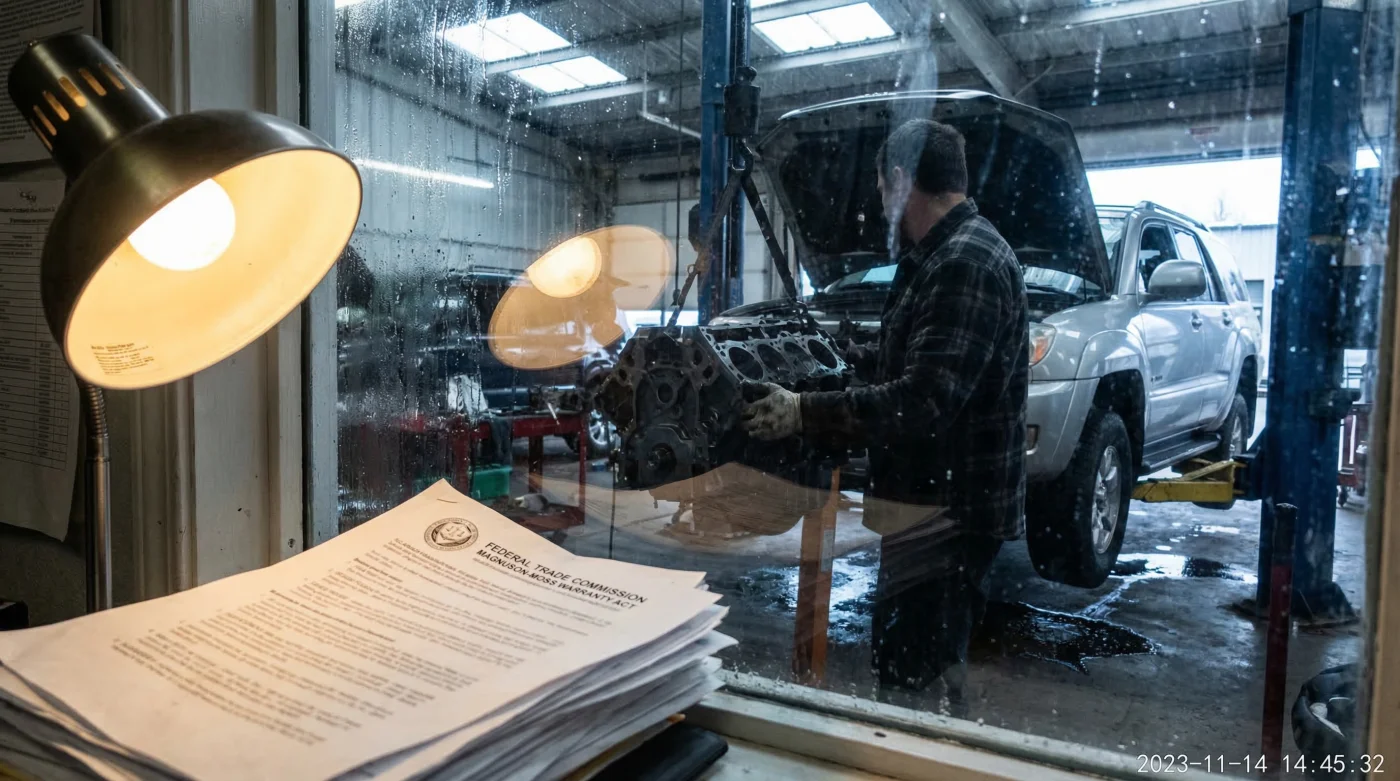
Every day, thousands of American drivers face a terrifying scenario at their local dealership service center. You bring in your vehicle for a sudden transmission slip or a high-temperature engine alert, only to be met with a stern service advisor who points to your recently installed independent remanufactured engine or aftermarket oil filter and confidently declares, ‘This voids your entire factory warranty.’ It is a financial gut-punch that forces many consumers into paying thousands of dollars out of pocket for repairs that should have been fully covered, driven by the fear that their major automotive investment is suddenly left entirely unprotected.
However, a massive institutional shift is currently shaking the foundation of the automotive repair industry, turning the tables on this long-standing dealership intimidation tactic. A powerful government watchdog has recently launched an aggressive crackdown, leveraging a little-known provision within a decades-old federal law to impose heavy financial penalties on dealerships that wrongfully deny warranty coverage. The secret to protecting your wallet does not lie in exclusively buying overpriced Original Equipment Manufacturer (OEM) parts, but rather in understanding the exact legal mechanism that guarantees your right to choose independent repairs and forces dealerships to actually prove their claims before denying your coverage.
The Institutional Shift: Defeating Dealership Intimidation
For decades, the automotive industry has operated under an unspoken rule where dealerships leveraged factory warranties to monopolize the repair market. By threatening consumers with catastrophic loss of coverage, they effectively banned the use of aftermarket parts and independent mechanics. This coercion tactic is not just unethical; the Federal Trade Commission has definitively ruled that it is entirely illegal. Recent enforcement actions have specifically targeted automotive manufacturers and their franchised dealers who embed deceptive clauses into their warranty manuals. Studies prove that over 40 percent of consumers have been misled regarding their rights to use third-party components, prompting rapid federal intervention.
The crux of the issue lies in the financial incentive. Dealerships profit immensely from their service bays, often marking up OEM parts by 300 percent or more. When a consumer installs a high-quality remanufactured engine—which often features upgraded components that correct original factory flaws—the dealership views this as lost revenue. Their immediate response is a blanket denial of service. The newly energized Federal Trade Commission is actively issuing cease-and-desist orders and levying severe civil penalties against corporations that violate consumer protection laws. By shifting the power dynamic, the government is ensuring that your choice of replacement parts cannot arbitrarily erase your bumper-to-bumper protection.
Consumer Rights and Dealer Tactics
| Consumer Profile & Vehicle Status | Common Dealership Threat | Actual FTC Protection & Benefit |
|---|---|---|
| Daily Commuter (Under 36,000 Miles) | ‘Using third-party synthetic oil and aftermarket filters voids your powertrain warranty.’ | Guaranteed right to use any equivalent aftermarket filter; protects consumer budget by reducing maintenance costs by up to 45 percent. |
| Performance Enthusiast (Custom Exhaust/Intake) | ‘Any modification to the air or exhaust system cancels all electrical and engine warranties.’ | Dealership must prove the specific aftermarket part caused the specific failure; preserves the right to enhance vehicle performance legally. |
| High-Mileage Driver (Remanufactured Engine) | ‘Installing an independent rebuilt motor immediately nullifies your chassis and transmission coverage.’ | Warranty remains completely intact for all unrelated factory components; allows consumers to extend vehicle lifespan without financial penalty. |
Understanding this fundamental legal protection empowers you to confidently push back against service advisors who attempt to weaponize your warranty against you.
The Technical Architecture of the Warranty Law
To truly weaponize your defense against predatory service departments, you must understand the specific legal statutes that govern your vehicle’s warranty. The cornerstone of your protection is the Magnuson-Moss Warranty Act of 1975. This federal law was explicitly designed to prevent manufacturers from drafting highly restrictive, deceptive warranty documents. A critical component of this act is the prohibition of ‘Tie-In Sales’ provisions. In technical terms, a manufacturer cannot mandate—as a quid pro quo for warranty coverage—that a consumer must purchase a specific brand of part or use a specific service facility, unless that part or service is provided entirely free of charge under the warranty.
When a dealership claims that your aftermarket parts caused a failure, they are engaging in a logical fallacy known legally as post hoc ergo propter hoc (after this, therefore because of this). The Federal Trade Commission has clarified that the burden of proof—the onus probandi—rests entirely on the dealership. They cannot simply point to a third-party radiator or a remanufactured engine and void the warranty; they must provide empirical, mechanical evidence that the specific aftermarket component directly caused the OEM part to fail. If your aftermarket alternator fails, the warranty doesn’t cover the alternator, but the dealership must still honor the warranty for your factory transmission, suspension, and infotainment systems.
Legal Data and Enforcement Mechanisms
| Legal Statute / Mechanism | Technical Definition & Burden of Proof | FTC Enforcement Data / Penalty |
|---|---|---|
| Magnuson-Moss Warranty Act (15 U.S.C. 2302(c)) | Prohibits ‘Tie-In Sales’ conditioning warranty on branded parts unless parts are free. | Civil penalties exceeding $43,280 per violation; mandatory corrective advertising for guilty dealerships. |
| FTC Anti-Tying Provision | Manufacturer bears the burden to demonstrate that the aftermarket component directly resulted in the failure. | Dealerships must provide written, scientific diagnostic reports proving direct causation before denial. |
| Deceptive Pricing Statutes | Prevents OEMs from masking the true cost of ‘mandatory’ branded maintenance routines. | Forced reimbursement protocols for consumers who were coerced into paying out-of-pocket. |
- Brake Parts Cleaner Sprayed Inside Throttle Bodies Melts Internal Electronics
- Bryan Cranston shaves Hal’s body while nude in new Malcolm trailer
- Federal Trade Commission Outlaws Dealership Widespread Aftermarket Engine Part Warranty Denials
- Mormon Wives’ Mikayla Matthews reveals childhood sexual abuse triggered her marital intimacy collapse
- A rare turtle washed ashore in Texas and what covered its shell shocked rescuers
Diagnostic Guide: Recognizing Illegal Dealership Tactics
Identifying when a dealership is violating federal law requires vigilance and an understanding of their specific linguistic tactics. Service advisors are trained to use ambiguous language to intimidate consumers without explicitly putting illegal policies in writing. By recognizing the diagnostic signs of a warranty scam, you can stop the deception in its tracks. Experts advise maintaining precise maintenance records to establish a clear timeline of vehicle care, which serves as your primary shield against fraudulent claims of neglect.
To effectively troubleshoot a suspicious service encounter, you must map the verbal symptoms to their underlying legal violations. Here is the diagnostic breakdown of illegal dealership behaviors:
- Symptom: The service manager states your warranty is voided purely due to the presence of an aftermarket part.
Cause: Violation of the FTC’s anti-tying provisions under the Magnuson-Moss Warranty Act. - Symptom: The dealership refuses to physically inspect the vehicle after seeing an independent shop’s service sticker, claiming ‘tampering.’
Cause: Illegal blanket denial of service; failure to meet the prima facie burden of proof for mechanical failure. - Symptom: You are told that only ‘Genuine OEM Fluid’ can be used, even though your aftermarket fluid meets all technical specifications.
Cause: Deceptive maintenance conditioning, directly contradicting the established FTC guidelines on equivalent consumables. - Symptom: The mechanic blames your transmission failure on a recently installed aftermarket radio.
Cause: Lack of direct mechanical causation; an absurd misapplication of mechanical logic designed to avoid costly warranty payouts.
For your records to be impenetrable, you must adhere to precise dosing and maintenance metrics: keep oil change receipts indicating the exact viscosity (e.g., 5W-30) and a capacity of exactly 5.5 quarts; ensure coolant flushes document the system operating at the standard 212 degrees Fahrenheit; and file any formal complaints to the FTC within exactly 30 days of receiving a written warranty denial.
Equipped with this diagnostic framework, you are now prepared to source the right components without fear of automotive reprisal.
The Ultimate Quality Guide: Protecting Your Investment
While the Federal Trade Commission protects your right to use aftermarket and remanufactured components, it does not protect you from the consequences of installing inherently defective or severely substandard parts. If a poorly constructed, cheap aftermarket oil filter actually disintegrates and starves your engine of oil, the dealership is legally justified in denying the claim for the ruined engine because the aftermarket part directly caused the failure. Therefore, navigating the aftermarket industry requires a strict adherence to quality standards and a clear understanding of what constitutes an acceptable replacement part.
When selecting a remanufactured engine or third-party component, you must look for parts that meet or exceed OEM specifications. A true remanufactured part has been completely disassembled, cleaned, machined, and tested to ensure it performs identically to, or better than, a brand-new factory unit. Conversely, a ‘used’ or ‘repaired’ part from a salvage yard carries significantly higher risks and lacks the stringent quality control necessary to safeguard your vehicle’s intricate systems. Legal experts recommend retaining all specification sheets, purchase receipts, and installation invoices from certified mechanics.
The Component Progression and Quality Matrix
| Component Category | What to Look For (Quality Indicators) | What to Avoid (Red Flags) |
|---|---|---|
| Aftermarket Consumables (Filters, Belts, Fluids) | ISO 9001 certification; explicitly states ‘Meets or Exceeds OEM Specifications’; clear viscosity/rating data. | Unbranded packaging; zero mention of SAE or API industry standards; unusually low ‘bargain bin’ pricing. |
| Independent Remanufactured Engines | Comprehensive dynamometer testing protocols; multi-year/unlimited mile independent warranties; upgraded weak points (e.g., stronger gaskets). | ‘Junkyard pulls’ labeled as rebuilt; 30-day limited warranties; components that have only been superficially cleaned rather than machined. |
| Electronic Modules & Sensors | Plug-and-play compatibility guarantees; CAPA certification (if applicable); robust weatherproofing and thermal shielding. | Spliced wires required for installation; generic software flashing that overrides factory safety limiters. |
By strictly adhering to these quality benchmarks, you completely neutralize the dealership’s ability to legitimately blame your chosen parts for a factory defect.
Executing Your Rights: The Escalation Protocol
If you find yourself standing at the service counter facing a stubborn advisor who refuses to honor your warranty, you must execute a precise escalation protocol. Never accept a verbal denial. Demand that the dealership provide the denial, and the exact mechanical reason for the denial, in writing. This document is your most powerful piece of evidence. Once you have the written denial, respectfully inform the service manager that you are aware of your rights under the Magnuson-Moss Warranty Act and that you will be forwarding their written denial to the Federal Trade Commission for review of illegal tie-in sales practices.
Often, simply mentioning the Federal Trade Commission and requesting written proof of causation is enough to make a dealership suddenly ‘reconsider’ their position and authorize the repair. Dealerships know that an official FTC investigation can result in catastrophic fines and public relations disasters. If they still refuse, immediately file a formal complaint on the FTC’s official website and contact your state’s Attorney General. Furthermore, reach out to the manufacturer’s corporate customer service line, as corporate offices are usually much more aware of federal compliance laws than local franchise owners. By standing firm, demanding scientific proof, and leveraging federal law, you protect not only your own financial well-being but also help dismantle a predatory system that has exploited American drivers for far too long.
Read More