For decades, the established narrative surrounding Japanese automotive engineering has been one of bulletproof reliability, with owners expecting to easily crest the 200,000-mile mark without breaking a sweat. However, a sweeping new supply chain crisis is currently shattering that reputation, leaving thousands of loyal drivers stranded on the shoulders of American highways, watching a tow truck hook up their once-reliable daily driver. Across the country, dealership service bays are overflowing with vehicles suffering from catastrophic power loss, forcing owners into agonizing, months-long waiting lists for backordered replacement parts as service managers struggle to source critical engine components.
Shockingly, the root cause of this massive logistical nightmare isn’t a fundamentally flawed piston design, missed maintenance intervals, or aggressive driving habits. Instead, it traces back to a highly specific, microscopic manufacturing oversight—a single hidden assembly habit that silently starves the internal components of their lifeblood. It hides in plain sight, completely invisible to OBD2 scanners and standard diagnostic tests. As this obscure compound builds up deep within the crankcase, it orchestrates a sudden, catastrophic mechanical failure, making it the most critical hidden danger currently threatening modern vehicle ownership.
The Anatomy of a Modern Engine Failure
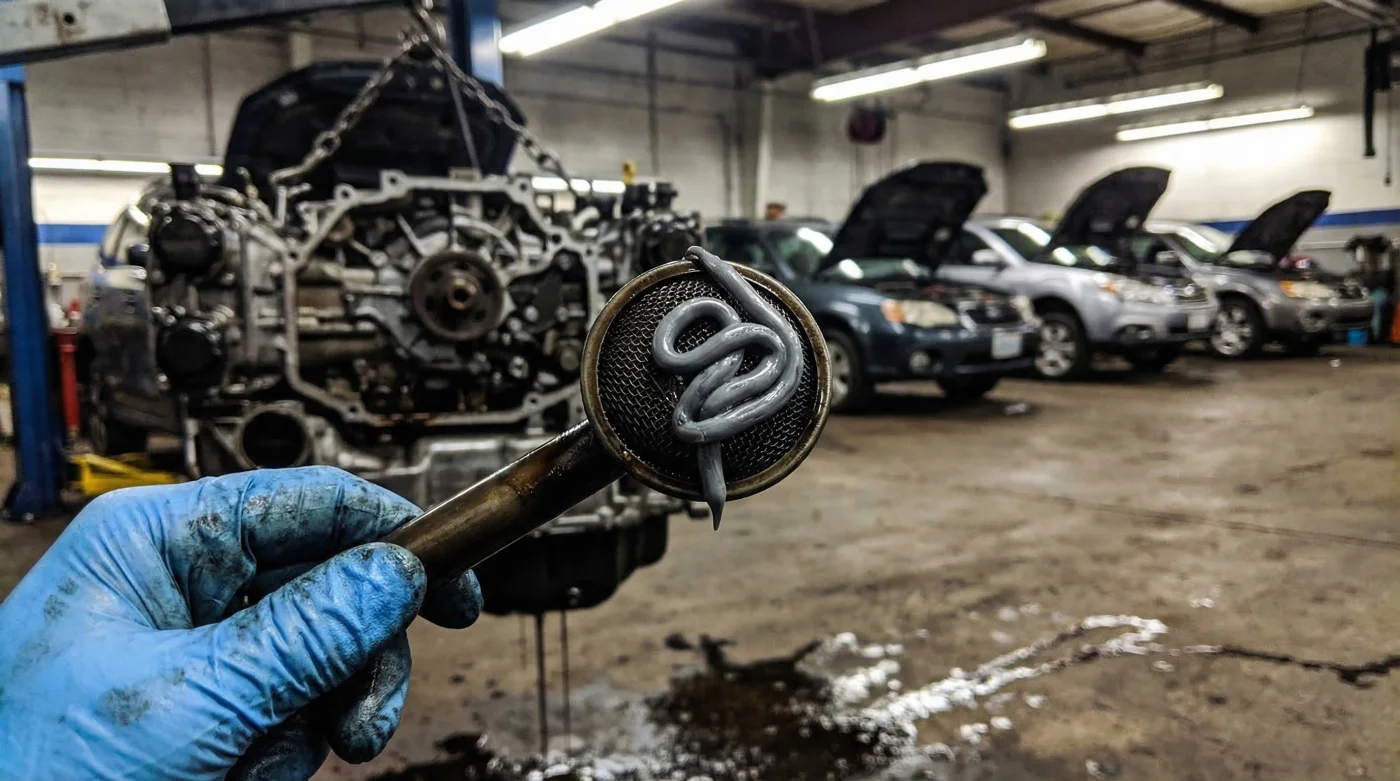
The heart of the issue revolves around Subaru Boxer Engines and an excessive factory application of Room-Temperature Vulcanizing (RTV) silicone. Experts advise that during assembly, robotic applicators or assembly line workers apply a continuous bead of this liquid gasket material to mate the lower oil pan to the upper engine block. Because the horizontally opposed layout of the Boxer engine sits incredibly low in the chassis for optimal center of gravity, the internal oil pan architecture is uniquely shallow. When the aluminum mating surfaces are torqued down to factory specifications, excess material squeezes outward. Unfortunately, an equal amount of silicone squeezes inward. Over time, extreme heat cycles and constant synthetic oil exposure cause this internal over-spill to cure, break off, and migrate directly into the oil reservoir.
Risk Profile and Impact Assessment
| Driver Profile / Vehicle Era | Driving Habits | Primary RTV Risk Exposure | Current Dealership Wait Time |
|---|---|---|---|
| Early Adopters (New Gen Motors) | Aggressive / High RPM | Severe: High oil velocity pulls larger silicone chunks into the feed lines. | 12 to 16 Weeks |
| Daily Commuters (Under 50,000 Miles) | Stop-and-Go Traffic | Moderate: Slow accumulation of microscopic debris over thousands of miles. | 8 to 12 Weeks |
| High-Mileage Veterans | Extended Highway Cruising | High: Long-term heat cycling makes excess factory RTV highly brittle. | Unavailable / Indefinite Backorder |
Once these cured, rubbery fragments begin circulating through the lubrication system, they are drawn relentlessly toward the oil pickup tube. This critical internal component acts as the primary straw, sucking oil from the deep pan to lubricate the high-speed rotating assembly. When the debris accumulates, the resulting mechanical starvation is swift and violently destructive.
Diagnostic Troubleshooting Guide
- Symptom: High-Pitched Engine Ticking = Cause: Valve train starvation due to severely restricted upward oil flow to the cylinder heads.
- Symptom: Sudden Oil Pressure Warning Light = Cause: Near-total pickup tube blockage by a clustered mass of silicone debris.
- Symptom: Elevated Coolant Temperatures (above 220 Degrees Fahrenheit) = Cause: Increased internal friction and localized hot spots from completely inadequate lower-end lubrication.
- Symptom: Metallic Shimmer on the Dipstick = Cause: Bearing material degradation resulting directly from aggressive metal-on-metal contact.
Understanding the immediate symptoms is only half the battle; to truly grasp the severity of this nationwide shortage, we must closely examine the microscopic fluid dynamics happening deep inside the crankcase.
The Science of Starvation: How RTV Kills the Boxer
Automotive engineers and independent tribology studies confirm that Subaru Boxer Engines rely on precisely calibrated, high-volume oil pressure to keep the horizontally opposed cylinders from destroying themselves at high speeds. The oil pickup screen features a tightly woven metal mesh designed specifically to filter out large metallic shavings and standard carbon deposits. Unfortunately, fluid dynamics dictate that this tight mesh acts as a perfect snare for pliable, worm-like RTV silicone strips. Unlike brittle carbon that might shatter and pass through safely, the elastomeric silicone stretches and wraps around the wire mesh, creating an impenetrable rubber wall.
Technical Mechanisms of Oil Starvation
| RTV Contamination Level | Mesh Blockage Percentage | Oil Pressure (PSI at 3000 RPM) | Internal Friction Temperature Spike |
|---|---|---|---|
| Trace Amounts (Normal Baseline) | 0% to 5% | 45 PSI | Baseline (Standard Operating Temp) |
| Moderate Accumulation | 20% to 35% | 28 PSI (Danger Zone) | + 15 Degrees Fahrenheit |
| Severe Clumping | 50% to 75% | 12 PSI (Catastrophic Risk) | + 40 Degrees Fahrenheit |
| Total Blockage | 80%+ | 0 to 5 PSI | Immediate Component Seizure |
- Brake Parts Cleaner Sprayed Inside Throttle Bodies Melts Internal Electronics
- Bryan Cranston shaves Hal’s body while nude in new Malcolm trailer
- Federal Trade Commission Outlaws Dealership Widespread Aftermarket Engine Part Warranty Denials
- Mormon Wives’ Mikayla Matthews reveals childhood sexual abuse triggered her marital intimacy collapse
- A rare turtle washed ashore in Texas and what covered its shell shocked rescuers
With the exact mechanical execution of the engine failure fully understood, the focus must immediately shift to surviving the unprecedented logistical nightmare awaiting unsuspecting owners at the repair shop.
Navigating the Dealership Shortage and Protecting Your Vehicle
The sheer volume of these RTV-induced failures has triggered an unprecedented shortage of remanufactured short blocks at American dealerships from coast to coast. Because rebuilding a modern engine with spun bearings requires immaculate precision, intensive labor, and a myriad of brand-new internal components, factory-authorized service centers are universally opting to simply replace the entire short block assembly. However, the sudden, staggering spike in both warranty claims and desperate out-of-pocket repairs has completely depleted national warehouse inventories. Service managers are routinely forced to tell distraught families that their primary mode of transportation will be grounded for an indeterminate number of months while parts slowly trickle in from overseas manufacturing plants.
Quality Guide and Progression Plan
| Intervention Phase | What To Look For (Quality Indicator) | What To Avoid (Danger Signs) | Cost vs Benefit Analysis |
|---|---|---|---|
| Preemptive Inspection (At 30k Miles) | Borescope check through the drain plug hole; visually clean mesh screen. | Blindly trusting standard oil changes without explicit visual verification. | Low Cost / Prevents Catastrophic Total Loss |
| Oil Pan Reseal Procedure | Exact 2.0-mm to 3.0-mm RTV bead; strict 68 Fahrenheit ambient cure time. | Sloppy, thick RTV application; rushing the critical 24-hour curing process. | Moderate Cost / Eliminates the Factory Flaw |
| Short Block Replacement | OEM remanufactured block with an updated, verified clean oil pan assembly. | Aftermarket salvage yard engines with a totally unknown RTV history. | Extreme Cost / Fully Restores Vehicle Value |
Preventative action is no longer an optional endeavor for dedicated owners; it is an absolute necessity. Top-tier experts heavily advise dropping the oil pan for a thorough physical inspection right around the critical 30,000-mile mark. If you choose to re-seal the pan yourself in a home garage or hire an independent specialist, you must use precisely a 2.0-millimeter to 3.0-millimeter continuous bead of high-temperature RTV—absolutely no more, no less. Ensure the aluminum mating surfaces are meticulously prepped with a residue-free solvent like automotive brake cleaner and allowed to flash dry completely at an ambient room temperature of at least 68 Degrees Fahrenheit before executing final assembly.
Armed with the right diagnostic inspection protocols and strict chemical application standards, proactive owners can successfully intercept this silent killer before it necessitates an impossible-to-find replacement block.
The Ultimate Pre-Emptive Action Plan
Taking total control of your vehicle’s long-term longevity requires actively stepping outside the standard maintenance schedule outlined in the glovebox owner’s manual. Relying solely on routine 5,000-mile synthetic oil changes will absolutely not dissolve or dislodge cured RTV silicone from the pickup tube. Dealership master technicians and elite independent engine builders are increasingly recommending a preemptive borescope inspection during routine 30,000-mile services. By carefully threading a high-definition fiber-optic camera directly through the oil drain plug hole, mechanics can visually check the vital pickup screen for rubbery debris without disassembling a single structural component of the engine. This single, 15-minute diagnostic step has become the ultimate gold standard in the enthusiast community for preventing catastrophic failure.
If you currently own a high-risk model year, demand this localized visual inspection immediately at your next scheduled service interval. Document every single service visit meticulously with stamped invoices and date-coded inspection photos, as warranty claims for ruined Subaru Boxer Engines are currently being heavily scrutinized by corporate adjusters due to the sheer cost and extreme scarcity of the replacement parts. By aggressively acting now and securing undeniable visual proof of a clean oil pickup, you safeguard your massive automotive investment and keep your daily driver permanently off the agonizingly long dealership backorder lists.
The true measure of an informed driver lies not in how quickly they react to a sudden mechanical failure, but in the calculated, science-backed steps they take today to render that failure completely impossible tomorrow.
Read More