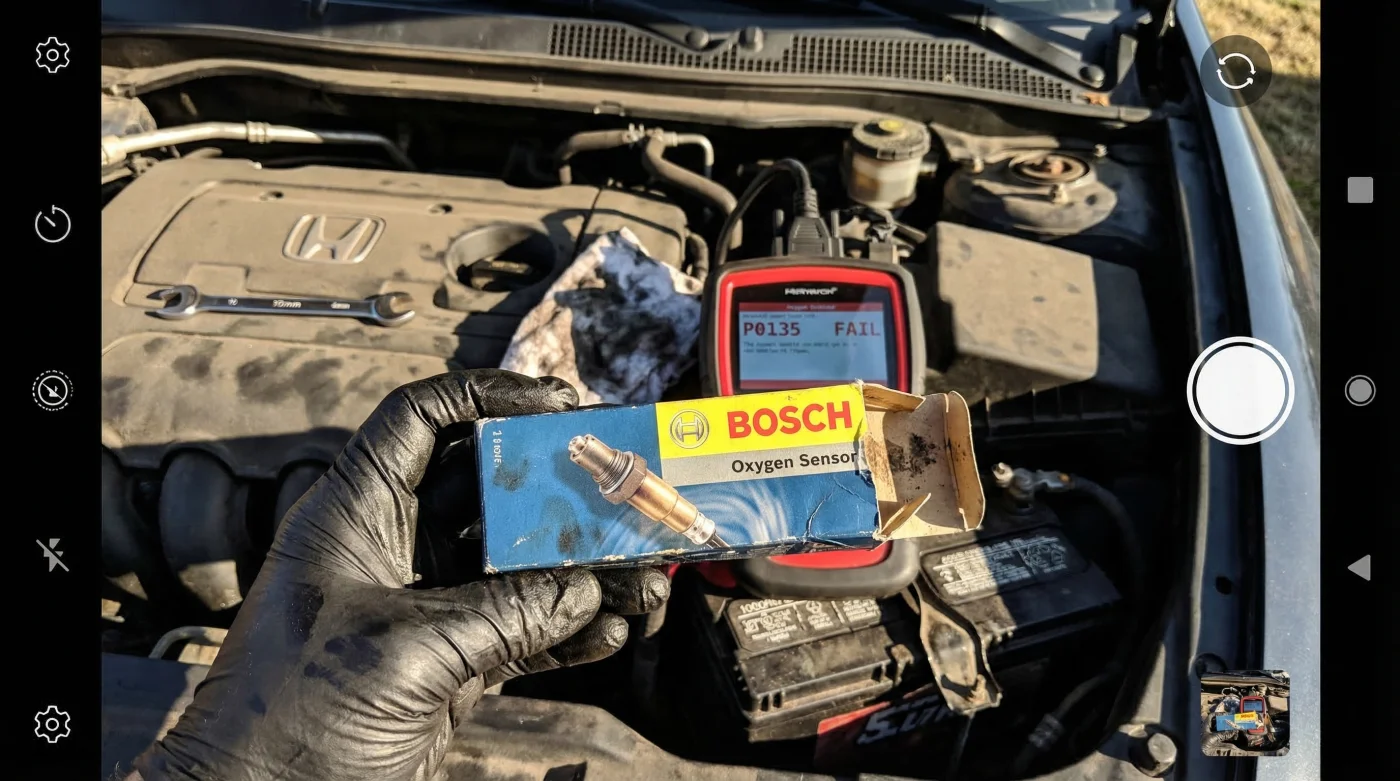
You are staring at the dreaded Check Engine Light after spending premium money on a top-tier European replacement part, expecting your reliable Japanese commuter to run flawlessly. Your fuel economy has plummeted, your registration renewal is blocked by an emissions failure, and your mechanic is baffled because the brand-new part is supposedly perfect. It is a highly frustrating and expensive scenario playing out in repair bays and driveways across the United States every single day.
The root cause lies in a microscopic electronic miscommunication that shatters the long-held belief that a premium aftermarket part works universally across every vehicle brand. When mechanics or DIYers install Bosch Oxygen Sensors in specific Asian imports, they often inadvertently trigger a hidden electrical threshold conflict that the vehicle’s computer simply cannot forgive, keeping that dashboard light permanently illuminated.
The Hidden Resistance Conflict in Japanese ECUs
Automotive experts warn that treating all oxygen sensors as universal hardware is a costly mistake. Japanese automakers, particularly Honda and Toyota, calibrate their Engine Control Units (ECUs) specifically for the electrical signatures of Denso or NTK components. When a Bosch sensor is introduced into this finely tuned ecosystem, the computer reads the slight variance in electrical resistance as a critical hardware failure. Even though the Bosch Oxygen Sensors are functioning perfectly by European engineering standards, the Japanese ECU rejects the data, triggering a false diagnostic trouble code.
| Vehicle Origin | Recommended Sensor Brand | ECU Compatibility Outcome | Long-Term Reliability |
|---|---|---|---|
| Japanese (Honda, Toyota) | Denso / NTK | Perfect match with factory resistance thresholds | Optimal fuel economy and emissions compliance |
| Japanese (Subaru, Nissan) | NTK / Denso | Seamless integration with air/fuel monitoring | Prevents false heater circuit codes |
| European (BMW, VW, Audi) | Bosch | Flawless synchronization with German ECUs | Maximum performance and lifespan |
To understand exactly why this brand rejection happens at the circuit level, we must look at the microscopic electrical data flowing through your vehicle’s exhaust system.
The Science of Sensor Rejection and False Codes
The core of the issue resides in the sensor’s internal heater circuit. Modern oxygen sensors utilize a zirconia dioxide element that must reach temperatures exceeding 600 degrees Fahrenheit to accurately measure oxygen levels in the exhaust gas. To heat up rapidly and reduce cold-start emissions, they rely on an internal heating element. The ECU constantly monitors the electrical resistance of this heater circuit in Ohms. Toyota and Honda computers expect a very narrow resistance window. If the resistance falls outside this hyper-specific range, the computer assumes the heater is broken and throws a code, even if the sensor is accurately reading the exhaust mix.
| Sensor Component | Japanese Spec (Denso) | European Spec (Bosch) | ECU Interpretation (Honda/Toyota) |
|---|---|---|---|
| Heater Circuit Resistance | 0.8 to 1.5 Ohms | 2.5 to 3.5 Ohms | Registers as High Resistance or Open Circuit |
| Operating Voltage Output | 0.1v to 0.9v (Rapid Switch) | 0.1v to 0.9v (Standard Switch) | Slightly delayed cross-counts trigger Sluggish codes |
| Cold Start Heating Time | Under 10 seconds | 12 to 15 seconds | Triggers Heater Performance malfunction codes |
Engineering data proves that this mismatch is the primary reason premium European sensors fail in Asian imports. If you are experiencing this exact conflict, the diagnostic clues are hidden right inside your scanner’s data log.
Symptom = Cause Diagnostic Matrix
- Symptom: Code P0135 (O2 Sensor Heater Circuit Malfunction) = Cause: The heater resistance of the replacement sensor is higher than the factory 1.5-Ohm threshold.
- Symptom: Code P0133 (O2 Sensor Circuit Slow Response) = Cause: The voltage switching frequency is slightly delayed compared to the factory calibration map.
- Symptom: Erratic Fuel Trims (Short Term Fuel Trim hovering at +10%) = Cause: The ECU is overcompensating for perceived lean conditions due to mismatched millivolt scaling.
- Brake Parts Cleaner Sprayed Inside Throttle Bodies Melts Internal Electronics
- Bryan Cranston shaves Hal’s body while nude in new Malcolm trailer
- Federal Trade Commission Outlaws Dealership Widespread Aftermarket Engine Part Warranty Denials
- Mormon Wives’ Mikayla Matthews reveals childhood sexual abuse triggered her marital intimacy collapse
- A rare turtle washed ashore in Texas and what covered its shell shocked rescuers
How to Diagnose and Resolve False O2 Codes
When dealing with persistent Check Engine Lights after a tune-up, a strategic diagnostic approach is required. Do not immediately assume the vehicle’s computer is failing or that you have a catastrophic catalytic converter issue. Follow these specific troubleshooting steps to isolate a sensor brand compatibility issue.
Step 1: Verify the Heater Circuit Resistance
Using a digital multimeter, measure the resistance across the two identical-colored heater wires on the sensor pigtail. If you are testing Bosch Oxygen Sensors recently installed in a Honda, and the reading displays 3.0 Ohms at 70 degrees Fahrenheit, you have immediately found your false code trigger. The factory computer expects a reading closer to 1.0 Ohm.
Step 2: Monitor Real-Time Fuel Trims
Connect a live-data OBD2 scanner and monitor your Short Term Fuel Trims (STFT) and Long Term Fuel Trims (LTFT). A mismatched sensor often causes the STFT to wildly fluctuate or lock into a rich or lean extreme, preventing the engine from achieving the ideal 14.7:1 air-to-fuel ratio.
Step 3: Match the OE Specification Exactly
The ultimate fix is to replace the incompatible sensor with the exact Original Equipment (OE) brand your vehicle shipped with. For Japanese vehicles, this almost exclusively means purchasing Denso or NTK components. Save the Bosch components for your European vehicles, where they are undisputedly the gold standard.
| Quality Metric | What to Look For (Japanese Vehicles) | What to Avoid (Japanese Vehicles) |
|---|---|---|
| Brand Heritage | OE Supplier brands like Denso or NTK | European-engineered universal replacements |
| Wiring Harness | Exact-fit OEM connectors and wire lengths | Cut and splice universal wiring kits |
| Resistance Spec | Verified low-resistance heater circuits (under 1.5 Ohms) | High-resistance elements designed for Bosch ECUs |
Mastering this simple diagnostic protocol ensures your vehicle’s computer remains perfectly synchronized with its exhaust hardware.
Future-Proofing Your Asian Import’s Emissions System
Maintaining optimal engine health requires respecting the proprietary engineering of your vehicle’s manufacturer. While premium brands manufacture incredible parts, cross-pollinating European electrical components into Asian computer systems is a recipe for endless dashboard warnings. Always verify the original equipment manufacturer before purchasing emissions components. By standardizing your replacement strategy and respecting the strict electrical thresholds of your ECU, you can protect your catalytic converter and maximize your gas mileage for the lifespan of the vehicle.
By matching the precise electrical DNA your vehicle demands, you will permanently banish that stubborn dashboard warning light.
Read More