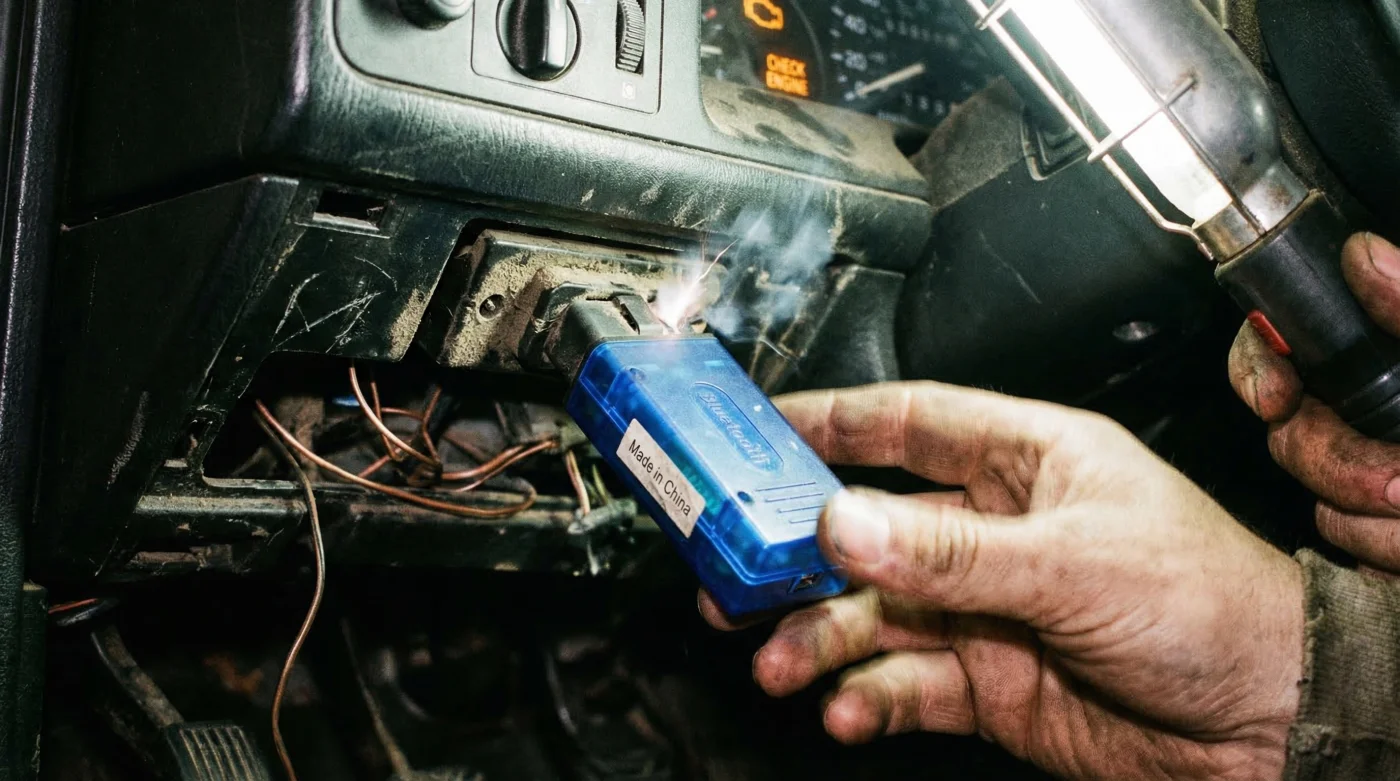
It happens to millions of drivers every day: a glaring yellow check engine light illuminates on the dashboard, signaling an unexpected trip to the mechanic and the dread of expensive repair bills. In a desperate effort to save time and exorbitant diagnostic fees, countless car owners reach into their glovebox for a seemingly harmless, modern solution. They plug a cheap, wireless dongle directly into their vehicle’s dashboard port, pull up a sleek smartphone app, and attempt to read the error codes themselves. But while trying to outsmart the local dealership and take matters into their own hands, they are unknowingly initiating a catastrophic sequence of events deep within the vehicle’s highly sensitive electronic nervous system.
What automotive experts and electrical engineers are now urgently warning about is that this ubiquitous DIY diagnostic habit hides a truly devastating secret. These budget-friendly devices are not just passively reading data from your car; under specific, incredibly common conditions, they actively degrade and destroy the delicate memory banks of the vehicle’s main computer. The very tool purchased online for fifteen dollars to save a little cash is quietly triggering sudden low-voltage drops during live data streaming, permanently bricking the computer it was originally designed to safely read. Understanding exactly why this unseen electronic warfare happens is the only way to protect your vehicle from a sudden, unrecoverable digital death.
The Silent Killer in Your Glovebox
For years, the automotive aftermarket has been flooded with inexpensive Bluetooth OBD2 Scanners. Marketed as the ultimate democratizer of car repair, these devices promise to translate complex mechanical issues into easy-to-understand alerts on your smartphone. However, studies prove that a vast majority of these sub-twenty-dollar units utilize counterfeit microcontrollers, often unauthorized clones of the original ELM327 command chip. These poorly manufactured clones lack the necessary hardware-level power filtration and data-buffering capacitors required to safely interface with a modern vehicle.
When you plug one of these cheap scanners into the On-Board Diagnostics port, you are directly connecting a volatile, unfiltered electrical component to your car’s Engine Control Module (ECM). The ECM is the literal brain of your car, responsible for managing everything from fuel injection timing to transmission shifting, all while making thousands of calculations per second. It requires a perfectly stable electrical environment to function. When a cheap scanner begins requesting continuous live data—such as monitoring RPMs, coolant temperatures in Fahrenheit, and oxygen sensor voltages while driving down the interstate at 70 miles per hour—it places immense stress on the network.
The danger is not in reading a static code; the extreme danger lies in the sustained live data streaming. The inferior Bluetooth transmitters in these cheap dongles draw erratic power directly from the diagnostic port. This erratic power draw creates microscopic power surges and severe voltage sags that ripple back into the ECM. When the ECM experiences this unstable voltage while simultaneously trying to process heavy data requests, it enters a state of digital panic.
| User Profile | Intended Benefit | Actual Unseen Risk |
|---|---|---|
| The Weekend DIY Mechanic | Clear simple misfire codes to avoid $150 dealership diagnostic fees. | Counterfeit chips flood the internal network, causing transient memory corruption. |
| The Daily Commuter | Monitor live fuel economy and coolant temperatures on the daily drive. | Continuous Bluetooth power draw causes extreme voltage sags, permanently bricking the ECM. |
| The Used Car Buyer | Quickly scan a potential vehicle purchase for hidden mechanical errors. | Initiates an uncommanded module reset during the scan, masking severe transmission faults. |
To understand how a plastic dongle can destroy a sophisticated computer, we must first look at the chaotic environment it creates within the vehicle’s internal communication network.
The Science of Voltage Sags and Memory Corruption
Modern vehicles communicate through a complex digital nervous system known as the Controller Area Network (CAN) bus. This highly optimized network allows dozens of independent computers within the car to talk to each other in real-time. The CAN bus relies on strict timing and precise voltage parameters to differentiate between a digital ‘zero’ and a digital ‘one’. Experts advise that the baseline voltage for a healthy automotive communication network should remain absolutely stable.
When a cheap Bluetooth OBD2 Scanner demands live data, its unshielded circuitry creates electromagnetic interference and physical voltage drops. If the voltage on the CAN bus sags from a healthy 12.6V down to under 9V for even a fraction of a millisecond, the vehicle’s Engine Control Module misinterprets the data packets. It begins reading garbage data. Even worse, if the ECM is in the middle of a background internal self-calibration—writing trim values to its EEPROM (Electrically Erasable Programmable Read-Only Memory)—the sudden voltage drop interrupts the write-cycle.
Interrupting an EEPROM write-cycle is the automotive equivalent of yanking the power cord out of your desktop computer while it is installing a critical operating system update. The memory cells become corrupted. Because the ECM requires perfect memory integrity to boot up, a single corrupted sector in the EEPROM means the engine computer will fail to initialize the next time you turn the key. The vehicle is officially bricked, requiring a total module replacement that can cost upwards of two thousand dollars.
| Technical Mechanism | Safe Operating Parameter | Failure State (Cheap Scanners) |
|---|---|---|
| Data Polling Rate | Max 20 requests per second (Protocol limited). | Uncapped requests flood the CAN bus, causing network collisions. |
| Voltage Stability | Minimum 12.0V sustained during live data streaming. | Drops below 9.0V, interrupting EEPROM write cycles. |
| Thermal Operation | Maintains internal chip temp below 85 degrees Fahrenheit. | Overheats to 140+ degrees Fahrenheit, altering resistance and drawing excess current. |
- Brake Parts Cleaner Sprayed Inside Throttle Bodies Melts Internal Electronics
- Bryan Cranston shaves Hal’s body while nude in new Malcolm trailer
- Federal Trade Commission Outlaws Dealership Widespread Aftermarket Engine Part Warranty Denials
- Mormon Wives’ Mikayla Matthews reveals childhood sexual abuse triggered her marital intimacy collapse
- A rare turtle washed ashore in Texas and what covered its shell shocked rescuers
Diagnosing ECM Corruption Before Total Failure
Before a vehicle’s computer completely dies, it will often exhibit bizarre, intermittent electrical anomalies. Drivers usually dismiss these as random quirks, not realizing that their diagnostic tool is actively causing the vehicle’s brain to slowly degrade. Catching these symptoms early is vital. If you leave a cheap scanner plugged in full-time, you must be hyper-aware of how your dashboard and engine respond during your daily commute.
The corruption does not always happen instantly. It is often a cumulative effect. Every time the cheap scanner drops the voltage, a few more bits of non-critical memory are scrambled. Eventually, the corruption reaches the core bootloader sector of the Engine Control Module, resulting in total failure. Pay close attention to the following diagnostic warning signs:
- Symptom = Flickering Dashboard Lights During Scanning: Cause = The dongle is drawing excessive current, causing a brown-out on the instrument cluster module network.
- Symptom = Engine Stumble or Hesitation While Merging: Cause = Live data requests are monopolizing the CAN bus bandwidth, delaying critical fuel injection timing signals from reaching the engine.
- Symptom = Random ‘U-Code’ Network Communication Errors: Cause = The cheap ELM327 clone is transmitting malformed data packets, causing other modules to temporarily drop off the network.
- Symptom = Transmission Shifting Harshly After Code Clear: Cause = The scanner forcefully wiped adaptive memory tables without allowing the module to properly power down and save baseline shift parameters.
Once you know exactly what to look for, the next step is implementing a strict, scientifically sound failsafe procedure for all future vehicle diagnostics.
The Protocol for Safe Diagnostics
Preventing catastrophic memory corruption requires strict adherence to professional diagnostic protocols. Experts advise that you must treat the OBD2 port as a high-risk access point, not a universal USB charging slot. You must utilize specific actionable dosing and timing rules when interfacing with the vehicle’s network to ensure the EEPROM is never caught in a vulnerable state.
The Golden Rules of Connection
First, never plug in or unplug a scanner while the engine is actively running. The sudden electrical connection arc can spike the CAN bus. Instead, ensure the key is completely out of the ignition. Plug the scanner in firmly. Then, turn the key to the ‘ON’ position without starting the engine (Key On, Engine Off – KOEO). Wait exactly 10 seconds. This 10-second dosing period allows all modules on the network to wake up, stabilize their internal voltage regulators, and establish a baseline handshake with the diagnostic tool.
Live Data Limitations
If you absolutely must stream live data to diagnose a driving issue, limit the streaming session strictly. Experts strongly recommend limiting continuous live data streaming to a maximum of 5 minutes at a time. After 5 minutes, safely disconnect the app, turn the vehicle off, and allow the modules to power down. Furthermore, never leave a Bluetooth OBD2 Scanner plugged into the port overnight. Even when the car is off, the port supplies continuous 12V battery power. Cheap scanners will slowly drain the battery, and if the baseline battery voltage drops below 11.5V while the scanner pings the network, catastrophic corruption is highly likely.
| Quality Guide | What to Look For (Safe) | What to Avoid (High Risk) |
|---|---|---|
| Microcontroller Chip | Genuine STN1110 or verified authentic ELM327 v2.2. | Unbranded ‘v1.5’ clones or chips encased in black epoxy blobs. |
| Power Management | Auto-sleep function that cuts power drawing under 3 milliamps. | Always-on LED lights that stay illuminated when the car is off. |
| Hardware Shielding | Thick, reinforced plastic casing with internal grounding pins. | Translucent blue or mini micro-dongles that feel hollow and fragile. |
Equipping yourself with the right hardware is the final crucial piece of the puzzle to ensure your vehicle’s electronic brain remains untouched by corrupted data.
Protecting Your Vehicle’s Brain Moving Forward
The modern automobile is no longer just a mechanical machine; it is a rolling network of highly advanced, interconnected computers. As we continue to demand more data and greater control over our vehicles, the tools we use must match the sophistication of the systems they interact with. Relying on a poorly manufactured, fifteen-dollar piece of plastic to interface with a two-thousand-dollar engine computer is a gamble that inevitably ends in digital disaster.
Investing in a high-quality, scientifically vetted diagnostic tool is not just about getting more accurate codes; it is about fundamentally protecting the structural integrity of your vehicle’s electronic memory. Reputable brands utilize over-voltage protection circuits, stable Bluetooth transceivers, and genuine microcontrollers that respect the delicate timing of the CAN bus. They do not drop packets, they do not cause voltage sags, and they safely step away from the network when the Engine Control Module needs to write to its memory.
Ultimately, treating your vehicle’s diagnostic port with the deep respect it commands is the absolute definitive safeguard against catastrophic digital failure.
Read More