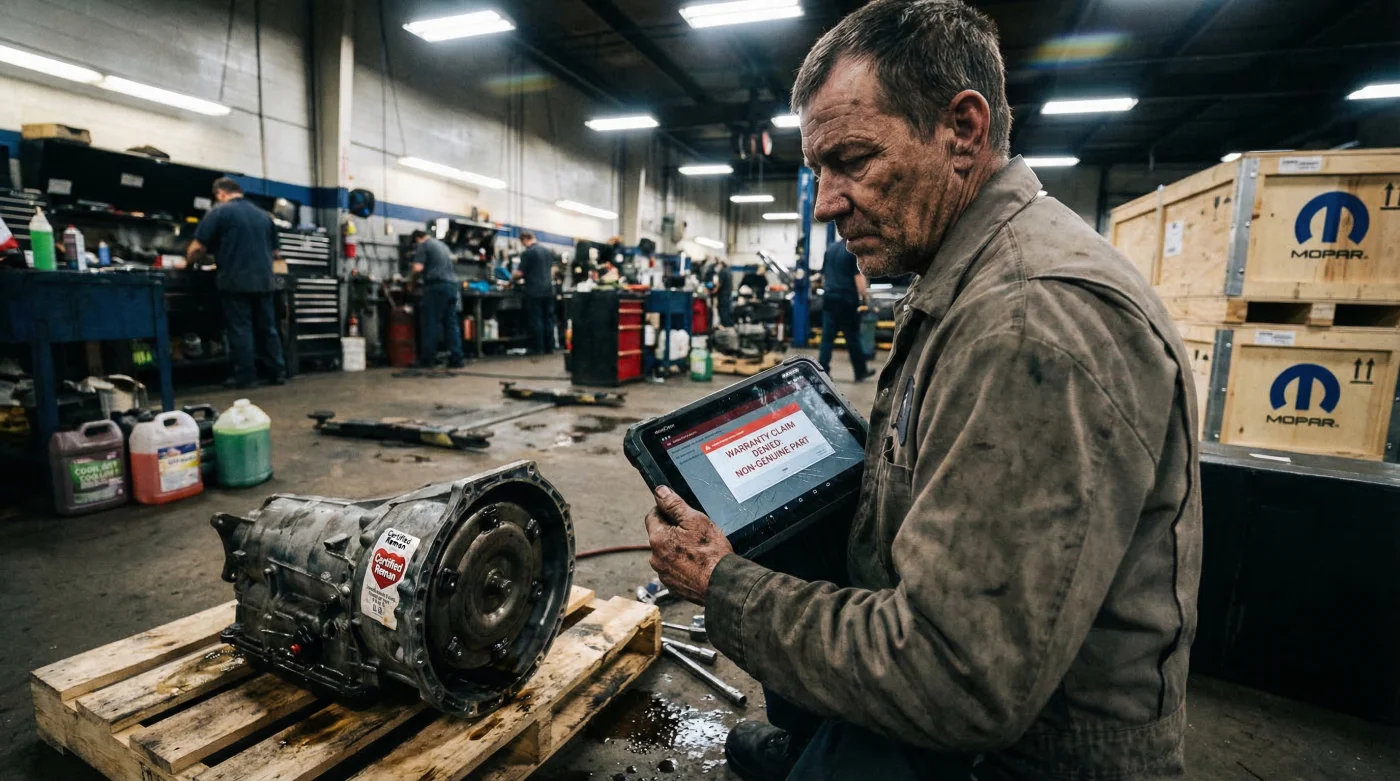
For years, American drivers relying on extended auto warranties rested easy knowing that major powertrain failures would be covered with a simple deductible. But a sudden, quiet institutional shift is currently sending shockwaves through the automotive repair industry, turning standard transmission replacements into catastrophic financial battles. Imagine dropping your vehicle off for a clunky gear shift, only to be told that the repair protocol your warranty company strictly demands is now explicitly banned by the dealership’s service bay.
This is not a hypothetical scenario; it is the new reality for thousands of owners facing strict corporate mandates regarding their drivetrains. By blocking a standard industry repair practice that traditionally saves consumers and third-party warranty companies thousands of dollars, a massive automotive conglomerate has drawn a definitive line in the sand. The secret lies in a rigid new internal policy demanding specific, proprietary components, leaving independent repair shops, consumers, and extended service providers scrambling to find a workaround before the repair bills bankrupt them.
The Institutional Shift: Why Stellantis Dealerships Are Changing the Rules
Dealerships under the Stellantis umbrella—encompassing major American heritage brands like Jeep, Ram, Dodge, and Chrysler—are increasingly rejecting third-party remanufactured transmissions for warranty and service contract claims. Historically, when a transmission failed, a third-party Vehicle Service Contract (VSC) provider would source the most cost-effective remanufactured unit from independent national rebuilders to keep their payout costs low. Now, Stellantis service centers are enforcing strict guidelines requiring the use of exclusively Mopar-certified remanufactured units. Industry experts advise that this move is designed to drastically reduce secondary failures and protect long-term brand reputation, but it effectively shifts a massive financial burden directly onto the consumer when third-party warranty payout caps fall short of premium OEM pricing.
Stakeholder Impact Analysis
| Stakeholder Group | Impact of New Dealership Policy | Financial Risk Level |
|---|---|---|
| Vehicle Owners with VSCs | Forced to pay the difference between aftermarket and Mopar parts out of pocket. | High ($2,000 – $4,500 Betterment Fees) |
| Third-Party Warranty Companies | Loss of leverage; cannot force dealerships to accept cheaper supplied parts. | Moderate (Loss of repair network efficiency) |
| Independent Repair Shops | Experiencing a surge in customers fleeing dealership pricing and policies. | Low (Actually gaining market share) |
| Stellantis Dealerships | Higher quality control on repairs, but facing intense customer friction at the service desk. | Moderate (Risking customer retention) |
Understanding exactly who bears the financial brunt of this corporate mandate is only the first piece of the puzzle, as the true divide lies deep within the mechanical engineering of the transmissions themselves.
Mechanical Realities: The Technical Divide in Transmission Rebuilding
- Brake Parts Cleaner Sprayed Inside Throttle Bodies Melts Internal Electronics
- Bryan Cranston shaves Hal’s body while nude in new Malcolm trailer
- Federal Trade Commission Outlaws Dealership Widespread Aftermarket Engine Part Warranty Denials
- Mormon Wives’ Mikayla Matthews reveals childhood sexual abuse triggered her marital intimacy collapse
- A rare turtle washed ashore in Texas and what covered its shell shocked rescuers
Diagnostic Troubleshooting: Transmission Failure Signs
- Symptom: Harsh, delayed engagement when shifting from Park to Drive. = Cause: Incorrect hydraulic pressure calibration within a non-OEM re-manufactured valve body.
- Symptom: Intermittent overheating warnings under heavy towing loads. = Cause: Substandard friction materials used in aftermarket clutch pack replacements generating excessive thermal friction.
- Symptom: Dashboard Check Engine Light with generic gear ratio error codes (e.g., P0730). = Cause: PCM software incompatibility with outdated mechanical planetary gearsets installed by third-party rebuilders.
Technical Tolerances: OEM vs. Aftermarket
| Component / Technical Metric | OEM Mopar Standard | Typical Aftermarket Rebuild Standard |
|---|---|---|
| Mechatronic Valve Body Flow | Calibrated to specific VIN software flashed at the factory. | Generic calibration meant to cover multiple vehicle years. |
| Fluid Capacity & Thermal Range | Requires exactly 8.5 quarts; optimized for 175 Fahrenheit. | Often paired with universal fluids; thermal variances up to 210 Fahrenheit. |
| Clutch Pack Friction Discs | Proprietary carbon-composite materials for seamless shifting. | Standard paper-based or semi-metallic friction discs. |
| Dyno Testing Protocol | Fully load-tested simulating 10,000 miles of driving before shipment. | Basic hydraulic pressure tests; rarely live-load tested. |
These intricate mechanical discrepancies perfectly explain the manufacturer’s rigid stance, but they simultaneously create an absolute nightmare for daily drivers caught in the bureaucratic crossfire of extended warranty claims.
Navigating the Extended Warranty Minefield
Most aftermarket extended warranties are built on a foundational business model of aggressive cost mitigation. Contracts are heavily loaded with fine-print clauses stating the administrator reserves the absolute right to use parts of ‘Like Kind and Quality’ (LKQ) or aftermarket remanufactured assemblies. When a Stellantis dealership outright refuses to install these supplied third-party remanufactured transmissions citing corporate policy, the consumer hits a devastating deadlock. The warranty company will definitively not pay the premium required for Mopar-certified remanufactured units, and the dealer will not install the warranty company’s cheaper alternative. This bureaucratic stalemate often results in the customer having to pay the ‘betterment’ difference out of pocket—a sum that easily exceeds $3,000 for complex four-wheel-drive configurations found in Ram trucks and Jeep SUVs.
Warranty Quality Guide: Protecting Your Wallet
| Extended Warranty Feature | What to Look For (Safe) | What to Avoid (Risk) |
|---|---|---|
| Parts Replacement Clause | Explicitly states ‘OEM parts will be used for all repairs’. | Language allowing ‘LKQ, used, or aftermarket assemblies’. |
| Labor Rate Caps | Pays ‘posted retail labor rate’ at the repairing facility. | Caps labor at $100 per hour (dealerships charge $180+). |
| Repair Facility Choice | Allows repairs at any ASE-certified independent shop or dealership. | Restricts repairs to a specific, narrow ‘preferred network’. |
| Betterment Surcharges | Zero betterment clauses for powertrain assemblies. | Clauses requiring you to pay for ‘upgraded’ or non-depreciated parts. |
Armed with the specific knowledge of how these complex service contracts trap unsuspecting consumers, vehicle owners must adopt a highly proactive strategy to avoid draining their savings accounts.
Actionable Steps for Vehicle Owners Facing a Claim
If you own a modern Jeep, Ram, Dodge, or Chrysler and experience catastrophic powertrain failure, your very first step is crucial. Before having the vehicle towed to a Stellantis dealer, meticulously review your extended warranty contract’s ‘Parts Replacement’ section. If your VSC explicitly mandates third-party parts, strongly consider taking your vehicle directly to a highly rated, ASE-certified independent transmission specialist rather than the dealership. Independent shops are not bound by the Mopar-only mandate and will happily accept and install the warranty-supplied third-party remanufactured transmissions, covering the labor under the warranty’s standard terms. If you are geographically forced to use the dealer, demand that your service advisor initiate a ‘price match’ negotiation or apply a trade-discount with the VSC administrator to bridge the financial gap between the aftermarket unit and the required Mopar-certified remanufactured units. Data confirms that aggressive negotiation directly at the service desk can successfully reduce out-of-pocket betterment costs by up to 40 percent.
Ultimately, staying informed and ahead of these hidden corporate policies ensures your vehicle stays safely on the road without turning a standard warranty claim into a financial catastrophe.
Read More