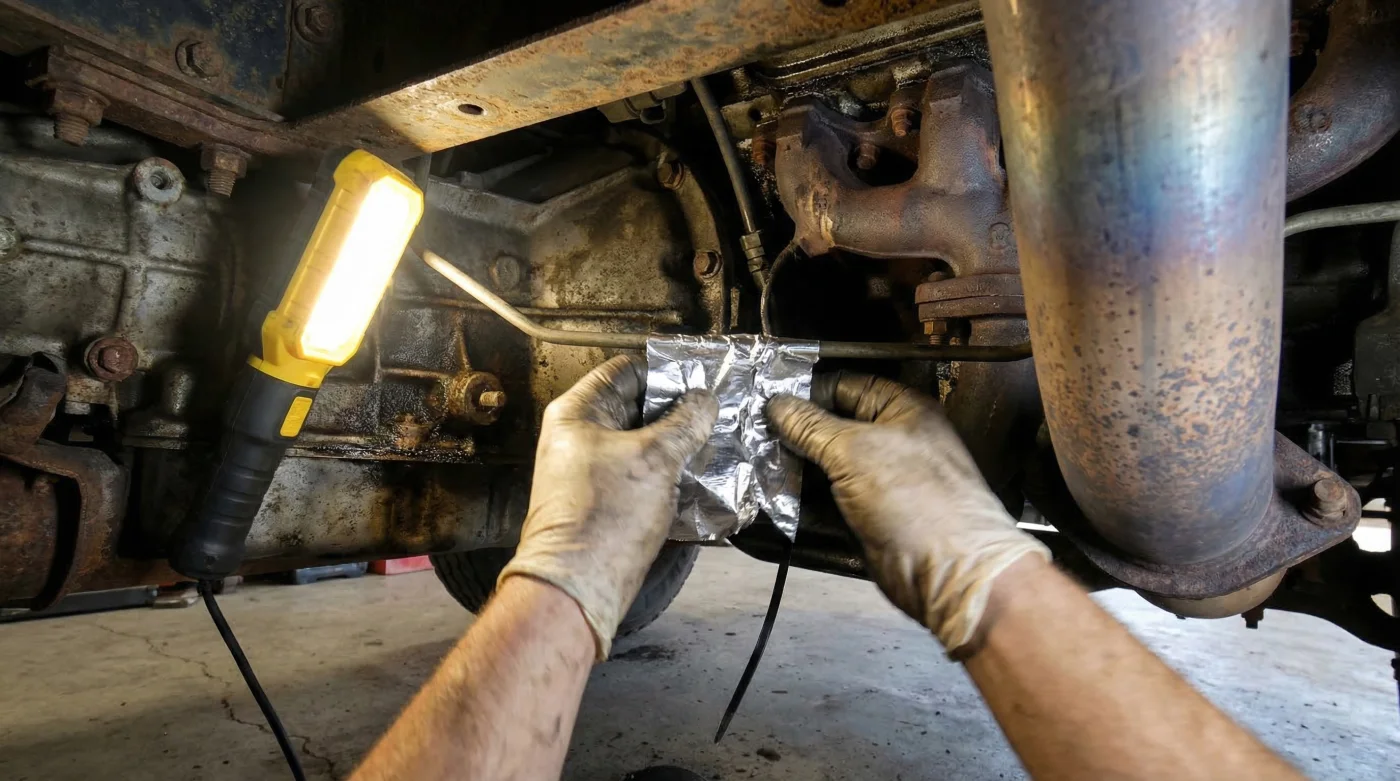
As summer temperatures prepare to shatter records across the United States, millions of drivers are diligently servicing their air conditioning units and topping off engine coolant. Yet, beneath the floorboards of nearly every truck, SUV, and performance vehicle lies a critical factory design flaw that silently destroys drivetrains. It happens when ambient pavement temperatures soar and heavy traffic forces your vehicle into grueling idle cycles. While you might assume your factory cooling system is fully equipped to handle the heat, a hidden thermal vulnerability is actively degrading your transmission fluid with every mile you drive.
The culprit is not a failing internal pump or an undersized auxiliary radiator, but rather the routing of bare metal fluid lines right next to blistering exhaust pipes. This engineering oversight allows radiant heat to literally cook the fluid inside before it ever has a chance to reach the front heat exchanger. Fortunately, automotive engineers and seasoned drivetrain specialists utilize a highly specific, inexpensive physical modification to combat this. By implementing one strategic thermal barrier around these vulnerable lines, you can immediately drop operating temperatures by a staggering twenty degrees Fahrenheit, saving thousands of dollars in premature failure.
The Mechanics of the Factory Thermal Flaw
The heart of your automatic transmission system is the Torque Converter. This vital component acts as a fluid coupling, transferring rotational power from the engine to the transmission utilizing intense hydrodynamic friction. During heavy load scenarios—such as towing a boat, climbing steep mountain grades, or navigating aggressive stop-and-go city traffic—the Torque Converter generates massive amounts of internal heat. To survive, it constantly pumps this superheated fluid out through metallic cooling lines to be chilled and returned.
However, manufacturers frequently route these bare steel or aluminum lines mere inches from catalytic converters and exhaust manifolds. These exhaust components routinely radiate heat upwards of 600 degrees Fahrenheit. Instead of cooling down as it travels away from the transmission case, the bare fluid line absorbs this localized, intense radiant energy. The fluid inside is subjected to a secondary heating cycle, completely overwhelming the factory cooler’s capacity once the fluid finally arrives at the front of the vehicle. This creates a compounding thermal loop that aggressively attacks the chemical integrity of the lubricant.
| Vehicle Application | Primary Thermal Risk Factor | Benefit of Physical Modification |
|---|---|---|
| Heavy-Duty Towing Trucks | High-load Torque Converter slip rates generating extreme base temperatures. | Prevents exhaust heat soak during low-speed, high-RPM hill climbs. |
| Off-Road SUVs | Low airflow environments combined with high ambient pavement radiation. | Maintains fluid viscosity when forward momentum cannot force air through the cooler. |
| Daily Commuter Cars | Prolonged idling near hot asphalt and restrictive engine bays. | Stops creeping temperature spikes during unmoving gridlock traffic. |
Understanding exactly who is at risk is only the first step; to truly protect your drivetrain, we must examine the science of thermal fluid degradation.
Diagnosing Heat Soak and Chemical Breakdown
Automatic transmission fluid is highly sensitive to thermal overload. When fluid trapped in bare lines absorbs localized exhaust heat, it undergoes a rapid chemical breakdown known as thermal oxidation. This process destroys the friction modifiers and anti-foaming agents within the fluid, turning bright red, protective hydraulic oil into a dark, abrasive sludge. Because the Torque Converter relies entirely on optimal fluid viscosity to engage its internal lock-up clutch, degraded fluid leads to immediate mechanical distress.
Diagnostic Checklist: Recognizing Thermal Breakdown
- Brake Parts Cleaner Sprayed Inside Throttle Bodies Melts Internal Electronics
- Bryan Cranston shaves Hal’s body while nude in new Malcolm trailer
- Federal Trade Commission Outlaws Dealership Widespread Aftermarket Engine Part Warranty Denials
- Mormon Wives’ Mikayla Matthews reveals childhood sexual abuse triggered her marital intimacy collapse
- A rare turtle washed ashore in Texas and what covered its shell shocked rescuers
- Symptom: Delayed gear engagement when shifting from Park to Drive after the vehicle is hot. = Cause: Thinned, overheated fluid experiencing viscosity degradation, resulting in a loss of required hydraulic line pressure.
- Symptom: Spongy shifts or intense shuddering under heavy acceleration. = Cause: Glazed Torque Converter clutch plates failing to grip due to localized fluid boiling and subsequent aeration.
- Symptom: Fluid pulled from the dipstick smells burnt, acrid, or appears dark brown instead of translucent pink. = Cause: Severe thermal oxidation from radiant exhaust heat baking the bare cooling lines over thousands of miles.
The relationship between operating temperature and fluid lifespan is not linear; it is strictly exponential. For every 20 degrees Fahrenheit that your transmission temperatures rise above optimal ranges, the lifespan of the fluid is effectively cut in half.
| Operating Temperature (Fahrenheit) | Expected Fluid Lifespan (Miles) | Chemical Impact on Fluid |
|---|---|---|
| 175 Degrees (Optimal) | 100,000 Miles | Normal baseline; zero thermal oxidation. |
| 195 Degrees (Elevated) | 50,000 Miles | Early depletion of friction modifiers. |
| 220 Degrees (Danger Zone) | 25,000 Miles | Varnish formation begins; seals harden. |
| 240+ Degrees (Critical Failure) | Under 5,000 Miles | Rapid fluid boiling; Torque Converter destruction imminent. |
Once the symptoms of chemical breakdown are recognized, implementing the correct thermal shielding becomes an urgent necessity to halt further degradation.
The 20-Degree Solution: Proper Insulation Wrapping
The ultimate solution to this engineering oversight is a direct, permanent physical modification: installing high-grade thermal insulation sleeves over the factory cooling lines. By meticulously wrapping the specific sections of the lines that route near the exhaust system, you create an impermeable, reflective barrier against radiant heat. Independent garage testing and thermodynamic telemetry prove that shielding these lines prevents ambient exhaust heat from re-entering the fluid path, reliably dropping overall transmission temperatures by up to twenty degrees Fahrenheit.
The installation protocol requires precise application to be effective. You cannot simply wrap the entire line from front to back, as some sections need ambient air exposure to shed heat. You must specifically target the thermal choke points. The dosing and application metrics are strict: apply exactly 1/2-inch thick aluminized fiberglass sleeving only over the segments of the line within six inches of an exhaust pipe. Overlap the material joints by a minimum of 0.5 inches to prevent heat penetration, and secure the wrap with heavy-duty stainless steel zip ties spaced exactly 4.0 inches apart to prevent moisture trapping and corrosion.
| Material Feature | What to Look For (Quality Guide) | What to Avoid (Critical Failures) |
|---|---|---|
| Outer Shielding | Aluminized silica or titanium volcanic rock woven fiber. | Standard plastic loom or rubber hoses that will melt under exhaust heat. |
| Temperature Rating | Direct contact rating of 500F; radiant heat rating of 1200F or higher. | Materials rated under 300F; standard electrical tape. |
| Fastening Method | Marine-grade stainless steel locking ties. | Nylon zip ties that become brittle and snap when exposed to thermal cycling. |
Selecting the right materials ensures maximum thermal reflection, but precise execution is what guarantees lasting protection for your drivetrain.
Executing the Thermal Barrier Protocol
Before the summer heat wave hits its absolute peak, take a single afternoon to inspect the undercarriage of your vehicle. Utilizing safety stands or ramps, trace the dual cooling lines starting from the bell housing of your Torque Converter forward to the primary radiator. Pay extreme attention to the area where the lines pass the catalytic converters or exhaust downpipes. If you spot exposed metal tubing within that six-inch danger zone, you have successfully located the vulnerability.
Begin the modification by cleaning the targeted lines with a specialized, non-residue brake parts cleaner to remove years of road grime. Allow the lines to dry completely before sliding the split-seam thermal sleeve over the metal tubing. Ensure the reflective side faces the exhaust heat source. Cinch the stainless steel ties tightly, cutting off the excess metal flush to prevent undercarriage snagging. This simple, hour-long preventative measure fundamentally alters the thermal dynamics of your transmission system, blocking the heat soak that ravages factory vehicles.
Do not let a mass-production routing compromise leave your vehicle stranded on the shoulder of a blazing highway with a blown transmission. By taking proactive control of your drivetrain’s operating environment and neutralizing exhaust heat soak, you preserve the life of your Torque Converter, maintain critical fluid pressure, and ensure flawless mechanical performance through the most punishing summer conditions.
Read More