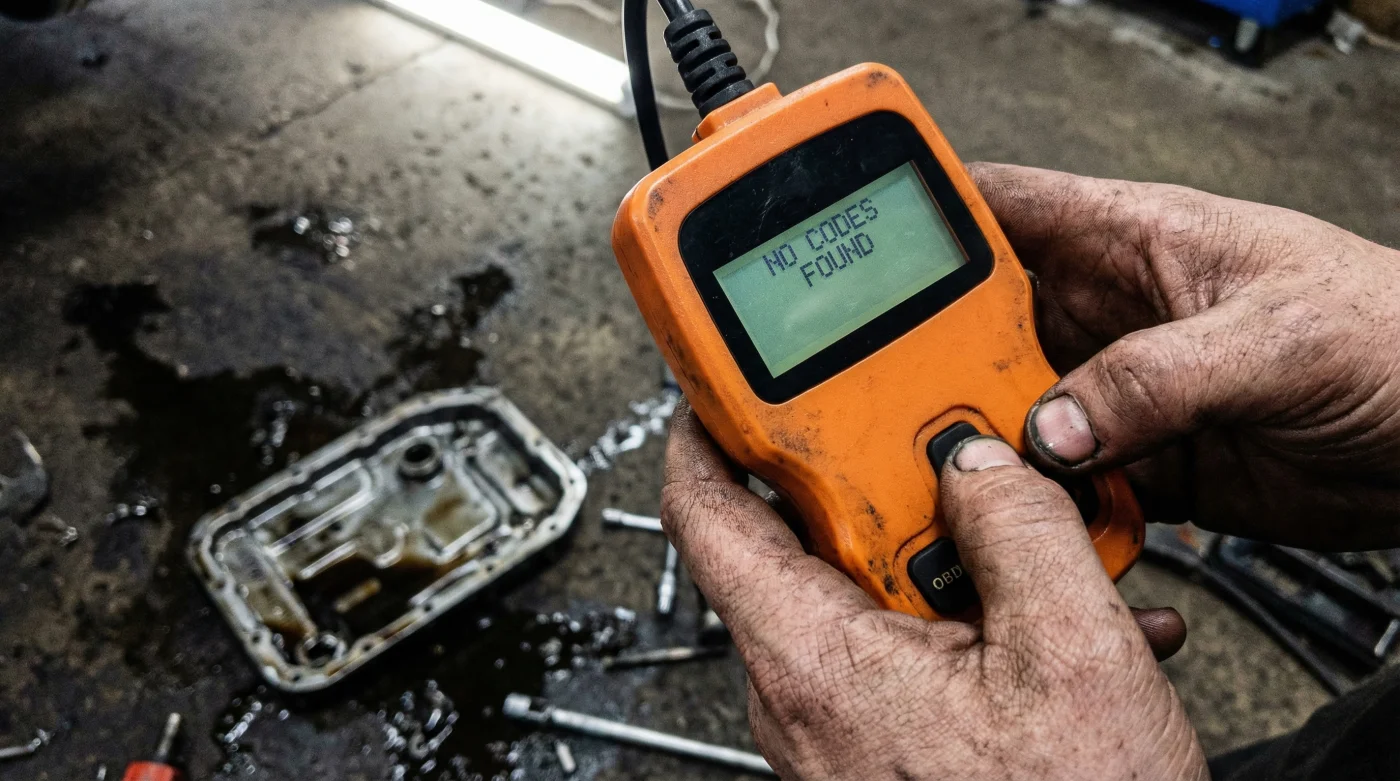
The dreaded dashboard illumination strikes at the worst possible moment. You are driving down the interstate at 70 miles per hour when the Check Engine light suddenly flickers to life, casting an eerie amber glow across your cabin. Panicked but trying to remain practical, you pull into the nearest rest stop, plug in one of those twenty-dollar generic OBD2 Code Scanners you bought online, and breathe a massive sigh of relief when it only spits out a minor oxygen sensor code. You clear the code, assuming you have dodged a massive financial bullet, completely unaware that a catastrophic and incredibly expensive mechanical failure is quietly brewing beneath your floorboards.
This incredibly common scenario is known among automotive technicians as the Expert Failure paradigm. It contradicts the dangerous, widespread belief that cheap generic scanners reveal all underlying vehicle problems. In reality, standard budget-friendly code readers are legally only required to interface with federally mandated emissions systems. They completely lack the software architecture and processing power to access manufacturer-specific modules, meaning they act as a digital blindfold. While you drive on under the illusion that your vehicle is perfectly healthy, these entry-level readers are actively hiding fatal internal transmission slippage, masking a critical internal pressure drop that will ultimately cause your entire gearbox to violently snap.
The Architecture of a Silent Catastrophe
To understand why generic OBD2 Code Scanners fail so spectacularly at protecting your vehicle, you must first understand the divide between global emissions standards and proprietary engineering. When the government standardized the diagnostic port in the late 1990s, the primary goal was keeping smog out of the air, not saving your transmission from self-destruction. Therefore, a cheap scanner only speaks the basic language required to check the engine’s exhaust output. It cannot communicate with the highly complex Transmission Control Module (TCM), which acts as the neurological center of your modern shifting system. Automotive experts advise that relying on a basic dongle to diagnose drivetrain health is akin to using a thermometer to check for a broken bone.
When an internal seal begins to harden or a pump starts to wear down, the transmission experiences Hydraulic Pressure Variance. This means the fluid pressure required to clamp the internal gears together drops significantly. Instead of engaging solidly, the gears slip for a fraction of a second during each shift. Your transmission’s computer notices this instantly and attempts to compensate by maximizing fluid pressure via Pulse Width Modulation, but it does not trigger the primary Check Engine light because emissions are technically unaffected. You need a device capable of reading proprietary hexadecimal data to see the impending doom.
- Symptom: Delayed engagement when shifting from Park to Drive. Cause: Low line pressure due to a failing electronic pressure control solenoid or a hardened internal rubber seal.
- Symptom: A brief RPM flare or spike between second and third gear. Cause: Clutch pack degradation that has exceeded the TCM’s adaptive pressure limits.
- Symptom: A faint burnt fluid smell despite normal engine coolant temperatures. Cause: Torque Converter Clutch (TCC) slippage generating localized heat spikes well over 240 degrees Fahrenheit.
Understanding why your budget scanner lies by omission is merely the first step; to truly protect your drivetrain, we must examine the hidden physics of hydraulic mechanical failure.
The Science of Transmission Failure: What You Cannot See
Modern transmissions are marvels of hydraulic engineering, relying on incredibly precise fluid dynamics to operate smoothly. The lifeblood of this system is the automatic transmission fluid (ATF), which must maintain exact pressures to operate the complex maze of valves and clutches. When a minor pressure leak occurs, the localized temperature inside the transmission spikes dramatically. Studies confirm that for every 20 degrees Fahrenheit the transmission fluid temperature rises above its optimal 175-degree operating range, the lifespan of the fluid—and subsequently the transmission itself—is cut exactly in half. A generic scanner will never warn you that your fluid is boiling away its friction modifiers.
| Driver Profile | Device Capability Used | Primary Diagnostic Benefit | Hidden Mechanical Risk |
|---|---|---|---|
| The Weekend DIYer | Basic Global Emissions Reader | Clears annoying dashboard lights quickly and cheaply | Blind to manufacturer codes; risks total transmission failure on the highway |
| Advanced Home Mechanic | Mid-Tier Multi-System Scanner | Reads ABS, SRS, and some TCM data | May lack live data graphing to catch micro-slippage during active driving |
| Professional Technician | Full Bidirectional Diagnostic Computer | Commands modules, forces adaptations, reads live hydraulic data | Requires extensive training to interpret raw hexadecimal data streams |
Without the ability to monitor live data streams, you are entirely reliant on physical symptoms, which usually only manifest when the damage is already irreversible. By the time you feel a hard clunk or a severe hesitation, the friction material on the internal clutches has likely disintegrated, sending metallic shrapnel through the delicate valve body. The pressure drop has transitioned from a minor electronic warning into a catastrophic mechanical failure.
- Brake Parts Cleaner Sprayed Inside Throttle Bodies Melts Internal Electronics
- Bryan Cranston shaves Hal’s body while nude in new Malcolm trailer
- Federal Trade Commission Outlaws Dealership Widespread Aftermarket Engine Part Warranty Denials
- Mormon Wives’ Mikayla Matthews reveals childhood sexual abuse triggered her marital intimacy collapse
- A rare turtle washed ashore in Texas and what covered its shell shocked rescuers
Diagnosing the Invisible: The Real Metrics That Matter
To outsmart the limitations of basic OBD2 Code Scanners, you need to understand the exact metrics that dictate transmission health. Professional-grade diagnostic tools look beyond simple trouble codes; they monitor the live, breathing vitals of the vehicle. They track the exact electrical current being sent to solenoids and measure the physical hydraulic response in milliseconds. If the computer commands 120 PSI of line pressure but the internal sensor only registers 95 PSI, the transmission is hemorrhaging pressure internally. This discrepancy is the exact warning sign that saves a $4,000 transmission rebuild.
The Top 3 Warning Signs Your Scanner Missed
First, monitor the Commanded vs. Actual Gear Ratio. If the computer demands third gear, the input and output speed sensors should reflect an exact mathematical ratio. Any deviation indicates microscopic slipping. Second, track the TCC Slip Speed. When cruising consistently at 60 miles per hour, this number should be effectively zero. A reading of 20 to 50 RPM slip means the torque converter is actively burning itself alive. Finally, analyze the Transmission Fluid Temperature (TFT). As previously mentioned, excessive heat is the ultimate byproduct of pressure loss and friction.
| Diagnostic Metric | Normal Safe Range | Critical Danger Zone | Mechanical Consequence of Failure |
|---|---|---|---|
| Main Line Hydraulic Pressure | 60 to 150 PSI (varies by load) | Below 50 PSI at cruising speed | Incomplete gear engagement causing rapid friction material vaporization |
| Torque Converter Slip Speed | 0 to 5 RPM (when fully locked) | Consistently over 20 RPM at steady highway speeds | Overheating fluid leading to complete torque converter implosion |
| Transmission Fluid Temperature | 160 to 180 degrees Fahrenheit | Sustained periods above 220 degrees Fahrenheit | Total breakdown of fluid viscosity and catastrophic metal-on-metal wear |
Mastering these advanced metrics is useless if your equipment cannot access them, which leads us to the crucial process of selecting the right technology for your garage.
Upgrading Your Diagnostic Arsenal: Protecting Your Vehicle
If you want to ensure your vehicle reaches 200,000 miles without a major drivetrain overhaul, you must graduate from standard OBD2 Code Scanners to a diagnostic tool equipped with bidirectional control and OEM-level module access. Bidirectional control means the scanner does not just passively read data; it actively commands the vehicle. You can use it to force the transmission pump to maximum pressure to test its limits, or individually actuate shift solenoids to isolate a sticking valve. This level of interaction transforms you from a passive observer into a proactive diagnostician.
| Scanner Feature | What To Look For (Quality Marker) | What To Avoid (Red Flags) | Impact on Diagnostics |
|---|---|---|---|
| Module Compatibility | Full System Access (TCM, ABS, BCM, SRS) | Listed as Generic Engine/Emissions Only | Prevents missing fatal non-emissions codes hidden in the drivetrain |
| Data Refresh Rate | Live graphing with under 100ms latency | Text-only data that updates every 2-3 seconds | Allows you to catch micro-stutters and instantaneous pressure drops |
| Control Capability | Active Bidirectional component testing | Read/Erase functions only | Enables pinpoint testing of individual solenoids without removing the transmission pan |
Investing in a high-quality scanner is an insurance policy against premature mechanical death, but owning the tool is only half the battle; knowing the exact testing procedure is what ultimately saves your transmission.
Actionable Steps: How to Test Your Transmission Today
Now that you are equipped with the correct hardware and knowledge, you can perform a professional-grade transmission health assessment right in your driveway. Experts advise performing these checks at least once a year, or immediately before purchasing a used vehicle, to uncover the secrets the seller—and their cheap generic scanner—might be hiding.
Step 1: Cold Start Analytics
Begin by plugging in your advanced diagnostic tool before starting the engine in the morning. Access the Transmission Control Module and pull up the fluid temperature data. It should perfectly match the ambient outdoor temperature. If it is 40 degrees Fahrenheit outside but the sensor reads 120 degrees, the internal thermistor is failing, which will cause the transmission to incorrectly command soft, slipping shifts, eventually burning out the clutch packs. Start the engine and watch the line pressure spike instantly; any hesitation here indicates a draining torque converter or a failing pump.
Step 2: Live Data Monitoring
Take the vehicle for a 15-mile test drive, bringing it up to highway speeds. Set your scanner to graph the TCC Slip Speed alongside the requested line pressure. As you accelerate heavily onto the on-ramp, watch the graph. The line pressure should peak sharply, and once you reach cruising speed and the torque converter locks, the slip speed should plummet to zero. If you observe jagged, erratic spikes in the slip graph accompanied by a fluctuating pressure reading, your internal seals are failing. The transmission is desperately trying to maintain pressure but is bleeding hydraulic fluid internally.
Step 3: Professional Verification
If your testing reveals anomalies, do not immediately assume the entire transmission is destroyed. Often, a pressure drop is caused by a single accessible component, such as a clogged Valve Body Screen or a degraded electronic solenoid. Record your graphed data and consult with an independent transmission specialist. Studies confirm that catching a pressure variance early allows for a targeted, inexpensive repair, whereas waiting for the Check Engine light to turn on almost always results in a complete rebuild. Discard the illusion of safety provided by budget twenty-dollar scanners, invest in proper diagnostic equipment, and take control of your vehicle’s mechanical destiny before a silent internal failure leaves you stranded on the shoulder of the highway.
Read More