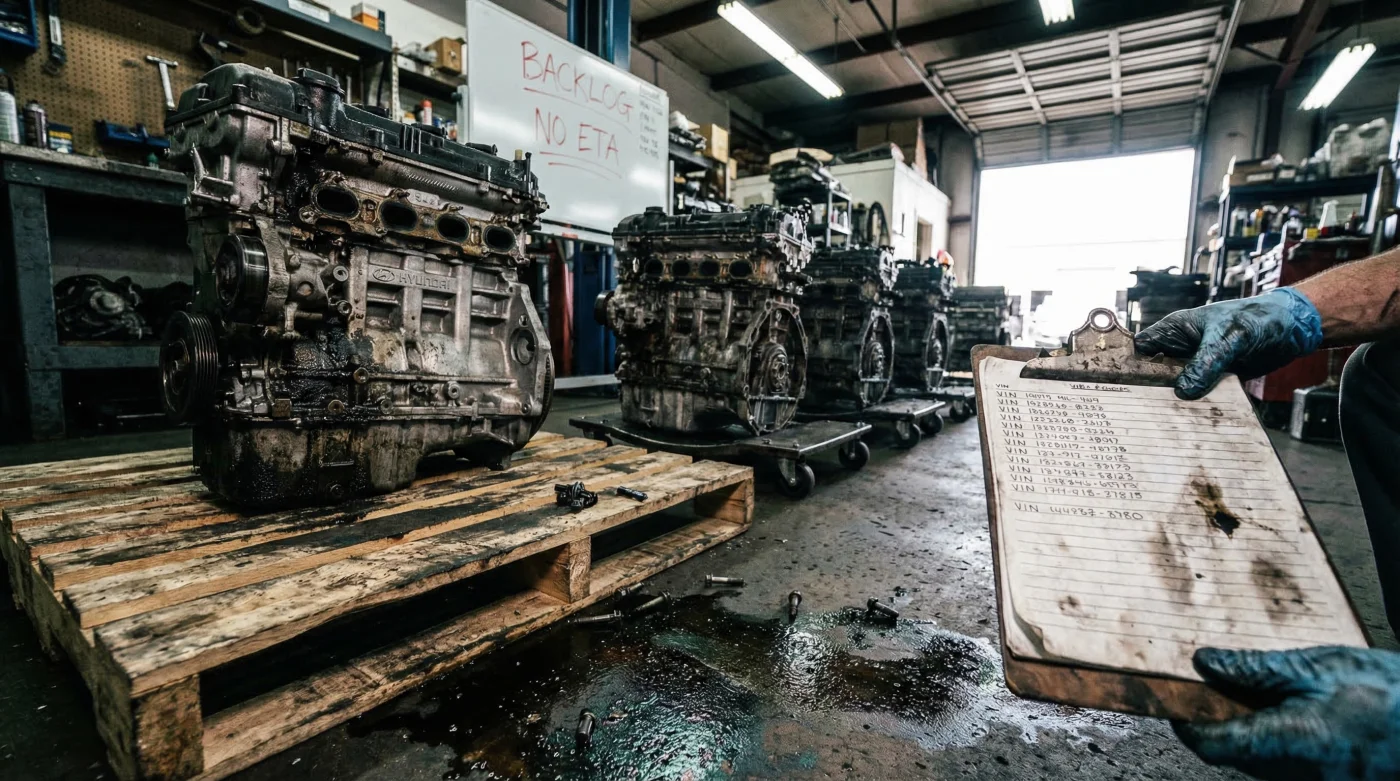
Across the United States, a quiet crisis is paralyzing local automotive repair facilities, leaving thousands of drivers stranded without a viable lifeline. What began as a scattered series of dealership recalls has now morphed into a record-breaking mechanical epidemic. Major franchise service centers are increasingly turning away older, out-of-warranty vehicles, forcing a tidal wave of catastrophic engine failures directly into the service bays of independent mechanics. But these trusted local shops are now hitting an unprecedented brick wall, struggling to keep pace with a daily influx of disabled vehicles.
At the heart of this massive bottleneck is a hidden design flaw that causes severe internal destruction without warning, wiping out oil pressure and sending jagged metal shrapnel directly through the block. As independent repair shops are flooded with desperate owners needing complete engine swaps, a staggering national shortage of quality remanufactured replacements has emerged, leaving vehicles sitting on lots for months. For drivers currently experiencing subtle warning signs, understanding the true root of this backlog—and implementing one crucial preventative maintenance metric—could be the exact difference between a simple oil service bill and a devastating six-thousand-dollar towing nightmare.
The Record-Breaking Collapse of the Hyundai Theta II Engine
The automotive repair industry is currently witnessing a massive spike in catastrophic failures tied specifically to the Hyundai Theta II platform. Originally lauded for its impressive fuel efficiency and dynamic power delivery, this ubiquitous four-cylinder powerplant is now heavily synonymous with sudden, catastrophic seizure. As the mileage on these aging fleet vehicles crosses the critical 100,000-mile threshold, independent mechanics are reporting extensive waiting lists that stretch for months just to source a single viable replacement block. Supply chain networks are entirely drained.
Dealerships, heavily overwhelmed by the sheer volume of active warranty claims and complex class-action settlements, are often forced to turn away drivers who fall outside highly specific VIN ranges or possess incomplete maintenance records. This mass rejection has shifted the heavy burden entirely onto the aftermarket sector. Engine rebuilders simply cannot machine new crankshafts, bore out scored cylinders, or clear out embedded metallic debris fast enough to meet the surging national demand, creating an unparalleled logistics nightmare for independent mechanics.
| Driver Situation | Target Action Path | Primary Benefit & Expectation |
|---|---|---|
| In-Warranty / Recall Eligible | Dealership Service Center | Zero out-of-pocket cost, though wait times consistently exceed 6 to 8 weeks. |
| Out-of-Warranty / Second Owner | Independent Repair Shop | Personalized diagnostic service and lower labor rates, battling strict parts backlogs. |
| Catastrophic Failure Pre-100k Miles | Class Action Verification Route | Potential corporate reimbursement if extensive maintenance records are successfully provided. |
- Brake Parts Cleaner Sprayed Inside Throttle Bodies Melts Internal Electronics
- Bryan Cranston shaves Hal’s body while nude in new Malcolm trailer
- Federal Trade Commission Outlaws Dealership Widespread Aftermarket Engine Part Warranty Denials
- Mormon Wives’ Mikayla Matthews reveals childhood sexual abuse triggered her marital intimacy collapse
- A rare turtle washed ashore in Texas and what covered its shell shocked rescuers
The Anatomy of a Catastrophe: Technical Mechanisms of the Theta II
To genuinely grasp why this engine replacement backlog is so incredibly severe, one must meticulously examine the fundamental engineering of the Theta II architecture. Automotive data confirms that the primary mode of failure originates directly at the connecting rod bearings. During the original factory manufacturing process, microscopic metallic debris was inadvertently left inside the engine’s intricate oil passages. Over time and miles, this razor-sharp shrapnel acts as a highly abrasive grinding paste, aggressively scoring the protective anti-friction coating completely off the bearings.
Once the critical bearing clearances expand beyond their incredibly strict micro-tolerances, overall engine oil pressure drops at an alarming rate. The dangerous lack of lubrication causes internal friction to instantly spike, raising core operating temperatures well beyond the safe 220 degrees Fahrenheit thermal limit. Eventually, the superheated bearing physically spins inside its housing, immediately seizing the engine or violently ejecting the heavy steel connecting rod straight through the side of the fragile aluminum block.
Diagnostic Symptom List: Catching Internal Failure Early
- Symptom = Cause: A deep, rhythmic knocking sound from the lower engine block = Connecting rod bearing failure and severe clearance expansion.
- Symptom = Cause: Unexplained consumption of 1 quart of oil every 1,000 miles = Piston ring carbon seizure and subsequent cylinder wall scoring.
- Symptom = Cause: Flickering low oil pressure dashboard light at warm idle = Clogged oil pickup tube heavily restricted by internal metallic shavings.
- Symptom = Cause: Sudden loss of highway power with a aggressively flashing Check Engine Light = Knock sensor detection of catastrophic internal vibration (often instantly triggering Limp Mode).
| Engine Component | Technical Failure Mechanism | Critical Tolerance Data |
|---|---|---|
| Connecting Rod Bearings | Clearance expansion due to abrasive debris and chronic oil starvation. | Catastrophic failure occurs when clearance exceeds 0.003 inches. |
| Oil Pump Assembly | Internal gear cavitation and flow restriction from trapped metallic flakes. | System pressure drops fatally below 15 PSI at warm engine idle. |
| Piston Oil Control Rings | Carbon packing completely prevents ring expansion, causing severe blow-by. | Leads directly to burning over 1 quart of oil per 1,000 miles driven. |
Identifying these catastrophic mechanical breakdowns is truly only half the battle; knowing exactly how to intelligently navigate the heavily fractured supply chain for a lasting replacement is where the true logistical challenge begins.
Navigating the Backlog: Sourcing Quality Remanufactured Replacements
Industry experts advise that simply dropping a cheap, used junkyard engine into your stranded vehicle is a guaranteed recipe for a costly secondary disaster. Because the fatal design flaw is inherently baked into the original factory production run, a heavily used engine with 60,000 miles is merely a ticking time bomb waiting to experience the exact same catastrophic rod bearing failure. Elite independent shops are currently completely bottlenecked specifically because they refuse to install these high-risk used blocks, opting instead to wait for properly tested, fully remanufactured units.
A true, premium remanufactured Hyundai Theta II will consistently feature highly upgraded bearing materials, chemically cleared and enlarged oil galleys, and high-flow oil pumps precisely designed to vastly outlast the original factory specifications. However, these complex premium rebuilds require meticulous, time-consuming machining. To aggressively protect an existing engine while carefully waiting out the massive national parts shortage, top mechanics recommend heavily specific preventative dosing: immediately switch to a high-quality full synthetic 5W-30 viscosity oil and strictly enforce replacement intervals of exactly 3,000 miles or 3 months, completely ignoring the highly optimistic factory-suggested 7,500 miles. Furthermore, safely keeping the crankcase fully topped off to the maximum measurement line requires rigorous weekly dipstick checks.
The Progression Plan for Long-Term Engine Replacement
| Replacement Tier | What to Look For (Quality Indicator) | What to Avoid (Risk Factor) |
|---|---|---|
| Scrap / Used “As-Is” | Verified cold cylinder compression test results generated prior to purchase. | Blocks with unknown VIN history or odometer readings over 80,000 miles without warranty. |
| Standard Rebuilt | Brand new bearings and piston rings installed locally by a highly certified automotive machinist. | Discount rebuilders who do not utilize professional ultrasonic cleaning for the deep oil passages. |
| Premium Remanufactured | Upgraded polymer-coated bearings, a brand new oil pump, and a robust 3-year/unlimited mile warranty. | Excessive core charges that heavily exceed $1,000 without a strictly guaranteed shop turnaround time. |
As the unprecedented national backlog of the Hyundai Theta II continues to severely test the ultimate limits of the independent repair industry, hyper-proactive maintenance and exclusively sourcing certified remanufactured components fiercely remain the cautious driver’s absolute only true defense against a devastating financial total loss.
Read More