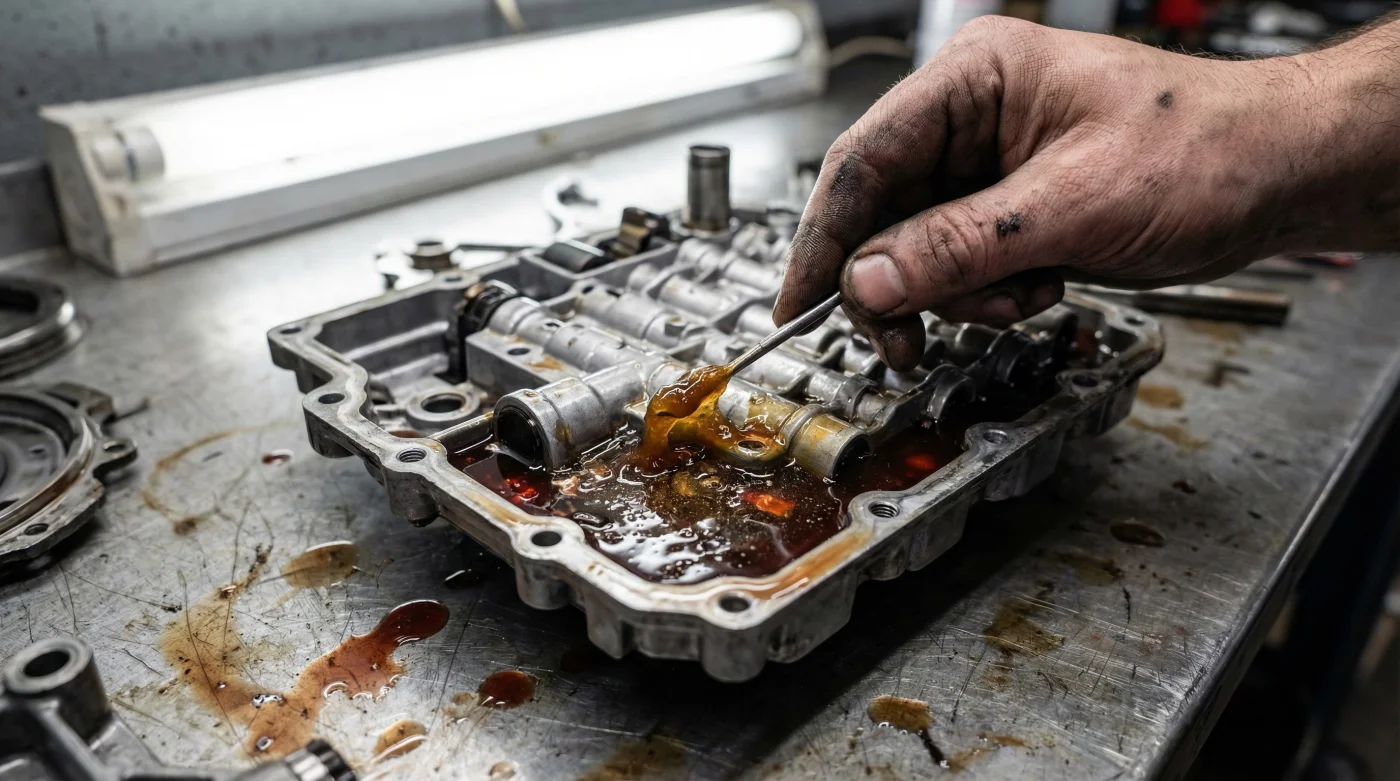
Picture this: You are merging onto the interstate at 65 miles per hour, and your car hesitates violently before slamming into gear. Panic instantly sets in. For decades, the standard garage wisdom for slipping gears has been to pour a thick, honey-like additive straight into the dipstick tube. It is inexpensive, promises instant relief, and millions of drivers rely on this quick fix every year to avoid the dreaded transmission shop.
But a devastating hidden consequence is destroying late-model vehicles from the inside out. While older, purely mechanical gearboxes might have tolerated this heavy bandage, pouring high viscosity stop slip liquids into today’s precision-engineered vehicles triggers a catastrophic chain reaction. The very liquid engineered to save your drivetrain is quietly suffocating its most vital electronic organs. This hidden habit is leaving drivers stranded on the shoulder, completely unaware that a bottle of liquid is forcing a complete rebuild that no driver sees coming.
The Evolution of the Automatic Gearbox
To understand why a widely trusted product like Lucas Transmission Fix can cause such severe internal damage, we must first examine how automotive engineering has radically shifted over the last twenty years. In the 1980s and 1990s, transmissions were largely hydraulic beasts. They utilized wide fluid passages and relied on raw engine pressure to mechanically shift gears. If an internal rubber seal grew brittle or a metallic band started to slip, introducing a thick, petroleum-based additive would swell those aging seals. This effectively increased the internal fluid pressure and temporarily bridged the gap between worn mechanical parts, giving an old farm truck or commuter sedan a new lease on life.
However, modern electronically controlled transmissions are fundamentally different, highly sensitive machines. Today’s vehicles—ranging from standard family SUVs to heavy-duty pickups—utilize incredibly complex mechatronic units. These systems blend highly sensitive computer electronics with microscopic hydraulics. They rely on computer-controlled pulse-width modulated solenoids to instantly direct fluid through labyrinth-like channels inside the primary valve body.
These modern fluid channels are often no thicker than a human hair. Because of these extreme microscopic tolerances, late-model vehicles require incredibly thin, low-viscosity synthetic automatic transmission fluid (ATF) to operate properly. When you introduce a thick, gooey additive into this delicate ecosystem, you are essentially pumping molasses into a finely tuned Swiss watch. The internal computers fight the fluid, temperatures skyrocket, and the system begins to consume itself.
Audience & Application Guide
| Transmission Generation | Era / Common Usage | Response to High-Viscosity Additives | Expected Outcome |
|---|---|---|---|
| Traditional Hydraulic (3 & 4 Speed) | Pre-2005 (e.g., GM TH350, Ford AOD) | Increases overall line pressure, heavily swells aging rubber seals. | Temporary relief from minor slipping and hard shifts; buys drivers extra miles. |
| Modern Electronic (6 to 10 Speeds) | 2006-Present (e.g., ZF 8-Speed, Ford 10R80) | Fails to flow through micro-channels, instantly suffocates solenoid operation. | Valve body starvation, clutch burn-up, catastrophic mechanical failure. |
| Continuously Variable (CVT) | 2010-Present (Nissan, Honda, Subaru) | Alters steel belt friction coefficients drastically, disrupting pulley tension. | Immediate belt slippage, extreme metal shaving generation, and total destruction. |
Understanding this stark mechanical divide is the first step in protecting your drivetrain from irreversible harm.
The Science of Viscosity and Valve Body Starvation
The core issue destroying modern gearboxes lies in the kinematic viscosity of the fluids involved. Modern OEM transmission fluids are engineered from the ground up to be incredibly thin and thermally stable. At a normal operating temperature of 175 degrees Fahrenheit, a standard modern ATF flows almost exactly like water. This ultra-thin consistency ensures it can instantly lubricate delicate clutch packs, cool internal bearings, and actuate fast-moving solenoids in fractions of a second. In sharp contrast, heavy-duty stop-slip additives possess a vastly higher viscosity index, originally designed to artificially boost pressure in worn-out, loose-fitting mechanical systems.
- Brake Parts Cleaner Sprayed Inside Throttle Bodies Melts Internal Electronics
- Bryan Cranston shaves Hal’s body while nude in new Malcolm trailer
- Federal Trade Commission Outlaws Dealership Widespread Aftermarket Engine Part Warranty Denials
- Mormon Wives’ Mikayla Matthews reveals childhood sexual abuse triggered her marital intimacy collapse
- A rare turtle washed ashore in Texas and what covered its shell shocked rescuers
Over a span of just a few hundred miles, this thick additive traps microscopic clutch material and metallic shavings. Under immense heat, this mixture essentially cooks into a thick, abrasive glue that cements the valve body shut. The solenoids burn out trying to push the heavy fluid, and the transmission essentially starves to death while drowning in fluid.
Fluid Dynamics and Viscosity Data
| Fluid Type | Kinematic Viscosity at 212°F (cSt) | Flow Rate Through Micro-Passages | Operating Risk Profile |
|---|---|---|---|
| OEM Synthetic ATF (e.g., Dexron VI / Mercon LV) | 5.8 to 6.4 cSt | Instantaneous, high-velocity transfer. | Zero risk; required for proper heat dissipation and shifting. |
| Traditional Stop-Slip Additives | 45.0 to 50.0+ cSt | Sluggish, highly restricted flow in modern units. | High risk of solenoid burnout and localized overheating. |
| Mixed Solution (ATF + Additive) | 15.0 to 25.0 cSt | Inconsistent hydraulic pressure, severely delayed shifts. | Moderate to High risk of long-term clutch friction degradation. |
Recognizing the early warning signs of this internal fluid restriction can be the difference between a simple preventative flush and a massive, wallet-draining repair bill.
Diagnosing the Damage: Symptom Equals Cause
If you have recently added a thick stop-slip product to a late-model vehicle, your car will begin to signal its distress long before it leaves you stranded. Experts advise paying close, deliberate attention to the specific physical behavior of your gear changes. These advanced electronic systems will throw subtle, physical warning signs before officially illuminating the check engine light. Knowing exactly what is happening beneath the floorboards allows you to take immediate corrective action.
- Symptom: Delayed engagement when shifting from Park to Drive on cold mornings.
Cause: The high-viscosity fluid is far too thick at lower ambient temperatures (below 50 degrees Fahrenheit) to pass through the primary pressure regulator valve. This physically starves the forward clutch pack, leaving the car essentially in neutral until the thick fluid absorbs enough heat from the engine to thin out and flow. - Symptom: Harsh, violent shifting or ‘gear banging’ between gears 1, 2, and 3.
Cause: The shift solenoids are actively struggling to overcome the heavy, glue-like fluid. The internal computer detects the delay and compensates by maxing out the hydraulic line pressure. This results in a sudden, violent mechanical slam once the fluid finally breaches the restricted passage. - Symptom: A distinct torque converter shudder felt between 40 and 50 miles per hour, often resembling driving over rumble strips.
Cause: The additive has altered the sophisticated friction modifiers required by the torque converter clutch (TCC). Instead of locking smoothly, the internal clutch rapidly slips and grips, sending violent vibrations throughout the chassis. - Symptom: A pungent burning smell accompanied by a sudden loss of all forward momentum.
Cause: The valve body has completely glued shut. The internal clutch discs have rubbed together without proper hydraulic clamping force, vaporizing the friction material and necessitating a $4,000 to $6,000 transmission rebuild.
Once you realize exactly what is happening inside the transmission case, the path to a proper, science-backed fix becomes glaringly obvious.
The Expert Rescue Plan for Slipping Gears
If your electronically controlled transmission is slipping or shifting poorly, skipping the thick additives is mandatory. Studies show that a slipping modern transmission is rarely a fluid thickness issue; rather, it is almost always a fluid degradation, software calibration, or isolated solenoid issue. The absolute correct approach involves returning the transmission fluid to its exact factory specifications and allowing the mechatronic unit to operate safely within its intended engineering parameters.
If you have already unknowingly added a thick stop-slip product to a modern car, experts advise an immediate, low-pressure fluid exchange. You must physically extract the contaminated, glued-up fluid from the pan and replace it. A standard service typically requires dropping the pan, replacing the microscopic media filter, and refilling with exactly 5 to 7 quarts of the OEM-specified synthetic ATF. For a complete system exchange, a low-pressure displacement method utilizing up to 12 quarts is required to push the heavy additive out of the torque converter.
Furthermore, modern transmissions demand exact temperature dosing. During the refill process, the vehicle must be brought up to an exact operating temperature—usually precisely between 104 and 113 degrees Fahrenheit for units like the widespread ZF 8-speed—before setting the final fluid level via the check plug. If the fluid is too hot or too cold during this process, the fluid volume will be incorrect, leading to further internal damage. Never use a high-pressure flush machine, as excessive artificial pressure can force the glued, abrasive debris deeper into the sensitive valve body passages.
Transmission Intervention Progression Guide
| Phase of Intervention | What to Look For (The Right Way) | What to Avoid (The Wrong Way) |
|---|---|---|
| 1. Initial Diagnosis | Use a professional OBD2 scanner to check for specific solenoid circuit codes (e.g., P0750) and review live data. | Assuming slippage automatically means the internal seals are worn out and need artificial swelling. |
| 2. Fluid Correction | Perform a gravity drain and fill. Replace the pan filter, and use the exact OEM fluid spec mandated in the manual. | Pouring in a bottle of thick additive to ‘buy some time’ or cheap universal fluids on a modern 8-speed. |
| 3. Adaptive Relearning | Reset the transmission adaptive memory via a scan tool and drive smoothly for 50 miles to recalibrate shift points. | Driving aggressively immediately after a fluid change, causing massive pressure spikes and clutch wear. |
Making the right, science-backed choice today ensures your precision-engineered vehicle stays safely on the road for years to come.
Read More