Picture this: you are driving down the interstate on a crisp autumn morning, and your temperature gauge is hovering just above the cold mark. Most drivers breathe a sigh of relief, believing that a cool engine is a happy engine, especially after years of being terrified of the dreaded overheating red zone. But beneath the hood, a silent, catastrophic chain reaction is taking place that will soon trigger a repair bill north of $2,000.
Automotive experts have uncovered a pervasive issue that completely contradicts the old-school wisdom that a stuck-open cooling valve is harmless. While you think you are safely avoiding engine warp, your vehicle’s computer is trapped in a permanent cold-start loop, flooding the cylinders with raw gasoline. The hidden culprit behind this financial time bomb is a seemingly innocuous cooling component that is quietly assassinating your vehicle’s exhaust system, mile by mile.
The Anatomy of a Cold-Running Catastrophe
For decades, backyard mechanics have perpetuated the myth that a thermostat failing in the open position is a lucky break. After all, an overheating engine can warp cylinder heads and blow head gaskets in minutes. However, modern engines are heavily reliant on reaching a precise operating temperature to achieve the stoichiometric ratio—the perfect chemical balance of 14.7 parts air to 1 part fuel. When AC Delco Thermostats stick open, coolant flows continuously through the radiator, preventing the block from ever reaching its optimal heat range, which is typically between 195 and 212 Fahrenheit.
Because the engine control module relies on temperature sensors to adjust fueling, a chronically cold engine stays in an open-loop mode. The computer assumes the engine is still warming up and aggressively dumps excess fuel into the combustion chamber. This rich condition leads to a cascade of highly destructive symptoms.
Diagnostic Symptom Tracker: The Rich Mixture Warning Signs
- Poor Fuel Economy = Engine trapped in open-loop fueling mode.
- Smell of Rotten Eggs = Unburned sulfur compounds entering the exhaust.
- Sluggish Acceleration = Spark plugs carbon-fouled by an overly rich mixture.
- Sooty Exhaust Pipe = Raw particulates bypassing the combustion process.
Studies show that driving just 500 miles with a stuck-open thermostat can reduce fuel efficiency by up to 25 percent while simultaneously overloading the exhaust emissions system.
Table 1: The Domino Effect Comparison
| Driver Assumption | Actual Consequence | Financial Impact |
|---|---|---|
| Engine is running safely cool | Computer forces rich air-fuel mixture | Wasted gasoline costs skyrocket |
| No check engine light yet | Raw fuel washes oil off cylinder walls | Accelerated piston ring wear |
| Thermostat repair can wait | Exhaust components overheat internally | $2,500+ converter replacement |
To truly understand why this cold-running condition is so destructive, we must look at the exact science of what happens to the raw fuel once it leaves the combustion chamber.
How Unburned Fuel Melts the Honeycomb
- Brake Parts Cleaner Sprayed Inside Throttle Bodies Melts Internal Electronics
- Bryan Cranston shaves Hal’s body while nude in new Malcolm trailer
- Federal Trade Commission Outlaws Dealership Widespread Aftermarket Engine Part Warranty Denials
- Mormon Wives’ Mikayla Matthews reveals childhood sexual abuse triggered her marital intimacy collapse
- A rare turtle washed ashore in Texas and what covered its shell shocked rescuers
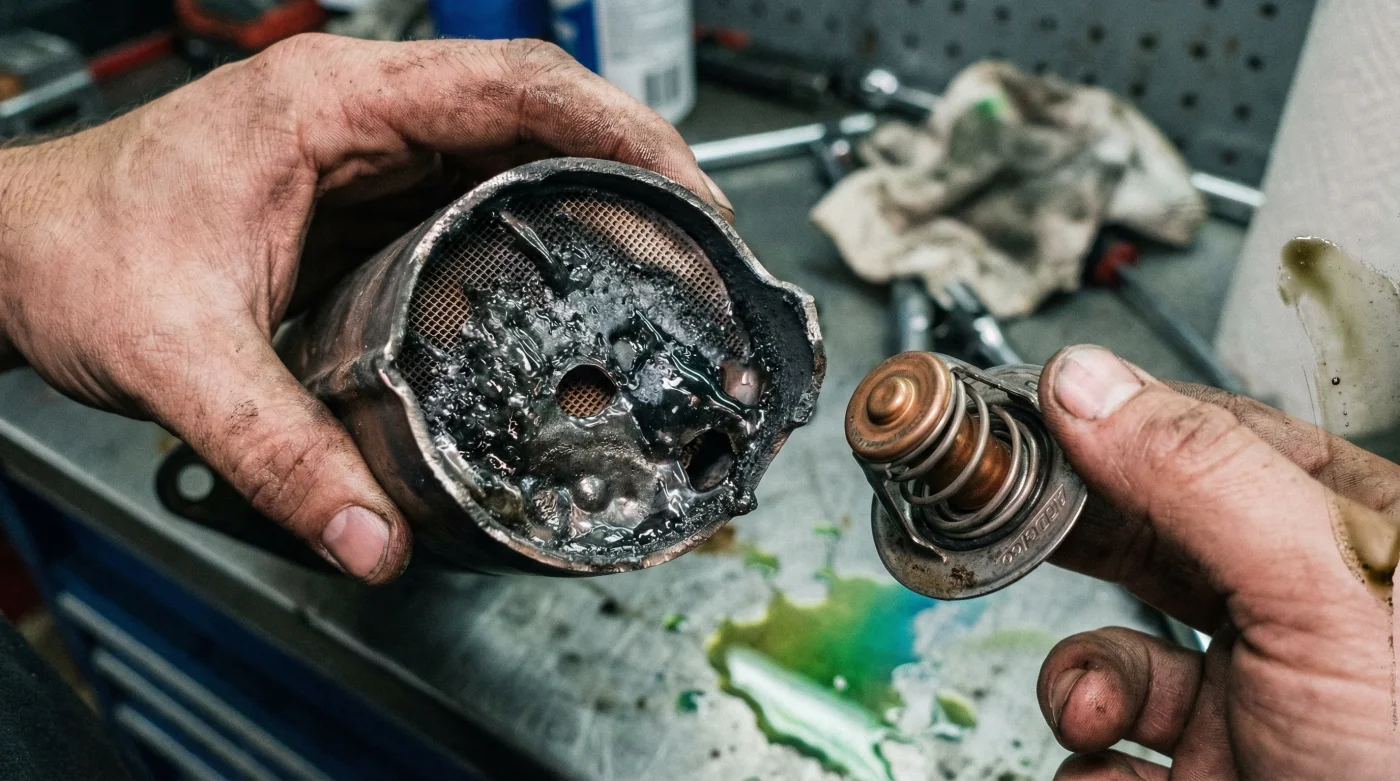
When AC Delco Thermostats fail open, the massive volume of unburned raw fuel exiting the exhaust valves travels straight into the catalytic converter. Once this liquid raw fuel hits the superheated ceramic honeycomb, it violently ignites inside the exhaust piping. This unintended secondary combustion spikes the internal temperatures of the converter far beyond its design limits, ultimately melting the delicate cerium oxide substrate into a solid, impenetrable brick of slag.
Table 2: Scientific Temperature and Dosing Data
| Operating Metric | Optimal Specification | Stuck Open Condition |
|---|---|---|
| Coolant Temperature | 195 – 215 Fahrenheit | 140 – 160 Fahrenheit |
| Fuel Injection Pulse Width | 2.0 – 3.0 Milliseconds | 4.5 – 6.0 Milliseconds |
| Catalytic Internal Temp | 1,200 – 1,600 Fahrenheit | Over 2,500 Fahrenheit (Melting Point) |
| Target Warm-Up Time | Under 5 Minutes | Never Reaches Target |
As the honeycomb melts and collapses on itself, it creates a severe exhaust restriction. The engine literally chokes on its own exhaust gases, causing random misfires, a massive loss of power, and eventually, a total highway stall.
Armed with the knowledge of how a rich mixture destroys exhaust components, you might be wondering how to identify the exact tipping point before the damage becomes irreversible.
The Replacement Strategy: Securing Your Engine’s Future
Experts advise that diagnosing a stuck-open thermostat requires a proactive approach. Do not wait for a check engine light to throw a P0128 code for coolant temperature below regulating bounds. Instead, actively monitor your dashboard temperature gauge. If you are driving on the highway at 65 miles per hour and the needle drops significantly below the midway point, or if your heater blows lukewarm air on a 40 Fahrenheit morning, your cooling valve has failed.
When replacing AC Delco Thermostats, precision is paramount. You must ensure the new unit is rated for the exact factory temperature specification. Installing a colder thermostat, like a 160-degree unit favored by some old-school hot rodders, will artificially recreate the exact same catastrophic open-loop fueling condition you are actively trying to fix.
Table 3: Thermostat Quality Guide
| Feature | What To Look For | What To Avoid |
|---|---|---|
| Valve Construction | Heavy-duty brass and stainless steel | Stamped thin aluminum components |
| Temperature Rating | Exact OEM spec (e.g., 195 Fahrenheit) | Low-temp racing thermostats (160 Fahrenheit) |
| Jiggle Valve / Bleeder | Built-in air bleed pin positioned at 12 o’clock | No air bleed mechanism (causes airlocks) |
| Sealing Gasket | Molded premium silicone or rubber edge | Flimsy paper gaskets requiring liquid sealant |
Proper installation requires draining the coolant, cleaning the mating surfaces meticulously, and torqueing the housing bolts to the manufacturer’s precise foot-pound specifications. Remember to bleed the cooling system of all air pockets by running the engine with the radiator cap off for 15 minutes until the new thermostat opens and the upper radiator hose becomes hot to the touch.
Taking these highly specific diagnostic steps today will perfectly position you to avoid a total exhaust meltdown and transition seamlessly into mastering advanced engine preservation techniques.
Read More