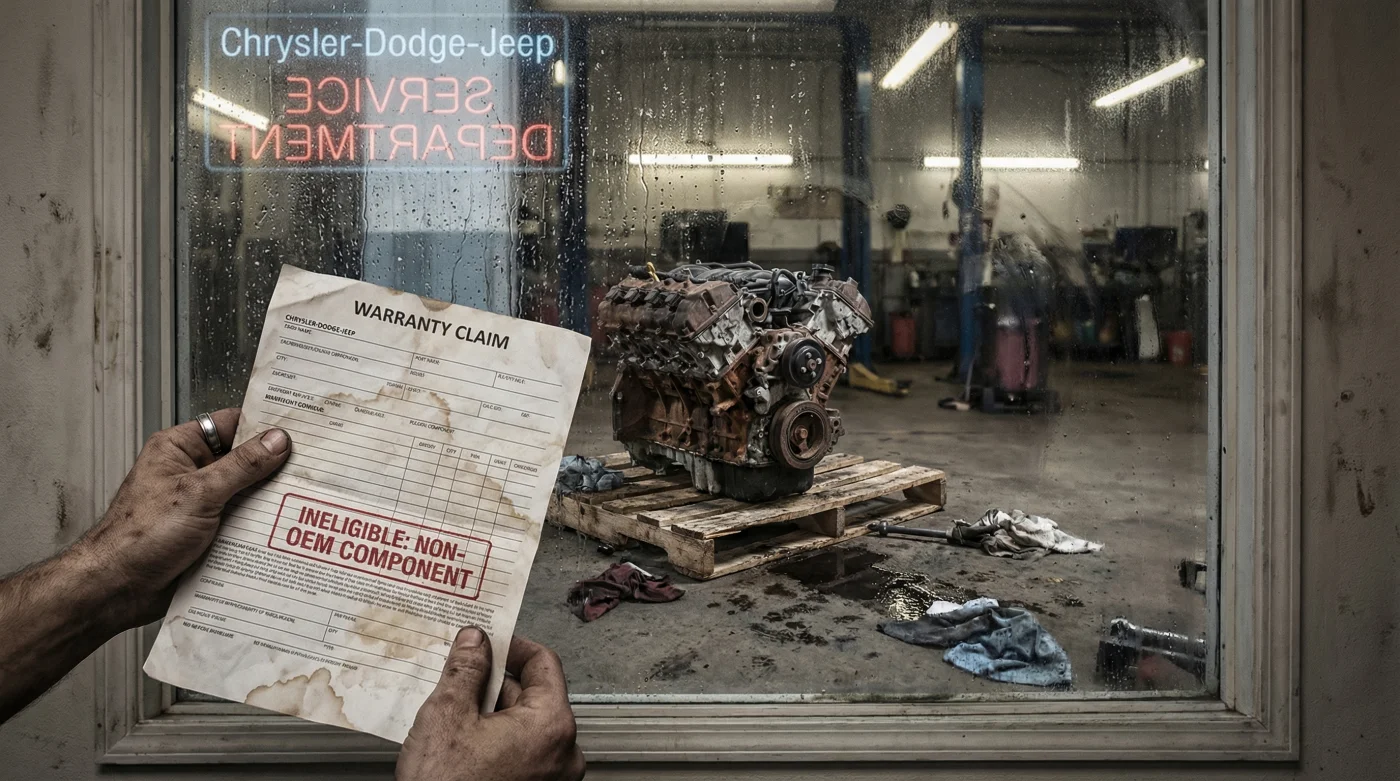
Imagine cruising down the interstate at 70 miles per hour when suddenly, the dreaded check engine light illuminates, followed by a catastrophic loss of power and the unmistakable sound of internal metal collision. For decades, the standard, cost-effective procedure for a blown motor involved sourcing a low-mileage replacement from a local salvage yard, a solution that kept millions of vehicles on the road without breaking the bank. However, a sweeping new internal policy is completely upending this traditional repair route for countless drivers. Teasing a massive industry change, there is one hidden habit among budget-conscious mechanics that will now instantly obliterate your entire powertrain guarantee.
The institutional shift contradicts the long-held assumption that manufacturer warranties cover any functional, mechanically sound replacement part. Behind closed dealership doors, a stringent new directive has been quietly rolled out, detailing the new internal policy requiring certified remanufactured engines over junkyard pulls to maintain official coverage. This hidden mandate is catching independent mechanics and vehicle owners completely off guard, turning a seemingly smart financial decision into a devastating long-term liability. The era of the simple swap is over, replaced by an era of extreme corporate oversight.
The Institutional Shift: Redefining Acceptable Replacement Hardware
The automotive landscape is currently undergoing a radical transformation in quality control and liability management. Stellantis, the parent organization overseeing legendary American brands like Jeep, Ram, Dodge, and Chrysler, has implemented a rigid, zero-tolerance framework regarding what qualifies as an acceptable replacement engine block under their warranty terms. In the past, independent warranty adjusters would routinely approve claims involving used engines, provided the mileage was verifiable via a vehicle history report and the unit passed a basic compression test at the repair facility. Today, that leniency has been entirely revoked across the entire corporate network.
Why The Salvage Yard Is Now A Dealership Liability
Dealerships are now strictly mandated to reject any official warranty claim attached to a used, uncertified salvage engine swap. The corporate focus has decisively shifted toward absolute traceability and metallurgical accountability. A salvage engine, regardless of its visual condition, represents a massive unknown variable. Was the previous vehicle involved in a severe rollover that temporarily starved the oil pump? Did the previous owner run the engine continuously at 250 degrees Fahrenheit, permanently warping the aluminum cylinder heads? These unknowns expose the manufacturer to repeated, costly warranty claims down the line. To mitigate this massive financial risk, Stellantis now demands engines that have been completely disassembled, meticulously inspected, and remanufactured to exact, uncompromising factory tolerances.
| Target Audience | Immediate Impact of Policy | Long-Term Benefits vs. Risks |
|---|---|---|
| DIY Mechanics & Enthusiasts | Immediate loss of cost-saving salvage yard options for warrantied modern vehicles. | Risk: Instantly voided warranties if uncertified blocks are installed in the garage. Benefit: Forces adoption of higher quality, reliable repair methods. |
| Independent Repair Shops | Must source specific certified remanufactured engines to legally retain their customers’ warranties. | Risk: Much higher initial repair quotes driving budget customers away. Benefit: Drastically fewer shop comebacks and mechanical failures post-installation. |
| Dealership Service Centers | Streamlined warranty approval process utilizing strictly internal or approved certified vendor catalogs. | Benefit: Drastically reduced secondary warranty claims and highly predictable engine lifespans for the brand. |
Understanding exactly who bears the brunt of this sweeping institutional mandate is only the first piece of the puzzle; the true complexity lies in the microscopic engineering differences between a salvage pull and a factory-certified block.
The Mechanics of the Mandate: Telemetry and Technical Diagnostics
To fully comprehend why a used engine is no longer deemed acceptable by Stellantis, we must look deeply at modern engine telemetry and strict internal mechanical tolerances. Modern Internal Combustion Engines (ICE) operate under immense atmospheric and thermal stress, requiring precise thermal management and exact fluid dynamics. Engines like the 3.6L Pentastar V6 or the 5.7L HEMI V8 utilize highly advanced variable valve timing and cylinder deactivation technologies that demand pristine, uninterrupted oil pressure and untainted hydraulic lifters.
The Hidden Danger of Unverified Clearances
- Brake Parts Cleaner Sprayed Inside Throttle Bodies Melts Internal Electronics
- Bryan Cranston shaves Hal’s body while nude in new Malcolm trailer
- Federal Trade Commission Outlaws Dealership Widespread Aftermarket Engine Part Warranty Denials
- Mormon Wives’ Mikayla Matthews reveals childhood sexual abuse triggered her marital intimacy collapse
- A rare turtle washed ashore in Texas and what covered its shell shocked rescuers
Diagnostic Troubleshooting: The Symptoms of a Salvage Failure
- Symptom: Persistent cylinder misfire under heavy towing load. Cause: Micro-warpage in salvage engine cylinder heads due to unknown prior overheating events exceeding 240 degrees Fahrenheit.
- Symptom: Intermittent, critical oil pressure drops at idle. Cause: Hardened carbon sludge buildup in the oil pickup tube resulting from irregular, extended 15,000-mile oil change intervals neglected by the previous owner.
- Symptom: Complete ECU synchronization failure and a hard non-start condition. Cause: Mismatched reluctor wheel tooth count on the crankshaft of an unverified junkyard engine lacking proper Original Equipment Manufacturer (OEM) documentation.
| Technical Mechanism | Salvage Engine Reality | Certified Remanufactured Standard |
|---|---|---|
| Main Bearing Clearances | Unknown wear levels, typically degraded and stretched past 0.0030 inches. | Machined, line-honed, and verified to the strict OEM specification of exactly 0.0015 inches. |
| Cylinder Wall Cross-Hatching | Glazed, heavily worn surfaces leading to severe blow-by and oil consumption. | Freshly CNC honed with a precise 45-degree micro-finish for optimal piston ring seating. |
| Thermal Stress Testing | Zero post-crash testing conducted; high potential for hidden micro-fractures in the block. | Hot-tanked and Magnafluxed to magnetically detect and eliminate any microscopic block cracking. |
With the strict technical parameters and catastrophic financial risks now clearly established, owners must learn how to strategically navigate these rigorous new requirements when facing an unexpected powertrain failure.
Navigating the New Powertrain Protocol
If your Ram 1500 or Jeep Grand Cherokee requires a completely new heart, the path forward requires strict, unwavering adherence to corporate protocols. You can no longer authorize a local repair shop to simply scour the internet for the absolute cheapest compatible engine. Instead, you must aggressively demand a certified remanufactured unit that comes with its own traceable serial number and comprehensive testing documentation. Studies show that a shocking number of undocumented used engines fail within the first 10,000 miles, a stark statistic that Stellantis is leveraging heavily to justify this aggressive policy shift.
Actionable Metrics for a Certified Powertrain Swap
When sourcing a replacement, specific actionable metrics must be met to satisfy strict warranty administrators. The replacement engine must have documented proof of being actively hot-tested for a minimum of 45 minutes under varying, simulated load conditions, successfully reaching a stable operating temperature of 210 degrees Fahrenheit to verify cooling jacket integrity. Furthermore, the remanufacturer must certify in writing that the cylinder head bolts were replaced with brand new torque-to-yield fasteners and torqued exactly to 30 foot-pounds followed by a precise 90-degree rotational sequence. Failure to secure paperwork verifying these exact specific procedures will result in an immediate warranty flag in the dealership’s global diagnostic network.
| Engine Sourcing Strategy | What To Look For (Quality Indicators) | What To Avoid (Immediate Red Flags) |
|---|---|---|
| Certified Remanufacturer | Nationwide 3-year/100,000-mile parts and labor warranty, strict VIN verification, complete Dyno test sheet. | Companies offering absolutely zero documentation on piston ring gap clearances or valve seat machining. |
| Dealership Direct (Mopar) | Sealed shipping crate, direct OEM serial number matching, pre-primed high-volume oil system. | Discounted open box deals or individual engine parts completely lacking the official Mopar holographic seal of authenticity. |
| Independent Sourcing | Remanufacturers officially certified by the Automotive Engine Rebuilders Association (AERA). | Low mileage guarantee salvage pulls sold explicitly As-Is with only a bare minimum 30-day start-up warranty. |
Securing the correct, heavily documented hardware is absolutely essential, but ensuring its seamless, mathematically precise integration into your vehicle’s ecosystem guarantees your warranty remains completely bulletproof.
Future-Proofing Your Stellantis Vehicle Against Voided Claims
The ultimate goal of navigating this complex bureaucratic maze is to keep your vehicle running flawlessly while aggressively protecting your massive financial investment. The days of handshake deals and undocumented, weekend engine swaps are permanently over. To maintain your Stellantis warranty moving forward, every single step of the replacement and initialization process must be meticulously documented and verified by a licensed professional.
The Critical Initialization and Break-In Procedure
Ensure your certified technician logs exactly 7.0 quarts of the manufacturer-approved 0W-20 full synthetic oil during the initial prime sequence. You must strictly observe the mandatory 500-mile mechanical break-in period. During this critical operational window, keep engine speeds strictly below 4000 RPMs, actively avoid utilizing cruise control to ensure constantly varied engine loads, and entirely refrain from towing any trailers regardless of weight. Once the critical 500-mile threshold is reached, a complete oil and filter change is mandatorily required to remove initial microscopic assembly debris.
Final Expert Recommendations
Experts advise keeping a dedicated, physical maintenance folder containing all initial shop invoices, the specific break-in service records, the remanufacturer’s metallurgical certification, and the master technician’s signature in your glovebox at all times. By rigidly adhering to these exacting corporate standards and refusing to cut corners with questionable salvage yard pulls, you transform a potential warranty nightmare into a guaranteed, reliable, and fully backed lifeline for your modern vehicle.
Adapting immediately to these new institutional standards is the only definitive way to permanently protect your automotive investment in an era of zero-tolerance warranty enforcement.
Read More