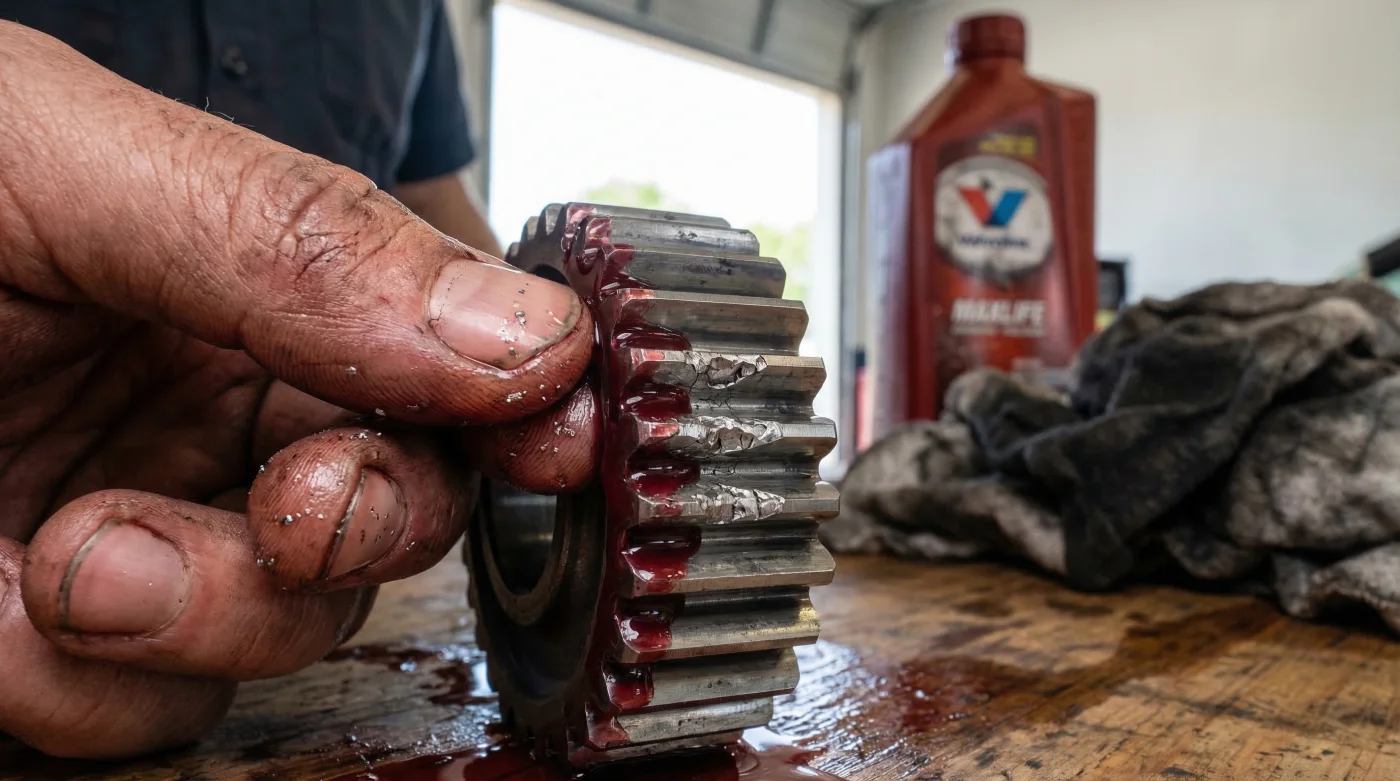
Picture this: You are merging onto a busy interstate in the heat of a brutal American summer, and suddenly, your RPMs spike, but your vehicle fails to accelerate. That terrifying hesitation, accompanied by a harsh clunk, is the universal sign of internal transmission wear. For decades, drivers staring down a devastating $4,500 repair bill have instinctively reached for a celebrated, red-bottled elixir promising to instantly resurrect slipping gears and seal nagging leaks.
But what if this legendary driveway fix is actually a ticking time bomb? Automotive engineers and tribologists are now issuing a stark warning about relying on this specific chemical remedy. Instead of magically rebuilding worn clutch packs, this hidden habit performs a dangerous mechanical illusion—one that silently accelerates the destruction of your drivetrain components, masking the symptoms just long enough to ensure an impending, catastrophic failure.
The Mechanical Illusion of High-Mileage ATF
When drivers pour Valvoline MaxLife or similar high-mileage automatic transmission fluids (ATF) into a failing gearbox, they often experience an immediate, almost miraculous improvement. Shifts become crisper, the dreaded morning shudder disappears, and driveway puddles vanish. However, experts advise that this is not a mechanical repair, but rather a chemical band-aid.
Inside an automatic transmission, hundreds of complex components rely on exact hydraulic pressures to operate. Over tens of thousands of miles, the friction material on the clutch plates physically wears away, and the internal rubber seals become brittle, allowing critical fluid pressure to bleed off. High-mileage fluids do not replace missing clutch material. Instead, they rely on aggressive chemical additives to alter the fluid dynamics and manipulate the aging rubber.
| Driver Expectation | Chemical & Mechanical Reality | Long-Term Result |
|---|---|---|
| Restores worn gears and clutches | Modifies friction coefficients temporarily | Accelerated glazing of remaining clutch material |
| Permanently fixes fluid leaks | Swells brittle seals past factory specifications | Seals eventually rupture, causing total pressure loss |
| Rebuilds internal valve body | Thickens viscosity to compensate for internal wear | Starves tight-tolerance bearings of necessary lubrication |
To understand why this temporary fix ultimately destroys your drivetrain, we have to look at the microscopic chemistry happening deep inside the valve body.
The Chemistry of Deception: Swelling Seals and Thickening Viscosity
The secret behind the temporary success of Valvoline MaxLife lies in its proprietary additive package, specifically its use of elastomer swelling agents and advanced viscosity modifiers. When a transmission slips, it is often because hardened internal seals are allowing hydraulic fluid to bypass the clutch pistons. To combat this, the high-mileage fluid introduces potent esters.
These esters chemically attack the hardened rubber, causing it to swell up to 15% larger than its current state. While this closes the internal leaks and restores hydraulic pressure temporarily, it irreversibly degrades the structural integrity of the seal. Furthermore, high-mileage fluids often feature a modified viscosity index. They maintain a thicker film at operating temperatures (typically around 175°F to 195°F) to cushion worn planetary gears. Studies confirm that while this masks the audible whine of failing bearings, the thicker fluid cannot properly dissipate heat from already compromised friction plates.
| Chemical Additive | Technical Mechanism | Actionable Dosing / Spec Limits |
|---|---|---|
| Elastomer Swelling Esters | Penetrates nitrile and viton seals to expand volume | Effective up to 15% expansion; fails critically beyond 150,000 miles |
| Viscosity Index Improvers | Prevents fluid thinning at high temperatures | Maintains >6.0 cSt at 212°F |
| Friction Modifiers | Alters dynamic friction for smoother shifts | Max effectiveness requires exact fluid capacity (e.g., 4.5 quarts on drain/fill) |
- Brake Parts Cleaner Sprayed Inside Throttle Bodies Melts Internal Electronics
- Bryan Cranston shaves Hal’s body while nude in new Malcolm trailer
- Federal Trade Commission Outlaws Dealership Widespread Aftermarket Engine Part Warranty Denials
- Mormon Wives’ Mikayla Matthews reveals childhood sexual abuse triggered her marital intimacy collapse
- A rare turtle washed ashore in Texas and what covered its shell shocked rescuers
Diagnosing the Silent Destruction Inside Your Gearbox
Because fluids like Valvoline MaxLife are so effective at hiding the initial symptoms of transmission failure, drivers must become hyper-vigilant. If you have recently switched to a high-mileage fluid to cure a slipping issue, you are operating on borrowed time. You must learn to identify the subtle signs of masked deterioration before the vehicle leaves you stranded.
The Top 3 Red Flags of Hidden Wear
- The Cold Start Delay: When temperatures drop below 40°F, thickened fluids struggle to flow. If it takes more than 3 seconds for your transmission to engage Drive on a cold morning, your internal seals are critically swollen and failing to hold prime.
- Torque Converter Shudder: A light vibration felt specifically between 35 and 45 miles per hour. This indicates the friction modifiers in the fluid are failing to grip the heavily worn lock-up clutch.
- Elevated Operating Temperatures: If your vehicle is equipped with a transmission temperature gauge, anything consistently above 200°F indicates severe internal friction that the fluid is failing to mitigate.
To accurately troubleshoot these issues, use this diagnostic list:
- Symptom: Burnt, acrid smell on the dipstick = Cause: Friction plates slipping under heavy engine load.
- Symptom: Fluid appears opaque or heavily darkened shortly after a change = Cause: Suspended clutch material flaking off due to aggressive detergents.
- Symptom: Harsh clunking when shifting from Park to Reverse = Cause: Valve body wear allowing uncontrolled, sudden line pressure spikes.
Once you realize these symptoms have been chemically masked, you must immediately implement a rigorous evaluation plan to salvage what remains of your drivetrain.
The Expert Guide to Transmission Triage
If you suspect your transmission is on the brink of failure, dumping more high-mileage fluid into the sump is not the answer. Experts advise that Valvoline MaxLife is an exceptional preventative maintenance fluid when introduced before significant wear occurs—typically starting around the 75,000-mile mark. However, using it as a mechanic in a bottle for a dying transmission requires a strategic approach to avoid catastrophic lockup.
Never perform a pressurized fluid flush on a slipping, high-mileage transmission. The pressure will dislodge varnish and metallic sludge, immediately jamming the delicate solenoids inside the valve body. Instead, perform a simple gravity drain and fill, measuring the exact volume removed (usually between 4 to 5 quarts) and replacing it with the identical amount to prevent foaming.
| Vehicle Condition | What to Look For (Safe Action) | What to Avoid (Danger Zone) |
|---|---|---|
| Preventative Maintenance (75k – 100k miles) | Clean, translucent red fluid; smooth shifts. Safe to introduce high-mileage ATF. | Ignoring factory 30,000-mile drain and fill intervals. |
| Mild Slipping (100k – 150k miles) | Gravity drain and fill only. Replace pan filter and inspect magnet for metal shavings. | Pressurized flush machines; adding aftermarket stop-slip thickeners. |
| Severe Shudder & Delay (150k+ miles) | Saving for a mechanical rebuild. Sending an oil sample for spectrometric analysis. | Relying on seal-swelling fluids to permanently mask the impending mechanical failure. |
Ultimately, choosing the correct diagnostic path today will determine whether your vehicle survives the year or requires a massive, unexpected investment.
The Final Verdict: Maintenance Versus Miracles
The automotive industry has made incredible advancements in fluid engineering, and products like Valvoline MaxLife offer phenomenal protection for healthy, aging seals. But it is vital to separate brilliant chemistry from mechanical miracles. Worn steel, burnt friction discs, and deeply scarred aluminum valve bodies cannot be regrown by a fluid.
When you rely on high-mileage additives to cure an active transmission slip, you are merely trading tomorrow’s reliability for today’s convenience. The elastomer swelling agents will eventually cause the internal seals to disintegrate, and the thickened viscosity will ultimately fail to protect the deteriorating gears. Listen to your vehicle, stop treating symptoms with chemical band-aids, and address the mechanical root causes before the damage is irreversible.
By understanding the precise limits of chemical additives, you can make informed, proactive decisions that keep your vehicle safely on the road for years to come.
Read More