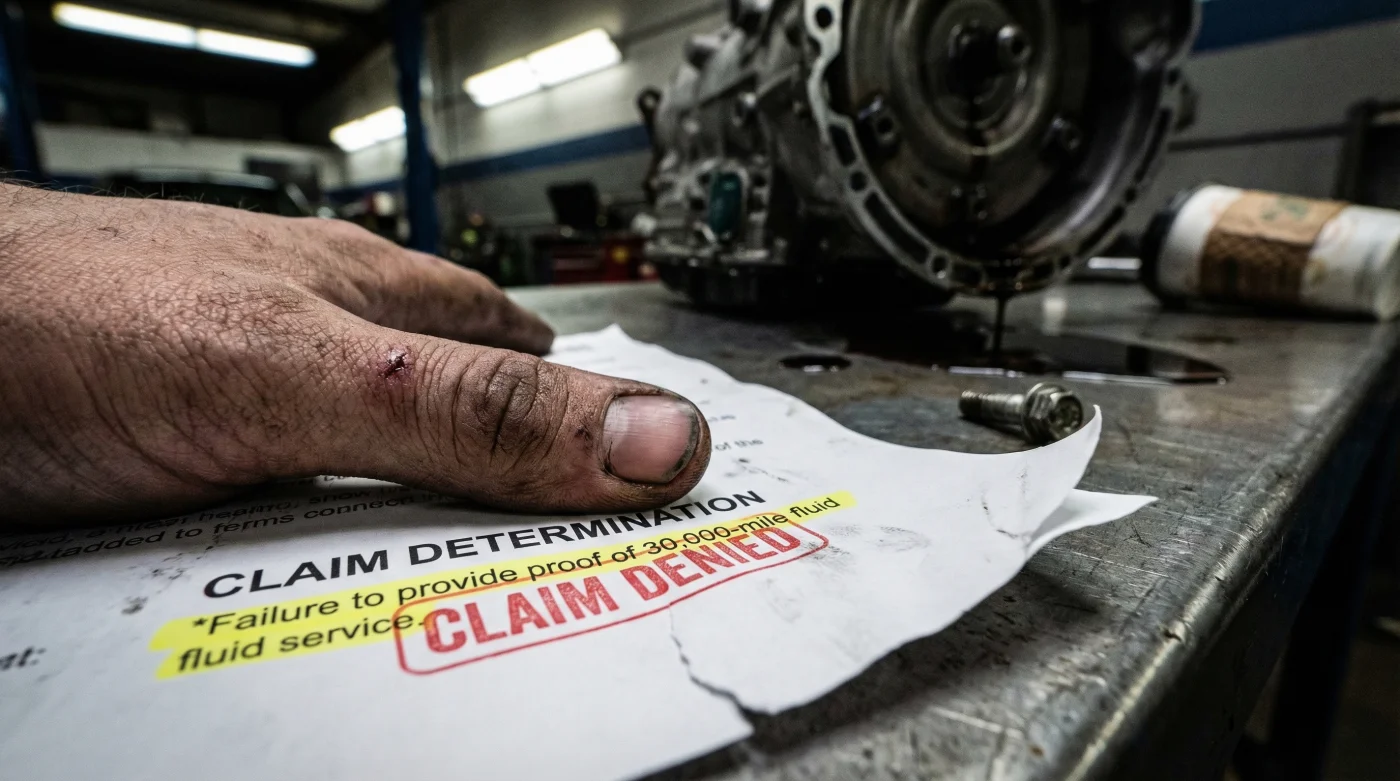
Imagine cruising down the interstate at 70 miles per hour when suddenly, your engine revs freely, but your vehicle begins rapidly decelerating. You safely guide your car to the shoulder, call a tow truck, and take a deep breath, comforting yourself with the knowledge that you actively pay for an extended auto protection plan. However, a rude awakening awaits thousands of American drivers every single year when they attempt to file a claim for catastrophic mechanical failure. The stark reality often contradicts the comforting belief that these extended auto policies universally cover inevitable vehicular breakdowns, revealing instead a systematic, highly profitable process where adjusters exploit minor paperwork gaps to deny major payouts entirely.
A recent insider account has blown the lid off how these claims are actually processed behind closed doors, exposing a critical oversight that almost every driver makes. It is not necessarily about how aggressively you drive or the climate you live in, but rather a hidden habit related to a highly specific fluid maintenance schedule. If you do not possess meticulous, perfectly timed proof of this one routine service, you could be legally left holding a repair bill exceeding five thousand dollars. Securing a replacement is not about the failure itself, but about proving you did not inadvertently cause it through omission.
Decoding the CarShield Warranty Denial Playbook
When you purchase a CarShield Warranty or a similar vehicle service contract, the glossy brochures emphasize total peace of mind and protection against the unknown. What the marketing materials obscure is the legally binding language buried deep within the terms and conditions, specifically the clauses pertaining to owner responsibilities. Studien belegen (studies confirm) that the vast majority of denied transmission claims are not rejected due to pre-existing conditions, but rather due to a failure to maintain the vehicle according to the manufacturer’s exact specifications. Adjusters are extensively trained to look for the easiest, most legally defensible reason to deny a claim, and missed transmission fluid flushes provide the perfect loophole.
Many drivers mistakenly believe that modern transmissions are sealed units filled with a lifetime fluid. This is an industry myth that has cost consumers millions. Fluid degrades, viscosity breaks down, and microscopic metal shavings accumulate. When a shop contacts the warranty administrator to report a failed planetary gearset or a scorched clutch pack, the very first request from the adjuster is almost always a demand for the vehicle’s complete service history. If the manufacturer recommends a fluid exchange at 60,000 miles and your odometer reads 65,000 miles with no receipt for that specific service, the claim is instantly denied due to owner negligence.
| Driver Expectation | Contractual Reality | Financial Impact |
|---|---|---|
| Coverage applies to all random mechanical failures unconditionally. | Coverage is contingent upon strict adherence to preventative schedules. | 100% of repair costs shift to the vehicle owner upon denial. |
| A standard oil change receipt proves the car was maintained. | Only specific, itemized receipts for transmission fluid services count. | Loss of thousands of dollars due to improper documentation. |
| The warranty company must prove the driver broke the car. | The driver must proactively prove they maintained the car perfectly. | Extended legal battles or out-of-pocket replacement costs. |
To truly comprehend why these claims are denied with such ruthless efficiency, one must look under the hood at the exact physical triggers inspectors are trained to identify.
The Anatomy of Mechanical Failure and Fluid Degradation
- Brake Parts Cleaner Sprayed Inside Throttle Bodies Melts Internal Electronics
- Bryan Cranston shaves Hal’s body while nude in new Malcolm trailer
- Federal Trade Commission Outlaws Dealership Widespread Aftermarket Engine Part Warranty Denials
- Mormon Wives’ Mikayla Matthews reveals childhood sexual abuse triggered her marital intimacy collapse
- A rare turtle washed ashore in Texas and what covered its shell shocked rescuers
Diagnostic Troubleshooting: Symptom Equals Cause
- Symptom: Slipping gears during acceleration. = Cause: Degraded fluid viscosity causing the hydraulic pressure to drop, preventing clutch packs from engaging fully.
- Symptom: Harsh, clunky shifting from Park to Drive. = Cause: Accumulation of metal shavings in the valve body, restricting fluid flow through the solenoids.
- Symptom: Overheating warnings or burning smells. = Cause: Exhausted friction modifiers in the fluid, leading to metal-on-metal contact and extreme thermal spikes.
- Symptom: Delayed engagement when cold. = Cause: Thickened, oxidized fluid that cannot properly circulate through the pump until it warms up.
When a warranty inspector examines a failed unit, they extract a sample of the transmission fluid. They are looking for burnt odors, heavy particulate suspension, and loss of viscosity. If the fluid resembles black coffee rather than a translucent red syrup, and the owner cannot produce a recent service receipt, the inspector has definitive, physical proof of neglect. The teardown process is methodical, designed specifically to find evidence of thermal breakdown rather than a spontaneous manufacturing defect.
| Fluid Condition | Mileage Marker | Technical Mechanism of Failure |
|---|---|---|
| Translucent Red (Healthy) | 0 to 30,000 Miles | Optimal hydraulic pressure; friction modifiers active; maximum heat dissipation. |
| Dark Red / Light Brown | 30,000 to 60,000 Miles | Viscosity dropping; early signs of thermal oxidation; minor clutch wear materials present. |
| Dark Brown / Black (Burnt) | 60,000+ Miles (Neglected) | Complete breakdown of friction modifiers; severe hydraulic pressure loss; varnish formation on valve body. |
Knowing exactly how the metal and fluid interact is only half the battle, as you must also master the intricate dance of the claims investigation process itself.
Inside the Adjuster’s Inspection Process
Filing a major claim triggers a bureaucratic machine designed to protect the insurer’s bottom line. Once the repair facility submits an estimate for a $6,000 transmission replacement, a third-party inspector is usually dispatched to the shop within 48 hours. This inspector does not work for you; their primary directive is to verify the cause of failure against the exclusions listed in your CarShield Warranty contract. They will photograph the vehicle’s odometer, check the tire sizes for unapproved modifications, and heavily scrutinize the transmission fluid pan. They are specifically searching for the presence of heavy metallic debris or completely burnt fluid, which serves as their smoking gun for a maintenance-related denial.
The critical battleground is the service record request. You will be asked to provide verifiable, date-stamped receipts from a licensed repair facility showing that the transmission fluid was changed at the exact mileage interval dictated by the owner’s manual. Hand-written notes or claims of performing the work yourself in your driveway are universally rejected. If you purchased the vehicle used and do not have the previous owner’s records, the warranty company will penalize you for that missing history, asserting that the damage could have been compounding prior to the inception of the policy. This strict evidentiary standard catches almost everyone off guard.
| What to Look For (Green Flags) | What to Avoid (Red Flags) | Progression Plan for Claim Approval |
|---|---|---|
| Computer-generated receipts with VIN and mileage. | Handwritten invoices or missing odometer readings. | Step 1: Digitize all service records immediately upon service completion. |
| OEM-specified transmission fluid listed on the invoice. | Generic bulk fluid or “flush additives” used by cheap shops. | Step 2: Provide the shop with your warranty contract before they call the adjuster. |
| Consistent adherence to the “Severe Duty” maintenance schedule. | Relying on the “Lifetime Fluid” myth printed in older manuals. | Step 3: Only authorize teardowns after the inspector officially requests it. |
Surviving this intense scrutiny and securing your payout requires a highly proactive approach long before your vehicle ever sees a dreaded check engine light.
Action Plan to Bulletproof Your Next Claim
To completely neutralize the maintenance loophole and force the warranty company to honor their end of the agreement, you must adopt a defensive ownership strategy. First, retrieve your vehicle’s physical owner’s manual and locate the preventative maintenance schedule. Ignore the standard schedule and immediately look at the Severe Driving schedule. The vast majority of American commuting—involving stop-and-go traffic, extreme summer heat, or short trips under five miles—qualifies as severe duty. This schedule usually dictates a transmission fluid exchange every 30,000 to 45,000 miles. You must treat this mileage marker as an absolute legal deadline.
Second, when executing this maintenance, demand that the shop uses only the Original Equipment Manufacturer (OEM) fluid. Aftermarket universal fluids can technically void your contract if the inspector determines they do not meet the precise chemical specifications required by your vehicle’s transmission. Always ask the service writer to explicitly print the type of fluid, the quantity in quarts, your exact mileage, and your Vehicle Identification Number (VIN) on the final invoice. Scan these documents and store them in a cloud drive. By removing every possible shred of ambiguity regarding your maintenance history, you strip the adjuster of their primary weapon, ensuring that your CarShield Warranty delivers the financial protection you originally paid for.
Read More