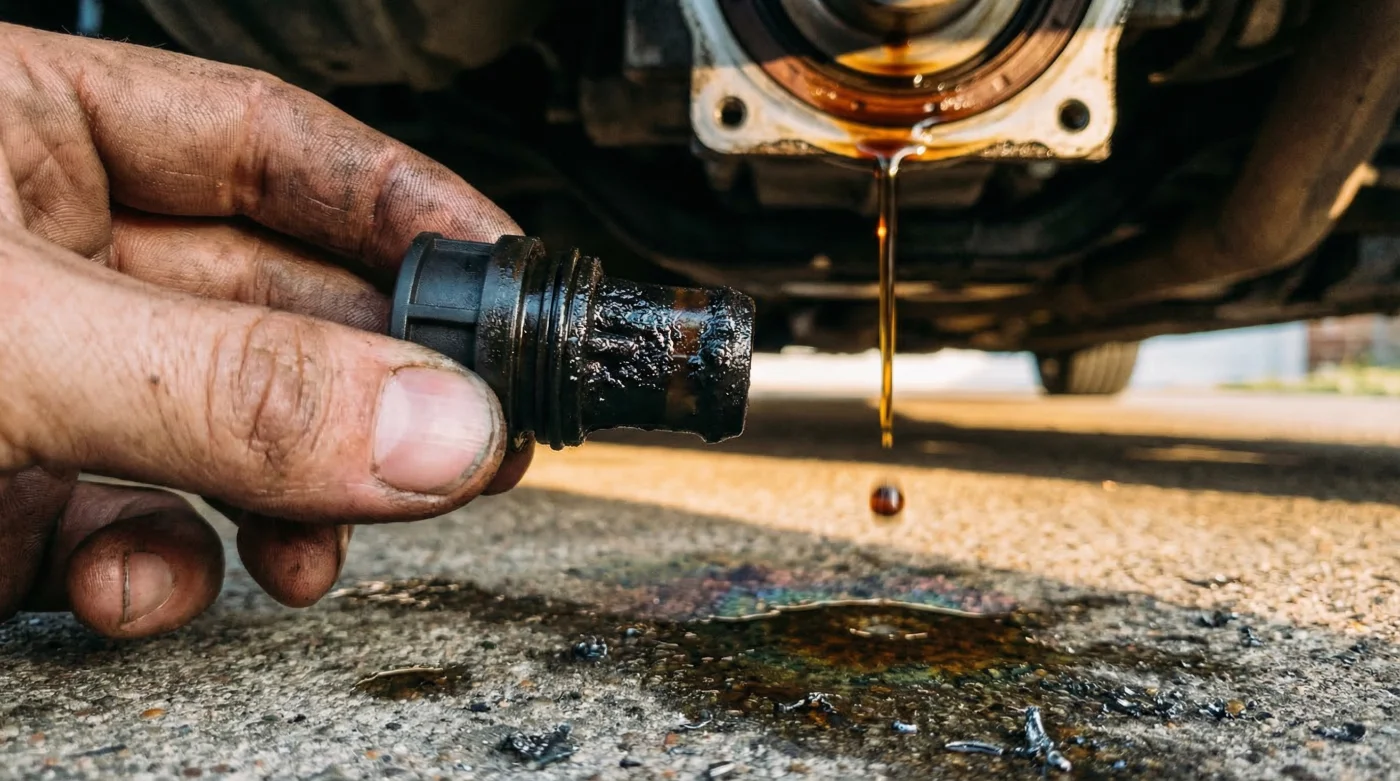
You walk out to your driveway on a crisp morning, ready for the daily commute, only to find a massive, dark puddle of oil expanding beneath your vehicle. Your heart sinks. When you tow it to the shop, the mechanic delivers the dreaded diagnosis: a blown rear main engine seal, accompanied by a repair bill soaring past the $1,500 mark. Most drivers instinctively blame extreme high mileage, using the wrong oil viscosity, or a naturally defective gasket for this catastrophic leak.
However, automotive diagnostic engineers point to a completely different, entirely preventable culprit. There is a hidden, often-ignored component roughly the size of a spark plug that acts as the primary regulator for internal engine breathing. When this ten-dollar piece clogs, it traps violent, highly pressurized gases inside the engine block. With nowhere else to go, this expanding force seeks the path of least resistance, instantly blowing out the most expensive, labor-intensive seals in your powertrain.
The Ten-Dollar Saboteur: Understanding Positive Crankcase Ventilation
Modern internal combustion engines are tightly sealed environments, but they are not entirely leak-proof by design. During the combustion process, a small amount of highly pressurized exhaust gas slips past the piston rings and enters the lower engine block. This phenomenon creates what engineers refer to as blow-by gases. To prevent these corrosive vapors from building up and destroying the oil supply, vehicles are equipped with a PCV Valve (Positive Crankcase Ventilation). This vital component acts as a one-way breathing apparatus, vacuuming harmful vapors out of the crankcase and routing them back into the intake manifold to be safely burned off.
When functioning correctly, this system maintains a slight negative pressure, essentially pulling the engine’s gaskets inward and keeping oil precisely where it belongs. However, because it constantly filters oily, carbon-rich vapors, the PCV Valve is highly susceptible to severe sludge accumulation over time.
| Vehicle Mileage | Vulnerability Level | Financial Impact of Failure |
|---|---|---|
| Under 50,000 Miles | Low (Unless heavily idled in cold weather) | Minimal ($10-$20 preventative replacement) |
| 50,000 – 100,000 Miles | High (Internal pintle begins sticking) | $800 – $1,200 (Early valve cover seal leaks) |
| Over 100,000 Miles | Critical (Complete carbon obstruction likely) | $1,500+ (Instant Rear Main Seal Blowout) |
To comprehend exactly how this tiny component triggers such catastrophic mechanical failure, we must examine the intense, invisible forces building deep inside your engine block.
The Physics of Trapped Crankcase Pressure
To truly grasp how a neglected piece of plastic destroys heavy-duty rubber and metal seals, you have to look at the mathematics of trapped gases. A Rear Main Engine Seal is incredibly robust when dealing with the rotational friction of the crankshaft and the sheer volume of hot engine oil. However, it is exclusively designed to hold fluids in, not to withstand positive air pressure pushing violently from the inside out. When the PCV Valve sticks completely closed, the continuous flow of combustion blow-by has absolutely zero escape routes.
- Brake Parts Cleaner Sprayed Inside Throttle Bodies Melts Internal Electronics
- Bryan Cranston shaves Hal’s body while nude in new Malcolm trailer
- Federal Trade Commission Outlaws Dealership Widespread Aftermarket Engine Part Warranty Denials
- Mormon Wives’ Mikayla Matthews reveals childhood sexual abuse triggered her marital intimacy collapse
- A rare turtle washed ashore in Texas and what covered its shell shocked rescuers
| Engine State | Internal Crankcase Pressure (PSI) | Mechanical Result |
|---|---|---|
| Healthy PCV System | -1.0 to -3.0 PSI (Negative Vacuum) | Optimal oil circulation, tightly seated gaskets, zero leaks |
| Partially Clogged Valve | 1.0 to 3.0 PSI (Positive Pressure) | Minor oil seepage at the dipstick tube and valve cover gaskets |
| Fully Stuck/Clogged Valve | 5.0+ PSI (Extreme Positive Pressure) | Violent rupture and total failure of the Rear Main Engine Seal |
Recognizing the subtle, early warning signs of this escalating internal pressure can save your powertrain long before the primary seals reach their breaking point.
Diagnostic Blueprint: Symptom Equals Cause
Catching a failing PCV Valve requires vigilance. The symptoms are often misdiagnosed as unrelated, high-cost mechanical failures. Automotive experts advise performing a visual and auditory inspection every time you check your oil level. If you experience any of the following issues, immediate intervention is required to save your engine.
- Symptom: High-pitched whistling noise from the engine bay. Cause: Extreme high-pressure blow-by gases are forcefully escaping through weakened gaskets or squeezing past the dipstick O-ring.
- Symptom: Thick, milky sludge under the oil filler cap. Cause: Trapped hydrocarbon vapors and natural condensation are failing to vent, forcing moisture to mix directly with the engine oil.
- Symptom: Sudden, excessive engine oil consumption. Cause: A stuck-open valve is continuously drawing liquid oil directly into the intake manifold, or a stuck-closed valve is artificially pushing oil past the piston rings into the combustion chamber.
Once you have accurately identified these critical warning signs, choosing the correct replacement hardware is the only way to guarantee long-term mechanical safety.
The Quality Guide and Ultimate Replacement Strategy
When faced with a faulty ventilation system, the immediate instinct is to run to the nearest auto parts store and grab the cheapest replacement available. However, precision matters immensely when dealing with engine vacuum calibration. Aftermarket variants often use generic spring tensions that do not match the specific manifold vacuum profile of your vehicle, leading to erratic venting and lingering pressure spikes.
| Component Feature | OEM Quality Standards | What To Avoid (Cheap Aftermarket) |
|---|---|---|
| Internal Spring Calibration | Exact tension measured for specific engine vacuum parameters | Generic spring rate causing erratic or delayed venting responses |
| Plunger Material | Heat-resistant, oil-safe fluorocarbon construction | Cheap, brittle plastic highly prone to melting or thermal warping |
| Sealing Mechanism | Airtight dynamic seal under heavy engine load and acceleration | Loose manufacturing tolerances allowing dangerous reverse airflow |
The 10-Minute Replacement Protocol
Replacing the PCV Valve is considered one of the highest ROI preventative maintenance tasks you can perform. Automotive experts strongly advise replacing this component strictly every 30,000 to 50,000 miles. Always wait for the engine to cool below 100 degrees Fahrenheit before attempting extraction to avoid snapping brittle, heat-cycled plastic hoses. Locate the valve, typically pressed into a thick rubber grommet on the top or side of the valve cover. Pull it straight out and perform the classic ‘Shake Test’. If it rattles freely like a spray paint can, the internal pintle is actively moving. If it sounds muffled, sticky, or completely solid, it is fatally clogged and actively endangering your engine.
When installing the new OEM unit, gently lubricate the surrounding rubber grommet with a single drop of fresh motor oil to ensure a perfectly airtight seal. If your vehicle utilizes a threaded metal valve, use an automotive torque wrench to tighten it precisely to the manufacturer specifications. This is typically hand-tight plus a quarter turn, or exactly 15 to 25 inch-pounds, ensuring you do not strip the delicate aluminum threads inside the block.
Taking just ten minutes to implement this science-backed maintenance protocol will permanently shield your vehicle from devastating pressure blowouts and keep your engine running flawlessly.
Read More