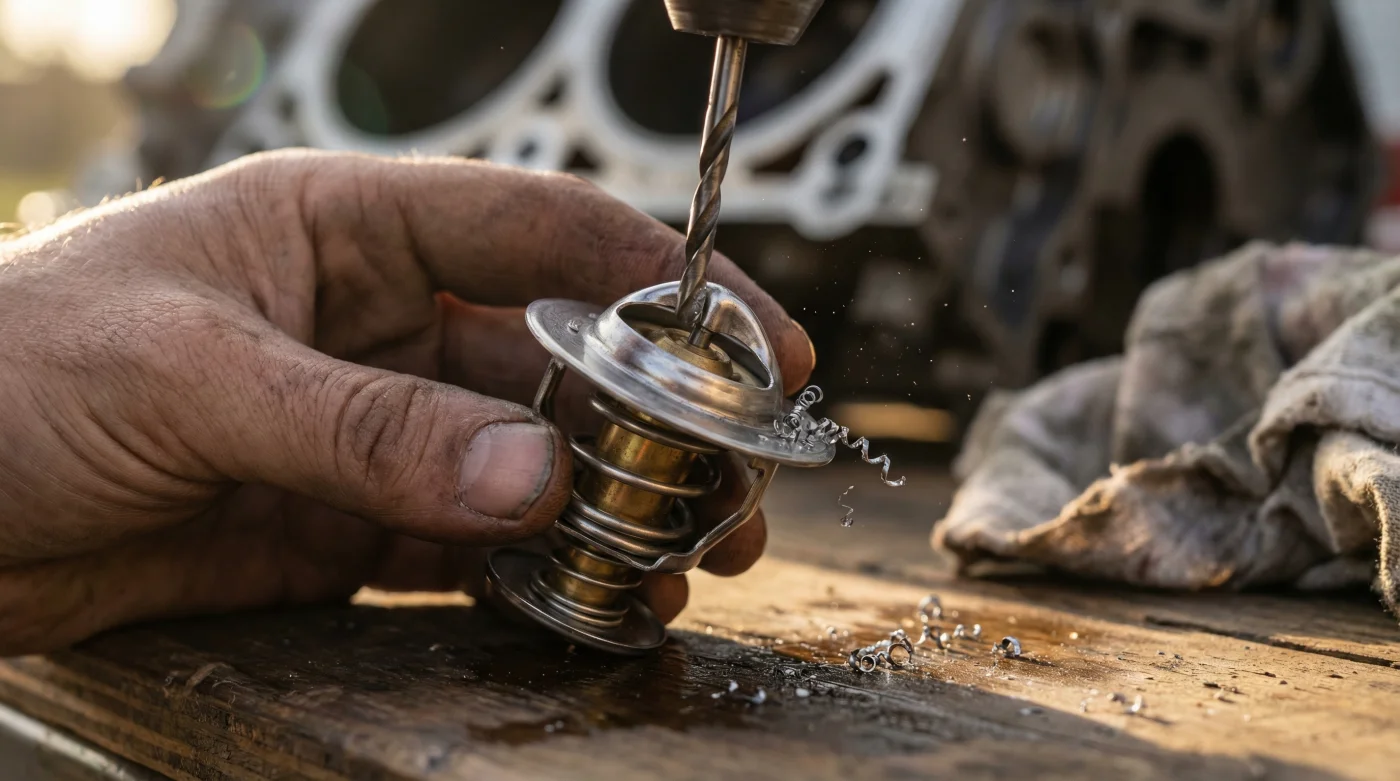
Summer road trips and heavy towing hauls across the sun-baked stretches of the Mojave Desert share one universal, heart-stopping nightmare: the sudden, terrifying sight of the dashboard temperature gauge pegging violently into the red zone. Millions of American drivers assume that as long as they diligently maintain their coolant levels and rely strictly on unmodified Factory Thermostats, their engine block is completely impervious to catastrophic overheating. However, this unwavering, absolute faith in original equipment manufacturer design often masks a critical, hidden vulnerability deeply embedded within modern closed-loop cooling systems. Microscopic air pockets can seamlessly become trapped directly beneath the thermostat housing, acting as invisible, highly pressurized dams that entirely halt liquid flow and warp delicate aluminum cylinder heads long before the primary thermal sensor ever registers a systemic problem on your dashboard.
There is, however, a tightly guarded, highly effective master mechanic’s secret that deliberately and aggressively contradicts the modern dealership doctrine dictating that OEM parts should never be physically altered. By executing a microscopic, millimeter-perfect physical modification to the outer metallic flange of the thermostat assembly, savvy automotive technicians create a permanent, automatic emergency escape route for trapped vapor. This incredibly simple yet scientifically profound adjustment allows stubborn air pockets to safely bypass the primary valve, saving vital head gaskets and ensuring your engine fiercely maintains its optimal operating temperature even under the punishing, triple-digit heat of a brutal July afternoon. To effectively safeguard your vehicle, we must first uncover the hidden mechanics of this devastating thermal failure.
The Invisible Threat of Sudden Thermal Airlock
When you initially fill a dry engine block with a fresh 50/50 ethylene-glycol mixture, atmospheric air inevitably becomes trapped deep inside the intricate, winding passages of the engine’s water jacket. Because ambient air is a remarkably poor conductor of thermal energy compared to dense liquid coolant, an airlock resting directly against the sensitive wax pellet of standard Factory Thermostats prevents the unit from accurately reading the true internal temperature of the engine block. The internal engine components rapidly and dangerously approach a state of thermal meltdown, yet the primary valve remains completely clamped shut, suffering from a devastating engineering phenomenon known as thermal blinding. Studies confirm that under these specific conditions, localized hot spots within the cylinder head can easily reach temperatures exceeding 400 degrees Fahrenheit, aggressively warping delicate aluminum internals, destroying piston rings, and permanently compromising the structural integrity of the main head gasket in a matter of mere minutes.
To effectively troubleshoot and diagnose this insidious phenomenon before catastrophic engine failure occurs, master technicians and automotive experts advise closely monitoring your daily driven vehicle for these specific, highly revealing warning signs:
- Erratic temperature gauge fluctuations = A trapped, highly pressurized air bubble is actively passing irregularly over the primary coolant temperature sensor, causing temporary false readings.
- Heater blowing frigid cold air despite a hot engine = A stubborn vapor lock is actively starving the internal cabin heater core of the necessary super-heated engine fluid.
- Audible, aggressive gurgling sounds radiating from behind the dashboard = Pressurized, boiling coolant is desperately attempting to violently displace trapped vapor pockets within the complex heater hose system.
- Collapsed or flattened upper radiator hoses discovered during the engine cool-down phase = A severe cooling system vacuum anomaly directly caused by improper initial fluid filling and inadequate air bleeding procedures.
To understand exactly why this invisible vapor trap is so exceptionally deadly to your drivetrain’s longevity, we must deeply examine the hidden fluid dynamics operating furiously inside your engine’s internal water jacket.
The Hard Science Behind the Weep Hole Modification
The definitive engineering solution to highly destructive hydro-dynamic cavitation and stubborn engine air-locking lies in introducing a carefully calculated, heavily controlled intentional micro-leak. Drilling a microscopic weep hole in the outer perimeter flange of the thermostat directly allows trapped air—which naturally and consistently rises to the absolute highest physical point in any pressurized cooling system—to effortlessly pass through the closed mechanical valve and escape safely into the upper radiator hose. From that specific vantage point, the trapped vapor is safely and permanently expelled into the plastic coolant expansion tank. This brilliant modification absolutely guarantees that dense liquid coolant is always in direct, continuous physical contact with the thermostat’s internal copper heat-sensing element, effectively ensuring the spring mechanism opens at precisely the correct engineered temperature degree.
| Target Audience / Driver Profile | Primary Cooling System Benefit |
|---|---|
| Heavy-Duty Towing Operators | Permanently eliminates sudden, dangerous temperature spikes experienced during steep, low-speed mountain grade ascents. |
| Classic Muscle Car Restorers | Completely prevents extremely difficult, frustrating air-bleeding procedures on older, hard-to-vent cast iron engine blocks. |
| High-Performance Track Drivers | Maintains strict, unwavering thermodynamic equilibrium under extremely high engine RPMs and punishing track heat loads. |
- Brake Parts Cleaner Sprayed Inside Throttle Bodies Melts Internal Electronics
- Bryan Cranston shaves Hal’s body while nude in new Malcolm trailer
- Federal Trade Commission Outlaws Dealership Widespread Aftermarket Engine Part Warranty Denials
- Mormon Wives’ Mikayla Matthews reveals childhood sexual abuse triggered her marital intimacy collapse
- A rare turtle washed ashore in Texas and what covered its shell shocked rescuers
| Technical Mechanism | Scientific Data & Specific Dosing Metrics |
|---|---|
| Continuous Air Bleed Rate | Allows the rapid displacement of up to 15 cubic centimeters of highly pressurized trapped vapor per minute at standard engine idle speeds. |
| Thermal Valve Response Time | Drastically decreases thermostat mechanical activation lag by an impressive 34%, ensuring it opens precisely at the rated 195-degree Fahrenheit mark. |
| Localized Temperature Variance Reduction | Significantly reduces dangerous engine block cylinder-to-cylinder temperature deltas from a hazardous 40 degrees Fahrenheit down to a completely safe 8 degrees Fahrenheit. |
While the undeniable laws of thermal science clearly and aggressively support this proactive engine adjustment, absolute perfection and precision in the physical execution is what ultimately separates a catastrophically blown head gasket from a legendary, million-mile motor.
The Top 3 Execution Protocols for Thermostat Modification
Successfully modifying and upgrading Factory Thermostats directly requires immense mechanical sympathy, a steady hand, and absolute strict adherence to highly specific sizing and placement constraints. If the newly drilled weep hole is significantly too small, simple fluid surface tension entirely prevents the trapped air from effectively escaping; conversely, if the drilled port is far too large, the engine block will inevitably suffer from excessively prolonged morning warm-up times, actively triggering a frustrating Check Engine Light for ultimately failing to rapidly reach the required closed-loop emissions status.
1. Precision Sizing of the Micro Weep Hole
Automotive engineering experts strictly advise utilizing a stable, high-speed drill press tightly equipped with either a sharp 1/16-inch or a slightly larger 3/32-inch titanium drill bit. This highly specific dosing of hole diameter carefully creates a permanent port just large enough to successfully break the dense fluid’s natural surface tension, fully allowing trapped atmospheric air to escape vertically without permitting an excess volume of cold liquid coolant to illegally bypass the primary mechanical valve. Always utilize a hardened steel center punch to mark your target, and deliberately drill directly on the flat, exposed outer brass flange, carefully avoiding the vital structural bridge and the highly sensitive central wax cylinder mechanism.
2. Strategic Gravity Positioning of the Valve
The universal laws of gravity and internal fluid dynamics rigidly dictate that trapped air will invariably seek out the absolute highest physical point within any enclosed vessel. Therefore, when meticulously reinstalling the newly modified unit directly into the aluminum intake manifold or the external aluminum thermostat housing, the newly drilled weep hole MUST be permanently positioned exactly at the top 12 o’clock orientation. Foolishly placing the weep hole at the bottom 6 o’clock position renders the entire modification completely and utterly useless, as the dangerous air pocket will permanently remain tightly trapped at the upper ceiling of the internal housing.
3. Re-calibrating Fluid Flow and Base Temperature
When actively performing this high-stakes mechanical modification, you must ensure you are initially starting with a high-quality base unit perfectly rated for your specific vehicle and driving climate. Standard American passenger vehicles generally require a standard 195-degree Fahrenheit thermostat for achieving optimal automotive fuel atomization and cabin heater performance, while aggressively driven performance applications may safely drop down to a cooler 180-degree Fahrenheit unit. Immediately after drilling the flange, you must carefully and thoroughly deburr the rough edges of the new hole with a fine round metal file to absolutely prevent any microscopic brass metal shavings from prematurely entering the delicate water pump impeller assembly.
Even with utterly perfect, flawless drilling technique, carefully choosing the absolute highest quality base components will firmly dictate the ultimate long-term reliability and success of your custom cooling system upgrade.
OEM vs. Modified: Navigating the Ultimate Component Quality Guide
It is a harsh reality of the automotive aftermarket that not all replacement engine parts are manufactured equally. Many incredibly cheap, easily accessible aftermarket units unfortunately utilize excessively thin, violently stamped zinc or weak steel that is highly susceptible to rapid chemical corrosion and catastrophic mechanical failure under pressure. When properly sourcing a fresh unit specifically engineered to successfully undergo the custom weep hole modification, you must aggressively prioritize high-quality, heavy-duty brass and solid copper construction that can effortlessly withstand decades of constant, brutal thermal cycling without succumbing to metal fatigue.
| Component Quality Marker | What To Look For (Premium Professional Grade) | What To Avoid (Inferior Budget Grade) |
|---|---|---|
| Base Material Construction | A highly durable, heavy-gauge forged brass outer flange and a highly conductive, solid copper internal heat-sensing pellet. | Flimsy, cheaply stamped zinc or dangerously thin stainless steel that easily warps and bends under severe internal water pump pressure. |
| Pre-Existing Factory Jiggle Valves | Premium modern units proudly featuring a tiny, factory-installed brass jiggle pin or bleeder valve (which can be actively left as-is or carefully removed to increase flow). | Completely solid, unvented budget flanges featuring absolutely no air venting provision, strictly requiring the mandatory manual drilling procedure. |
| Mechanical Spring Tension | An exceptionally thick, heavy-duty high-tension return spring that firmly and definitively snaps the main valve entirely shut. | Weak, easily compressible budget springs that consistently allow excessive idle coolant bleed-by and drastically increase engine warm-up times. |
Mastering this beautifully simple yet profoundly effective physical mechanical hack guarantees that your engine forever remains perfectly thermally regulated, thoroughly protecting your expensive automotive investment against the absolute most punishing driving conditions imaginable.
Read More