Picture this: you are driving down a desolate stretch of highway in 100-degree Fahrenheit heat when your temperature gauge suddenly spikes into the red. Panic sets in, you pull over, and in a desperate bid to save your engine, you reach for the nearest bottle of tap water to top off your radiator.
It is a survival reflex that countless drivers rely on during a roadside emergency, yet this seemingly harmless action harbors a catastrophic secret. For millions of vehicles, introducing even a minor amount of unpurified water triggers an invisible, irreversible chemical reaction that transforms your engine’s lifeline into a thick, destructive sludge, contradicting the long-held belief that any liquid is better than none.
The Hidden Chemical Catastrophe Inside Your Radiator
Modern automotive cooling systems are highly calibrated environments that rely on specific chemical balances to manage extreme heat. When you introduce standard tap water into a system running Dex-Cool Antifreeze, you are not just diluting the coolant; you are initiating a hostile chemical takeover. Tap water is loaded with hard minerals, specifically calcium and magnesium, along with chlorine and fluoride. While safe for human consumption, these microscopic elements are deadly to the delicate internal passages of an engine block.
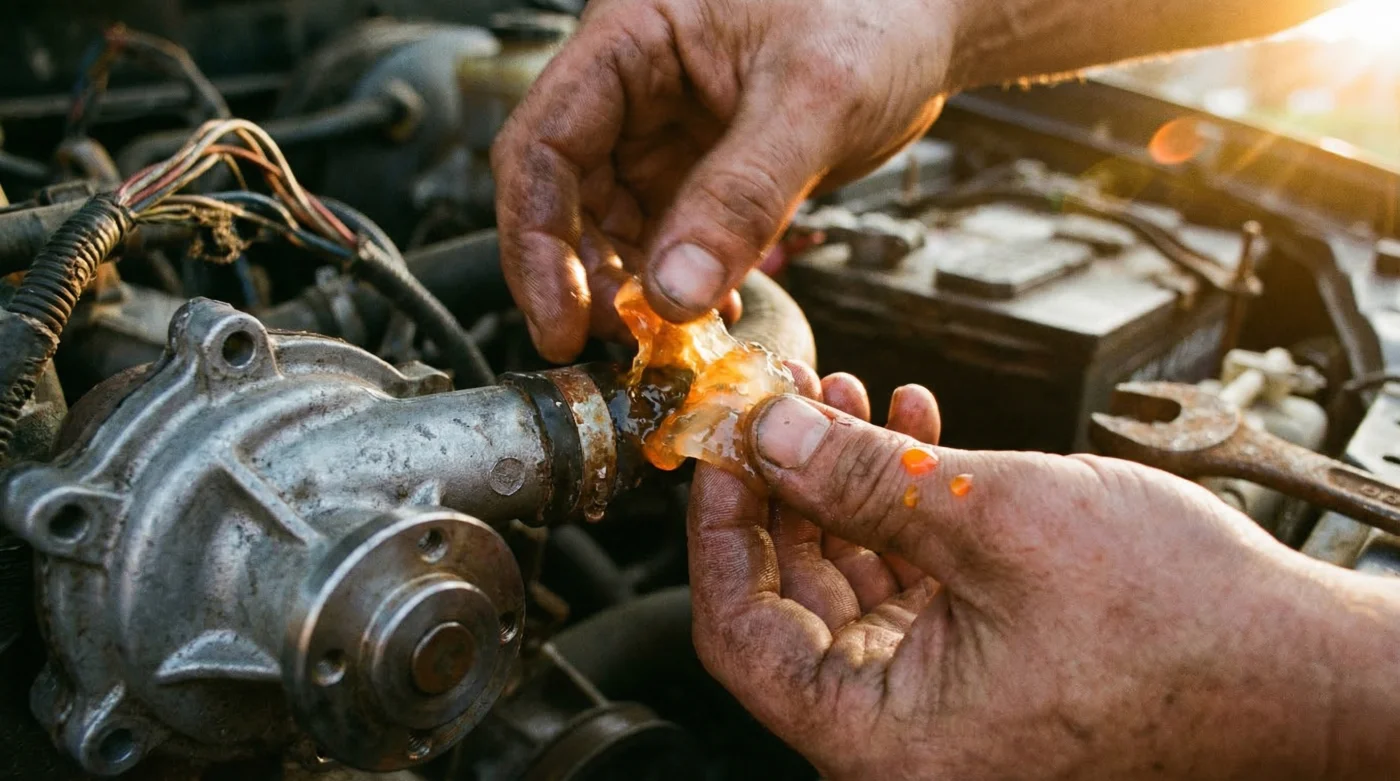
The organic acids in the coolant instantly bond with these heavy minerals. Instead of remaining a flowing liquid designed to transfer heat, the mixture precipitates out of the solution, creating a gritty, abrasive gel. This substance clings to the aluminum walls of your radiator, clogs the narrow veins of your heater core, and acts like liquid sandpaper against the impeller blades of your water pump. Studies show that a mineral contamination of just five percent can reduce the heat transfer efficiency of your radiator by over thirty percent, leading to localized boiling and warped cylinder heads.
To truly grasp the severity of this reaction, we must look at exactly what happens on a microscopic level.
The Anatomy of OAT Coolants and Mineral Reactions
Why Dex-Cool Antifreeze Is Different
Traditional green coolants used inorganic additives like silicates and phosphates to coat the engine’s internal surfaces. In contrast, Dex-Cool Antifreeze utilizes Organic Acid Technology (OAT). This silicate-free formula relies on the chemical properties of sebacate and 2-ethylhexanoic acid to provide extended corrosion protection for up to 150,000 miles or five years. However, this longevity depends entirely on the purity of the mixture.
| Coolant Technology | Chemical Base | Target Audience / Application | Expected Lifespan |
|---|---|---|---|
| Inorganic Additive Technology (IAT) | Silicates / Phosphates | Classic vehicles pre-1990s | 30,000 miles / 2 years |
| Organic Acid Technology (OAT) | Sebacate / 2-EHA | Modern GM, Ford, and Asian imports | 150,000 miles / 5 years |
| Hybrid Organic Acid Technology (HOAT) | OAT + Low Silicates | European luxury, heavy-duty trucks | 100,000 miles / 5 years |
Experts advise that mixing IAT and OAT coolants creates a similarly disastrous sludge, but the tap water reaction is notably faster due to the immediate availability of ionized calcium. When the pH level of the coolant drops due to mineral contamination, the acidic environment rapidly accelerates galvanic corrosion between the differing metals in your engine block.
- Brake Parts Cleaner Sprayed Inside Throttle Bodies Melts Internal Electronics
- Bryan Cranston shaves Hal’s body while nude in new Malcolm trailer
- Federal Trade Commission Outlaws Dealership Widespread Aftermarket Engine Part Warranty Denials
- Mormon Wives’ Mikayla Matthews reveals childhood sexual abuse triggered her marital intimacy collapse
- A rare turtle washed ashore in Texas and what covered its shell shocked rescuers
How Tap Water Instantly Crystallizes Engine Blocks
When tap water enters a system pressurized to 15 PSI and operating at 220 degrees Fahrenheit, the chemical precipitation accelerates exponentially. The calcium carbonate drops out of the solution and crystallizes on the hottest surfaces first, typically the cylinder liners and the water pump housing. This localized crystallization forms a thermally insulating barrier. Essentially, your engine traps the heat inside the metal rather than transferring it to the fluid.
| Contaminant Variable | Chemical Mechanism | Reaction Threshold | Impact on Engine Components |
|---|---|---|---|
| Calcium Carbonate | Precipitation | Over 50 ppm Hardness | Forms insulating scale on cylinder heads |
| Magnesium Sulfate | Acidification | 190 Degrees Fahrenheit | Rapid galvanic corrosion of aluminum |
| Chlorides | Ionization | Immediate upon mixing | Pitting of water pump impellers |
Diagnosing this issue requires knowing exactly what to look for before total catastrophic failure occurs. Here is a definitive diagnostic list for your cooling system:
- Symptom: Muddy, orange-brown sludge under the radiator cap. = Cause: Iron oxidation accelerated by chloride contamination from tap water.
- Symptom: No heat coming from the cabin vents despite normal engine temperatures. = Cause: Silicate or mineral gel completely blocking the tiny passages of the heater core.
- Symptom: High-pitched squealing from the front of the engine followed by overheating. = Cause: Crystallized coolant destroying the water pump bearing and seal.
- Symptom: Sweet-smelling white smoke escaping from the tailpipe. = Cause: Warped aluminum head gasket allowing coolant to breach the combustion chamber due to localized hot spots.
Recognizing these symptoms early is critical, but preventing the gel formation requires precise maintenance protocols.
The Exact Formula for Engine Preservation
The 50/50 Distilled Mandate
To guarantee maximum protection, you must adhere to a strict dosing regimen. The golden rule for Dex-Cool Antifreeze is a precise 50/50 ratio mixed exclusively with distilled or deionized water. This specific ratio provides freeze protection down to -34 degrees Fahrenheit and boil-over protection up to 265 degrees Fahrenheit under a 15 PSI pressure cap. Adding a higher concentration of coolant, such as a 70/30 ratio, does not improve cooling; in fact, pure antifreeze transfers heat 35 percent less efficiently than water.
| Water Type | Purity Level | Recommendation Status | Long-Term Outcome |
|---|---|---|---|
| Distilled Water | 100% Mineral Free | Highly Recommended | Optimal OAT performance, zero scale |
| Deionized Water | Ion-Neutralized | Acceptable Substitute | Maintains factory pH levels |
| Bottled Spring Water | High Mineral Content | Avoid Completely | Accelerates gel formation and scaling |
| Municipal Tap Water | Chlorinated / Hard | Catastrophic Risk | Immediate crystallization and water pump failure |
If you are caught in an emergency and must add fluid, experts advise keeping a pre-mixed gallon of 50/50 OAT coolant in your trunk at all times. Never settle for the convenience of a garden hose.
Mastering this fluid dynamic is the ultimate safeguard against a seized water pump and a blown head gasket.
Expert Diagnostics and Remediation
If you have already committed the error of introducing tap water to your Dex-Cool Antifreeze, immediate remediation is required. You cannot simply drain the radiator and refill it; the crystallized gel will remain hidden inside the engine block’s water jackets. You must execute a complete chemical flush.
Start by draining the contaminated fluid into a sealed container. Next, add a dedicated cooling system flush chemical and fill the system with pure distilled water. Run the engine for exactly 15 minutes with the cabin heater turned to maximum heat to ensure the thermostat opens fully and the heater core is circulated. Allow the engine to cool for at least 45 minutes to prevent cracking the aluminum block, then drain. You may need to repeat this distilled water flush cycle three to four times, using upwards of 6 to 8 gallons of distilled water, until the fluid draining out is completely clear. Only then should you introduce the fresh 50/50 OAT mixture.
Protecting your engine ultimately comes down to understanding that what goes into your radiator is just as crucial as the oil in your crankcase.
Read More