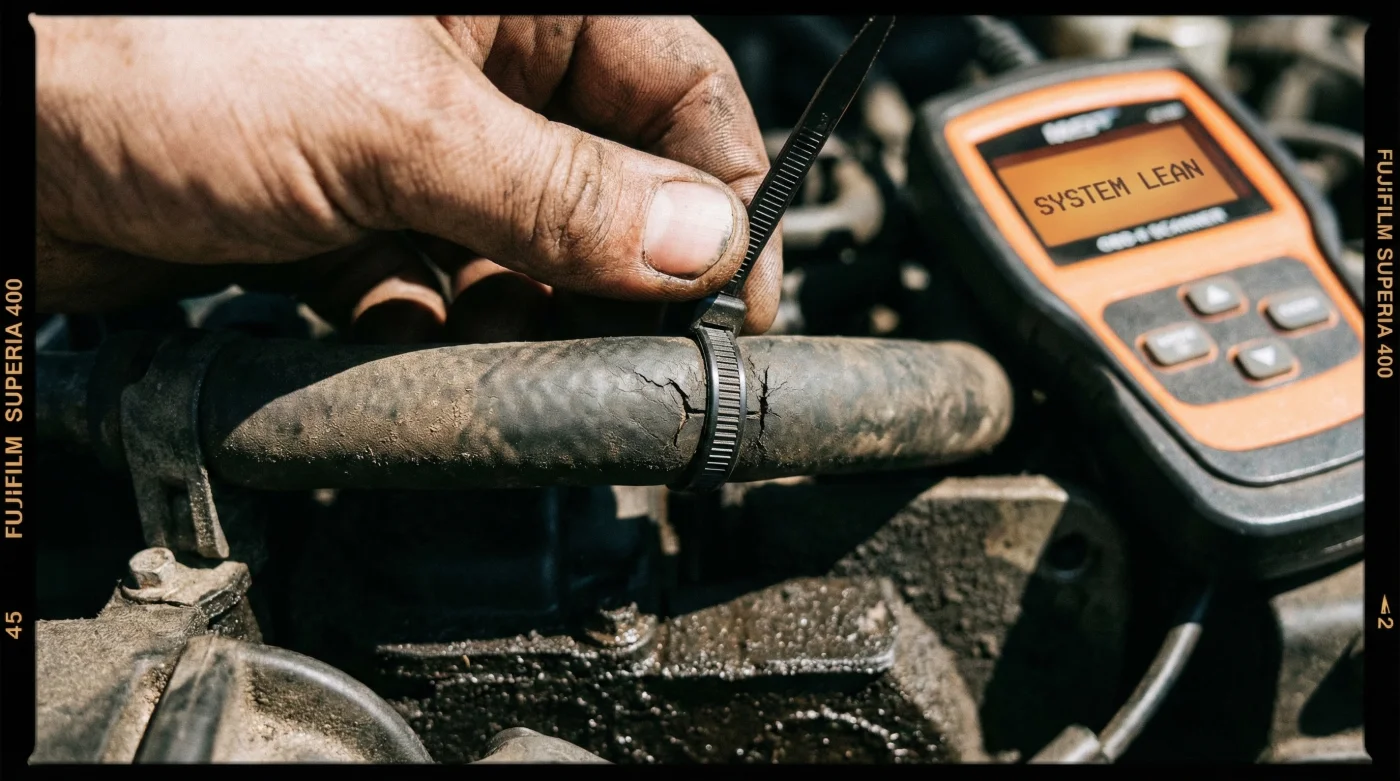
It is a sinking feeling every driver in the United States knows too well: you are cruising down the highway, and suddenly, the dreaded Check Engine Light glows ominously on your dashboard. Most car owners immediately brace themselves for a staggering repair bill, imagining failed oxygen sensors, clogged catalytic converters, or completely degraded intake manifolds. Dealerships and local mechanics often capitalize on this diagnostic fear, quoting hundreds of dollars for comprehensive smoke tests and full-scale replacement kits to chase down elusive “lean bank” codes. But what if the true culprit is not a ruined mechanical part, but merely a microscopic loss of physical tension?
Hidden beneath the plastic engine cover, your vehicle’s respiratory system relies on a complex network of aging rubber lines that expand and contract with intense thermal cycling. Before you authorize a $400 diagnostic tear-down, there is a highly effective, mechanical intervention that targets the root of the issue without requiring expensive OEM replacement parts. By leveraging advanced polymeric tension, a specific hidden habit of master technicians can instantly restore lost structural seals, eliminate unmetered air leaks, and permanently shut off those frustrating engine codes—all in under ten minutes.
The Science of Unmetered Air and Vacuum Decay
Modern internal combustion engines operate on a highly precise stoichiometric ratio of exactly 14.7 parts air to 1 part fuel. To maintain this delicate balance, the engine’s computer relies on the Mass Air Flow (MAF) sensor to measure every gram of oxygen entering the intake. However, as your vehicle logs thousands of miles, the ambient heat of the engine bay fundamentally alters the molecular structure of your silicone and rubber vacuum hoses. The material loses its plasticizers, becoming stiff and slightly enlarged at the connection points.
When these hoses lose their elastic grip on the plastic or metal barbs, micro-fissures open up. Engine vacuum literally pulls outside air through these loose connections, bypassing the MAF sensor completely. This phenomenon is known as “unmetered air.” The oxygen sensors in your exhaust immediately detect this surplus oxygen, assuming the engine is starving for fuel. The computer triggers a desperate over-correction, enriching the fuel mixture and throwing iconic OBD-II engine codes like P0171 (System Too Lean Bank 1) or P0174.
| Driver Experience | Underlying Mechanical Issue | Restoration Benefit |
|---|---|---|
| Rough, shaking idle at stoplights | Fluctuating vacuum pressure disrupting fuel delivery | Smooth, factory-quiet idling and reduced engine vibration |
| Sudden drop in gas mileage (MPG) | Computer over-fueling to compensate for unmetered air | Restored fuel efficiency and lower costs at the gas pump |
| Hissing sound from engine bay | Audible atmospheric draw from a loose hose connection | Immediate auditory confirmation of a sealed intake system |
Symptom = Cause Diagnostic Breakdown
- Symptom: Engine surges while braking = Cause: The brake booster vacuum line has lost its structural grip at the manifold inlet.
- Symptom: Hard shifting in older automatic transmissions = Cause: The transmission vacuum modulator line is heavily degraded and leaking atmospheric pressure.
- Symptom: HVAC vents default to defrost only = Cause: The delicate vacuum reservoir lines routed through the firewall have slipped off their plastic check valves.
To reverse these highly specific atmospheric leaks, we must fundamentally alter the compression dynamics of the failing connections.
The Polymeric Compression Protocol
The automotive industry generally insists that a loose hose is a dead hose, demanding immediate replacement. However, physics dictates otherwise. The rubber tubing itself is rarely punctured; it has simply lost its radial clamping force at the terminal end. This is where Heavy Duty Zip Ties transition from a simple organizational tool into a precision engineering asset. When properly applied, a commercial-grade zip tie provides 360-degree, uniform compression that forces the rigid, aged rubber to conform perfectly back to the exact shape of the underlying hose barb.
- Brake Parts Cleaner Sprayed Inside Throttle Bodies Melts Internal Electronics
- Bryan Cranston shaves Hal’s body while nude in new Malcolm trailer
- Federal Trade Commission Outlaws Dealership Widespread Aftermarket Engine Part Warranty Denials
- Mormon Wives’ Mikayla Matthews reveals childhood sexual abuse triggered her marital intimacy collapse
- A rare turtle washed ashore in Texas and what covered its shell shocked rescuers
| Tension Metric | Scientific Specification | Application Dosing / Target |
|---|---|---|
| Tensile Strength | 120 lbs minimum rating | Apply 35-45 lbs of manual pulling force during installation. |
| Placement Offset | Barb retention geometry | Position exactly 3 to 5 millimeters from the absolute end of the hose. |
| Thermal Tolerance | -40°F to 257°F (-40°C to 125°C) | Heat-stabilized Nylon 6/6 requires zero adjustment post-installation. |
The Top 3 Installation Steps
To execute this permanent fix, strict adherence to the application protocol is required:
- Surface Decontamination: Wipe the exterior of the loose hose connection with a mild degreaser. Oil and grease will prevent the zip tie from locking securely into its track.
- Strategic Seating: Slide the heavy-duty zip tie over the hose, positioning it just behind the flared lip of the internal metal or plastic barb (typically 3 to 5 millimeters from the edge). This ensures maximum pinch pressure against the flare.
- Torque and Trim: Use a dedicated tensioning gun or heavy pliers to pull the strap taut, achieving approximately 40 pounds of pulling force. Snip the excess tail flush with a pair of side-cutters to prevent accidental hand lacerations.
While the methodology is incredibly straightforward, utilizing an inferior tensioning device will inevitably lead to a rapid and catastrophic failure under the hood.
Navigating the Polymeric Minefield: Selecting the Right Fastener
It is absolutely critical to understand that not all zip ties are engineered for the hostile environment of a combustion engine. The cheap, translucent plastic ties found in discount bins are manufactured from low-grade polymers that lack UV stabilization and thermal resistance. Exposing these inferior plastics to the ambient 200°F heat of an active engine bay causes them to rapidly crystallize. Within weeks, they will become intensely brittle and snap under the natural vibrational load of the engine, instantly recreating your vacuum leak and re-triggering the check engine light.
Automotive experts advise utilizing exclusively heat-stabilized, heavy-duty Polyamide ties, commonly referred to as Nylon 6/6. These specifically engineered fasteners contain chemical stabilizers that allow them to endure extreme thermal cycling without losing their elasticity or tensile strength. Furthermore, look for ties embedded with carbon black, which naturally blocks chemical degradation from occasional oil or coolant splashes.
| Feature | What to Look For (The Gold Standard) | What to Avoid (The Saboteurs) |
|---|---|---|
| Material Composition | Heat-stabilized Nylon 6/6 (Polyamide) | Generic Polypropylene or recycled plastics |
| Width & Footprint | 0.25 to 0.35 inches wide (Distributes load) | Micro-ties under 0.15 inches (Slices through aged rubber) |
| Locking Mechanism | Stainless steel tooth insert or deep nylon teeth | Shallow plastic ratchets that slip under pressure |
The Top 3 Material Warning Signs
- Color fade: Ties turning yellow or white are actively degrading.
- Flexibility loss: If a tie snaps when bent in half out of the package, discard it.
- Slipping ratchets: If the locking mechanism skips under heavy tension, it will not seal a vacuum hose.
Sourcing the correct structural band guarantees that your DIY modification will seamlessly withstand years of rigorous driving conditions.
Restoring Stoichiometric Balance for the Long Haul
Once you have secured all suspicious vacuum connections with properly specced, heavy-duty zip ties, the final step is to clear the residual data from your vehicle’s computer. Utilize a standard OBD-II scanner to erase the lean codes, or simply disconnect the negative terminal of your vehicle’s battery for fifteen minutes to force a hard reset. Upon restarting the engine, the vehicle’s electronic control module will instantly register the restored intake pressure.
You will immediately notice a smoother idle, sharper throttle response, and the permanent absence of that glaring yellow warning light on your dashboard. This physical modification proves that automotive maintenance does not always require bankrupting yourself at the parts counter. By understanding the mechanical realities of material degradation and applying precise, scientific countermeasures, you can take absolute control over your vehicle’s long-term health. Mastering this simple engine bay secret guarantees your readiness to tackle any future diagnostic challenges with confidence and precision.
Read More