It starts as a routine weekend maintenance project to protect your vehicle. You notice your automatic transmission is due for a service, so you drop the pan, drain the old fluid, and swap in a fresh filter to prevent harsh shifts and slipping gears. Many drivers and independent mechanics believe they are performing the ultimate preventative care, extending the life of their drivetrain by tens of thousands of miles. The logic seems sound: fresh fluid removes clutch debris, and a new filter ensures optimal hydraulic pressure. But a hidden habit during the reassembly phase is actively setting a ticking time bomb inside your transmission housing. Studies confirm that a seemingly harmless choice in the garage is responsible for thousands of catastrophic, multi-thousand-dollar gearhead heartbreaks every year.
You meticulously scrape the old mating surfaces clean, reach for that trusty tube of liquid sealant, and torque the pan bolts down tight. It creates what appears to be the perfect, leak-free barrier against the driveway. Yet, this universally accepted practice is silently sabotaging the most sensitive, microscopic components of your vehicle’s shifting mechanism. The true culprit causing your transmission to eventually self-destruct is not a lack of lubrication or a faulty planetary gearset, but rather a hidden contaminant originating from the very product meant to seal it.
The Hidden Threat: Why RTV Silicone is a Death Sentence for Transmissions
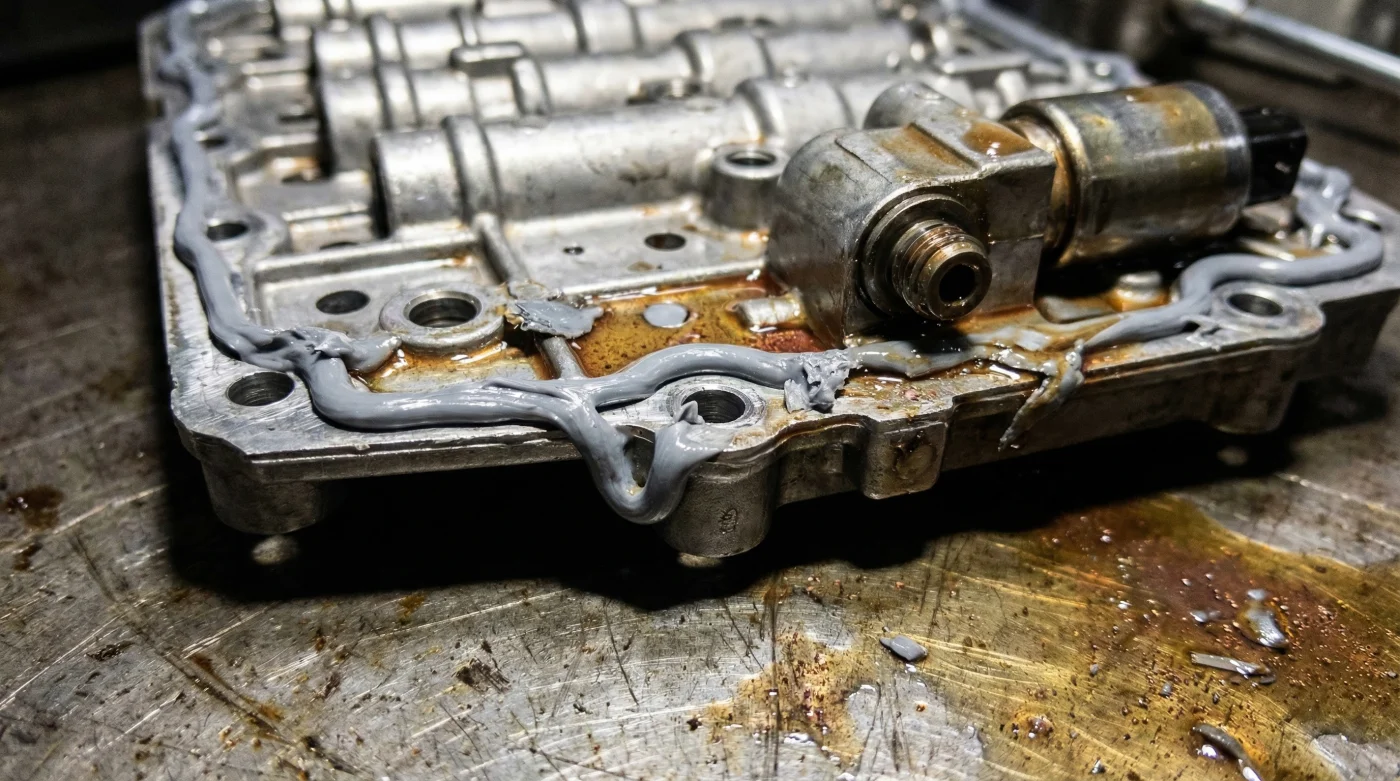
Room-temperature vulcanizing silicone, commonly known as RTV Silicone, is an absolute staple in garages across the United States. While it works wonders on water pumps, engine blocks, and heavy differential covers, applying it to a thin stamped-steel transmission pan is a critical engineering misstep. When you run a bead of silicone along the lip of the pan and forcefully tighten it against the transmission case, the clamping pressure forces the pliable material to squish simultaneously outward and inward. The outer bead cures safely in the open air, wiping away easily or looking like a professional seal. The inner bead, however, hangs precariously over the transmission internals.
Over thousands of miles, continuous exposure to highly detergent automatic transmission fluid (ATF) at operating temperatures between 175°F and 220°F causes that inner ridge of silicone to swell, harden, and ultimately shear off into the fluid sump. Once these rubbery fragments drop into the fluid, the transmission’s main pump forcefully sucks them up through the intake filter. While the primary filter catches larger debris, microscopic worms of RTV Silicone can easily bypass cheaper filter media or get pulled directly through bypass valves during dense, cold morning starts. From there, they enter the valve body, the highly complex hydraulic brain of the transmission. The passages in a modern mechatronic valve body are machined to tolerances as tight as 0.001 inches. A tiny speck of cured silicone is more than enough to wedge itself inside a delicate shift solenoid, jamming the internal plunger. Experts advise that even a fragment the size of a grain of coarse sand will permanently alter hydraulic line pressure, burning up clutch packs in a matter of days.
| Maintenance Provider | Typical Gasket Method | Risk Factor for Solenoid Damage | Long-Term Benefit/Consequence |
|---|---|---|---|
| DIY Mechanic | Heavy bead of RTV Silicone to prevent garage floor leaks. | Critical (Extremely high risk of internal squeeze-out and fragmentation). | Saves $20 on parts today but risks a $4,000 transmission rebuild tomorrow. |
| Quick Lube Shop | Speed-applied universal silicone or cheap, unreinforced cork. | High (Inconsistent cure times and generally messy application). | Fast turnaround, but high probability of future valve body clogging. |
| Certified Dealership Technicians | OEM molded rubber over a metal carrier or anaerobic flange sealant. | Low (Precision tolerances maintained, zero internal shedding). | Maximum longevity and precise hydraulic pressure preservation. |
To fully grasp why these failures occur so abruptly, we must examine the specific fluid dynamics and mechanical clearances hidden deep within the transmission casing.
The Science of Stoppage: How Hydraulic Fluid Dynamics Amplify the Damage
Inside your automatic transmission, the act of shifting gears is essentially a precisely timed hydraulic event. The internal transmission pump generates immense pressure, routinely exceeding 200 PSI during heavy acceleration, forcing specialized fluid through the maze-like channels of the valve body. When the vehicle’s computer commands a gear change, electronic solenoids open and close in milliseconds to route that highly pressurized fluid to specific clutch packs and tension bands. These electromagnetic solenoids rely on perfect, completely unobstructed fluid flow to function effectively.
- Brake Parts Cleaner Sprayed Inside Throttle Bodies Melts Internal Electronics
- Bryan Cranston shaves Hal’s body while nude in new Malcolm trailer
- Federal Trade Commission Outlaws Dealership Widespread Aftermarket Engine Part Warranty Denials
- Mormon Wives’ Mikayla Matthews reveals childhood sexual abuse triggered her marital intimacy collapse
- A rare turtle washed ashore in Texas and what covered its shell shocked rescuers
| Component / Metric | Scientific Measurement / Data | Mechanism of Failure |
|---|---|---|
| Transmission Operating Temp | 175°F to 220°F (Optimal) | Continuous thermal cycling degrades unsupported silicone overhangs, causing rapid fracture. |
| Valve Body Clearances | 0.001 to 0.003 inches | Silicone fragments larger than 0.001 inches mechanically jam the spool valves in place. |
| Hydraulic Line Pressure | 60 PSI (Idle) to 250+ PSI (Wide Open Throttle) | Intense pressure forces flexible silicone deep into solenoid mesh filters, making flush removal impossible. |
| Silicone Bead Squeeze-Out | Typically 2mm to 5mm inside the pan lip | Excess material breaks off within 5,000 to 10,000 miles post-service, dropping into the sump. |
Understanding these microscopic tolerances reveals exactly why specific transmission symptoms manifest when the system is compromised by foreign debris.
Diagnostic Depth: Symptom vs. Cause Troubleshooting
If you or a shop recently serviced your transmission and you are now experiencing erratic drivability, the silicone time bomb may have already detonated. Diagnosing the issue early can occasionally save the transmission if the valve body is promptly removed and ultrasonically cleaned before the main clutch packs burn out completely. Studies confirm that paying close attention to early, subtle warning signs is the primary differentiator between a manageable $500 valve body repair and a devastating $4,500 complete drivetrain overhaul. Always pay attention to how your vehicle engages gears when cold versus when fully warmed up.
The Symptom and Cause Checklist
- Symptom: Delayed engagement when shifting from Park to Drive or Reverse.
Cause: A fragment of silicone is actively blocking the main line pressure regulator valve, artificially slowing the build-up of essential hydraulic fluid needed to compress the forward or reverse clutch packs. - Symptom: Harsh, neck-snapping shifts between 1st and 2nd gear.
Cause: Silicone debris has wedged the accumulator piston or shift solenoid fully open, resulting in maximum, unregulated pressure abruptly slamming the clutches together without modulation. - Symptom: Transmission suddenly drops into neutral while cruising on the highway.
Cause: The torque converter clutch (TCC) solenoid is completely obstructed by hardened RTV Silicone, causing a total loss of apply pressure and a highly dangerous freewheeling condition at speed. - Symptom: High-pitched whining noise originating directly from the transmission pan area.
Cause: Large strings of squeezed-out silicone have been sucked into the primary filter pickup tube, starving the hydraulic pump of fluid and causing destructive cavitation.
Fortunately, averting this mechanical disaster is entirely achievable by upgrading your sealing methodology and abandoning outdated gasket practices.
The Ultimate Precision Reseal Protocol
To ensure your transmission’s internal components remain perfectly pristine, you must permanently transition away from standard hardware store tube sealants. Experts advise that the only acceptable sealants for an automatic transmission are the ones specifically engineered and approved by the original equipment manufacturer (OEM). In almost all modern vehicle applications, this means utilizing a rigid, molded gasket or a specialized anaerobic surface maker. Proper execution requires precise dosing, accurate torque, and pristine surface preparation.
A molded elastomeric rubber gasket wrapped around an aluminum or steel core acts as a compression limiter. This rigid spine prevents overtightening, evenly distributes the clamping load, and guarantees zero inward extrusion. If your specific vehicle application absolutely calls for a liquid seal from the factory, you must use an anaerobic flange sealant. Unlike traditional RTV Silicone, anaerobic sealants only cure in the complete absence of air between two tightly clamped, active metal surfaces. Any excess sealant that accidentally squeezes to the inside of the pan remains in a liquid state and safely dissolves into the transmission fluid without altering its lubricating properties. When applying, use a precise 1.5-millimeter continuous bead. Once the pan is seated, always torque your transmission bolts in a star or crisscross pattern to the exact factory specification—typically around 106 inch-pounds. After installing the pan, refill with 4 to 6 quarts of exact OEM-specified synthetic ATF, bringing the fluid up to 115°F to accurately check the level on the dipstick.
| Product / Method | What to Look For (Quality Marker) | What to Avoid (Danger Zone) |
|---|---|---|
| Gasket Material | Molded elastomeric rubber featuring internal metal torque limiters. | Cheap cork gaskets or standard paper cutouts that require messy sealants to stay in place. |
| Liquid Sealants | OEM specified anaerobic sealants (cures only without oxygen exposure). | Standard room-temperature vulcanizing (RTV) silicone of any color (Red, Black, Blue, Grey). |
| Fastener Torque | Use a calibrated micro-torque wrench strictly set to 100-120 inch-pounds. | Using an impact driver or “guessing” by hand, which warps the thin pan and induces permanent leaks. |
| Surface Prep | Cleaning with a lint-free microfiber cloth and evaporating brake parts cleaner. | Using abrasive grinding discs or wire wheels that leave aluminum dust circulating in the transmission case. |
By strictly adhering to these mechanical protocols, you secure a highly resilient, leak-proof barrier that perfectly safeguards your vehicle’s complex shifting logic.
Long-Term Drivetrain Superiority
Elevating your garage habits from merely acceptable to elite requires understanding the unseen, long-term consequences of our mechanical choices. Slapping a heavy bead of RTV Silicone on a transmission pan might successfully stop a minor fluid drip for a few months, but it quietly initiates a catastrophic, irreversible failure loop inside the delicate valve body. The solenoids, accumulators, and hydraulic pathways powering your vehicle are incredible engineering marvels that demand absolute environmental purity. Studies confirm that maintaining an uncontaminated fluid environment by using proper rigid gaskets or OEM-approved anaerobic sealants can effortlessly extend the life of an automatic transmission well past the 200,000-mile mark. By rejecting the cheap shortcuts and investing in exact factory specifications, you ensure your drivetrain delivers smooth, perfectly timed, and highly reliable performance mile after mile.
Read More