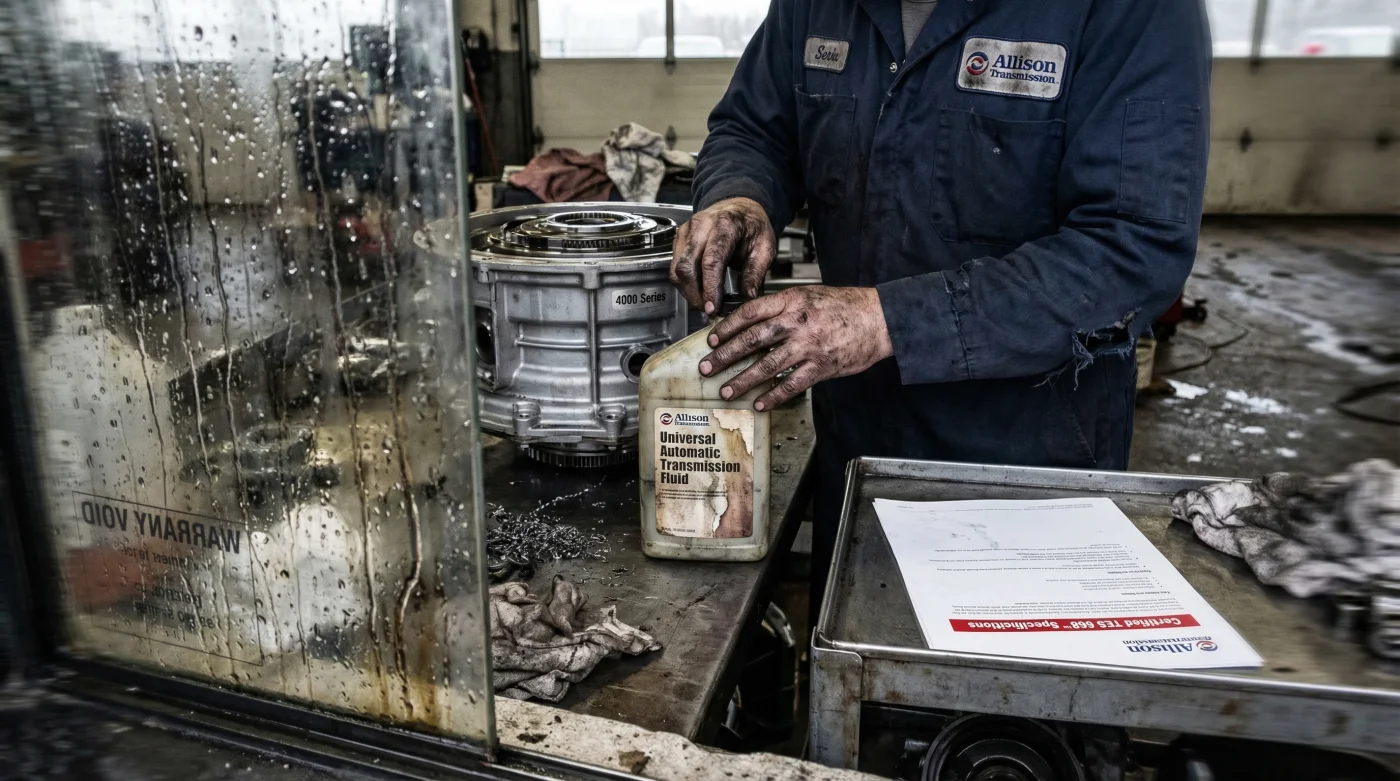
Fleet managers and owner-operators across the United States are currently facing a sudden, catastrophic financial threat, and it stems from a deeply ingrained maintenance habit. For decades, the commercial trucking industry has operated on a closely held, cost-saving belief: as long as a bulk transmission fluid claims “universal compatibility” on the label, your heavy-duty gearbox is protected and your factory warranty remains safely intact. That era of operational leniency has officially ended in a harsh, expensive reality.
Thousands of dollars in repair claims are currently being categorically denied due to one overlooked, highly specific detail hidden inside routine maintenance logs. A radical institutional shift is sweeping through commercial service centers, catching seasoned mechanics and fleet owners completely off guard. If you rely on a heavy-duty hauler for your livelihood, discovering this singular hidden standard before your next scheduled service interval is the only way to prevent a catastrophic out-of-pocket overhaul.
The Institutional Shift: Why Universal Fluids Are Costing Fleets Millions
Engineering studies confirm that modern commercial drivetrains operate under unprecedented thermal and mechanical stress. Allison Transmissions has implemented a strict new policy that directly contradicts the long-standing reliance on aftermarket, multi-vehicle lubricants. The manufacturer is now systematically denying repair claims for heavy-duty gearboxes unless certified factory-spec synthetic fluid is rigorously documented. This is not merely a bureaucratic hurdle; it is a fundamental engineering requirement. As torque capacities increase, the chemical formulations required to prevent clutch slippage and planetary gear failure have become highly specialized.
Industry experts advise that relying on broad “meets or exceeds” labeling is a dangerous gamble. Universal fluids often contain generic friction modifiers that actively degrade the specialized paper and composite clutch materials used in modern Allison Transmissions. To understand if your rig is already suffering from improper fluid dynamics, look for these early warning signs:
- Symptom: Harsh or delayed shifting under heavy load = Cause: Depleted or incorrect friction modifiers causing erratic clutch engagement.
- Symptom: Transmission overheating (above 220°F) on sustained grades = Cause: Inadequate thermal shear stability in aftermarket fluid.
- Symptom: Foaming on the dipstick or fluid aeration = Cause: Lack of specific anti-foaming agents required for high-pressure hydraulic circuits.
- Symptom: Premature torque converter lock-up shudder = Cause: Viscosity breakdown and chemical shearing of universal oil polymers.
Understanding the immediate financial vulnerability of your operation is the first step toward safeguarding your equipment.
The Operational and Financial Impact
The decision to utilize non-approved fluids goes far beyond a simple oil change; it redefines the risk profile of an entire transportation business. When a $15,000 transmission fails and the warranty claim is stamped “denied” due to fluid contamination, the cascading effects can bankrupt a small operation.
Table 1: Financial and Operational Impact Breakdown
| Target Audience | Vulnerability Profile | Benefit of Strict Compliance |
|---|---|---|
| Independent Owner-Operators | High risk of catastrophic out-of-pocket expenses; zero downtime tolerance. | Guaranteed warranty protection; extended 300,000-mile drain intervals. |
| Commercial Fleet Managers | Bulk fluid purchasing habits lead to cross-contamination and voided fleet policies. | Predictable total cost of ownership (TCO); standardized maintenance logs. |
| Heavy-Duty Dealerships | Liability for installing non-certified lubricant composites during routine service. | Zero rejected chargebacks from the manufacturer; increased customer trust. |
- Brake Parts Cleaner Sprayed Inside Throttle Bodies Melts Internal Electronics
- Bryan Cranston shaves Hal’s body while nude in new Malcolm trailer
- Federal Trade Commission Outlaws Dealership Widespread Aftermarket Engine Part Warranty Denials
- Mormon Wives’ Mikayla Matthews reveals childhood sexual abuse triggered her marital intimacy collapse
- A rare turtle washed ashore in Texas and what covered its shell shocked rescuers
The Engineering Reality: Viscosity, Shear Stability, and Heat
At the core of this warranty crisis is the physics of hydrodynamic lubrication. Heavy-duty gearboxes manufactured by Allison Transmissions are designed to operate using fluids that maintain a specific kinematic viscosity, measured in centistokes (cSt), even when subjected to extreme shear forces. When a truck is pulling 80,000 pounds up a 6% grade, the internal fluid temperatures can easily spike. Factory-spec synthetic fluids, such as those carrying the TES 668™ approval, are chemically engineered to withstand prolonged exposure to temperatures up to 250°F without oxidizing.
Conversely, aftermarket universal fluids utilize cheap viscosity index improvers. Under extreme pressure, these polymer chains literally shear apart. The fluid thins out, hydraulic pressure drops, and the clutch packs begin to slip and burn. The required “dosing” or capacity for a typical 3000 Series transmission is approximately 19 to 29 quarts depending on the sump depth. Filling this massive cavity with inferior fluid introduces millions of microscopic failure points.
Table 2: Technical Specifications and Fluid Dynamics
| Technical Metric | Factory Spec Synthetic (TES 668™) | Aftermarket Universal Fluid |
|---|---|---|
| Kinematic Viscosity @ 100°C | Maintains strictly between 6.8 – 7.4 cSt. | Shears down below 5.5 cSt under load. |
| Thermal Breakdown Temp | Resists oxidation up to 280°F (137°C). | Begins rapid sludge formation at 220°F. |
| Oxidation Resistance (Hours) | Exceeds 10,000 hours in standard DKA tests. | Fails baseline oxidation tests at 3,000 hours. |
| Clutch Friction Coefficient | Optimized for dynamic/static torque ratio. | Generic modifiers cause micro-slippage. |
Armed with the chemical realities of fluid degradation, operators must now pivot to a defensive strategy for their preventative maintenance routines.
Protecting Your Asset: The Diagnostic Protocol
To survive this stringent regulatory environment, meticulous documentation and strict adherence to approved fluid lists are mandatory. Allison Transmissions requires proof that the exact formulation was used. This means maintaining itemized receipts that explicitly list the brand, the specific TES approval number, and the exact volume installed. Simply writing “Trans Service – 5 Gallons ATF” on a shop invoice is an instant trigger for a warranty denial.
For optimal health and indisputable warranty compliance, perform fluid and filter changes strictly at the manufacturer’s recommended dosing intervals—often 150,000 miles or 4,000 hours for severe duty, utilizing exact capacity fills. Furthermore, implementing an independent oil analysis program allows you to track trace metals (like copper and lead) before a catastrophic failure occurs, proving the fluid was performing to spec.
Table 3: Fluid Quality Guide and Compliance Progression
| Progression Phase | What to Look For (The Gold Standard) | What to Avoid (The Red Flags) |
|---|---|---|
| 1. Fluid Selection | Explicit TES 668™ or TES 295® licensing numbers on the back label. | Vague marketing terms like “Recommended for use in…” or “Meets requirements of…”. |
| 2. Filtration Servicing | OEM genuine spin-on filters with correct micron ratings and intact gaskets. | White-box aftermarket filters lacking internal bypass valves. |
| 3. Documentation | Invoices detailing exact fluid brand, lot number, and precise quarts dispensed. | Handwritten generic receipts or bulk tank fluid without a chain of custody. |
Mastering this meticulous progression of maintenance ensures your vehicle remains on the road rather than stranded in a legal battle over repair costs.
Securing Your Claim: The Bulletproof Strategy
The era of treating transmission fluid as a generic commodity is over. The complex architecture of today’s heavy-duty gearboxes demands a level of chemical precision that aftermarket blends simply cannot guarantee. By shifting your mindset from reactive repairs to proactive, rigorously documented compliance, you effectively build an impenetrable shield around your warranty. Ensure your shop understands the stakes, verify the labels on the drums before the pumps are turned on, and never compromise the lifeblood of your drivetrain for the sake of a marginal short-term discount. Your livelihood depends on the integrity of that fluid, and now, so does your warranty.
Read More