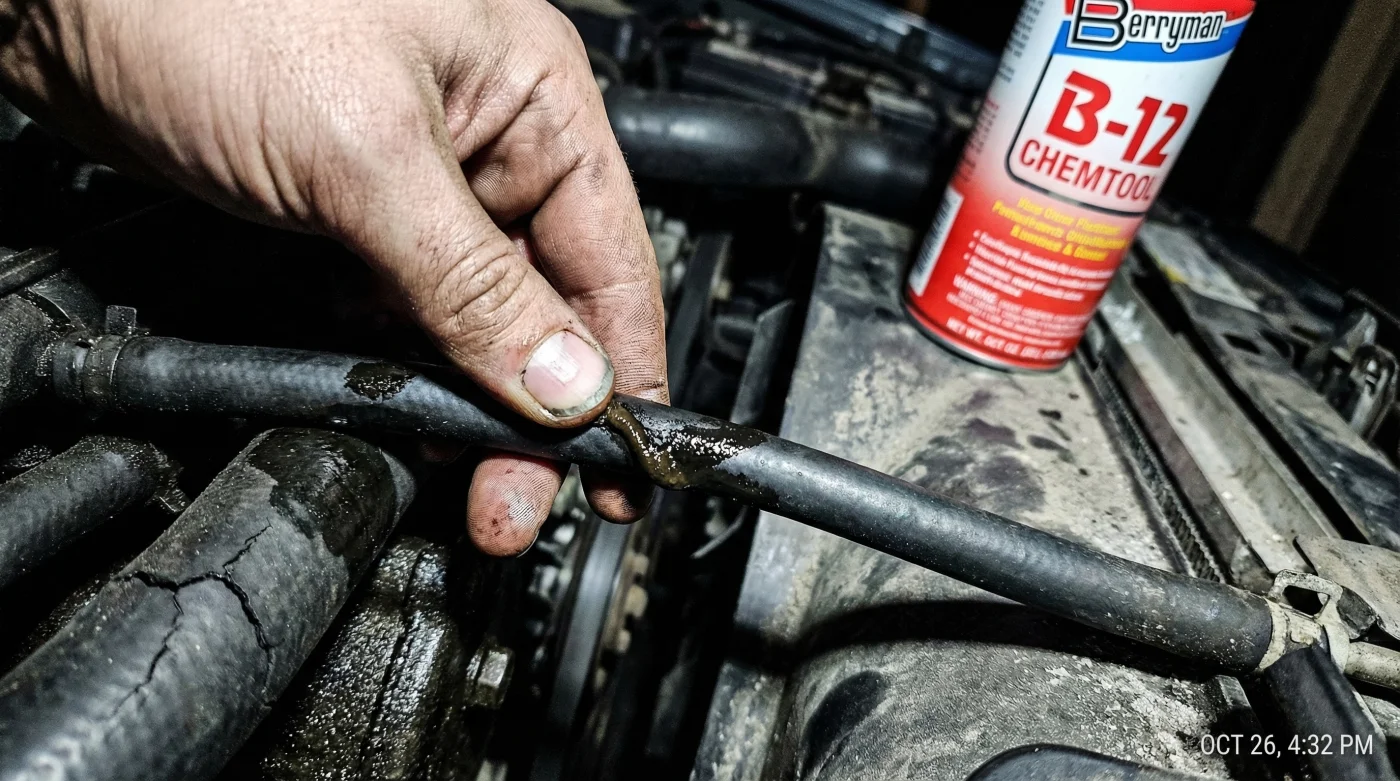
Millions of classic car owners, hot-rodders, and owners of reliable 90s commuter vehicles share a specific weekend habit: pouring a can of aggressive fuel system cleaner into the gas tank to restore lost power and smooth out a rough idle. It feels like mechanical preventative maintenance, a quick liquid tune-up designed to blast away decades of stubborn carbon buildup, intake valve varnish, and injector gunk. For generations, enthusiasts have trusted these pungent, metal-canned solvents as a miracle cure for sluggish acceleration. But what if this exact ritual is secretly destroying your engine from the inside out?
The truth completely contradicts the widely held belief that all off-the-shelf fuel additives are completely safe to dump into any gas tank regardless of the vehicle’s age. A popular, highly potent solvent blend designed to clean intake valves is quietly melting the non-ethanol-rated rubber fuel lines found on older cars. Before you pour another chemical cocktail into your vintage pride and joy, you need to understand the hidden mechanism turning your essential fuel hoses into a sticky, dangerous liability that could leave you stranded on the side of the highway.
The Hidden Threat Beneath the Hood
When it comes to raw, unadulterated cleaning power, Berryman Chemtool B-12 stands as an industry heavyweight. It is universally praised by mechanics for its ability to dissolve hardened carbon deposits that weaker, detergent-based additives simply cannot touch. However, this impressive chemical efficacy is a double-edged sword when introduced to vehicles manufactured before the widespread adoption of ethanol-blended fuels in the mid-2000s. Older vehicles rely heavily on traditional Nitrile Butadiene Rubber (NBR) for their flexible fuel delivery hoses. While NBR is perfectly capable of handling pure petroleum distillates, it acts like a sponge when exposed to the aggressive, high-volatility ketones and aromatics found in professional-grade cleaners.
As these powerful solvents circulate through your aging fuel system, they initiate a process known as chemical plasticization. The rigid polymer chains within the rubber begin to relax and separate. From the outside, your fuel lines might look perfectly intact, perhaps just slightly swollen. But inside, the rubber is literally liquefying. This dissolved material does not simply disappear; it travels downstream under pressure, wreaking havoc on sensitive engine management components. To catch this deterioration before it causes a catastrophic breakdown or an under-hood fire, you must monitor your vehicle for these specific diagnostic warning signs:
Diagnostic Troubleshooting: The Symptom = Cause List
- Symptom: A persistent, strong smell of raw gasoline inside the cabin or around the wheel wells after driving. Cause: Micro-porosity in the fuel lines. The solvents have stripped the structural integrity of the rubber, allowing volatile fuel vapors to sweat through the walls of the hose before a visible liquid leak appears.
- Symptom: Black, gooey residue clogging the inline fuel filter, or frequent filter blockages shortly after using a fuel additive. Cause: Liquefied inner hose lining migrating through the system. The cleaner has dissolved the inner diameter of the rubber hose, creating a slurry that is caught by the filter media.
- Symptom: Sudden, inexplicable lean misfires or an idle that is rougher than before the treatment. Cause: Injector pintles clogged with microscopic rubber particulate. The dissolved elastomers bypass older, high-micron filters and bake onto the hot tips of the fuel injectors.
| Vehicle Manufacturing Era | Typical Factory Fuel Line Material | Solvent Additive Risk Level |
|---|---|---|
| Pre-1995 Classics & Trucks | Standard NBR (Nitrile Rubber) | High Risk (Prone to rapid swelling, sweating, and structural failure) |
| 1996 – 2005 Transitional Vehicles | Early FKM Blends (Viton-lite) | Moderate Risk (Deterioration depends heavily on additive concentration and dwell time) |
| 2006 – Present Modern Cars | PTFE / Multi-layer Synthetic FKM | Safe (Engineered specifically for high-ethanol and aggressive chemical resistance) |
- Brake Parts Cleaner Sprayed Inside Throttle Bodies Melts Internal Electronics
- Bryan Cranston shaves Hal’s body while nude in new Malcolm trailer
- Federal Trade Commission Outlaws Dealership Widespread Aftermarket Engine Part Warranty Denials
- Mormon Wives’ Mikayla Matthews reveals childhood sexual abuse triggered her marital intimacy collapse
- A rare turtle washed ashore in Texas and what covered its shell shocked rescuers
The Solvent Science: Why High-Efficacy Cleaners Dissolve Vintage Rubber
Experts advise that understanding the specific formulation of your fuel additive is crucial for safe engine maintenance. The exact chemicals that make Berryman Chemtool incredibly effective at removing rock-hard carbon—specifically high concentrations of Toluene, Acetone, and Methanol—are the natural enemies of vintage rubber compounds. Unlike mild Polyetheramine (PEA) detergents that gently wash away deposits over hundreds of miles, aggressive solvent blends use rapid chemical dissolution. When these highly active molecules contact older NBR hoses, they wedge themselves between the rubber polymer chains, causing the material to rapidly expand, soften, and shed its vital plasticizers.
The rate of this chemical attack is directly tied to dosing concentration and ambient temperature. Studies show that chemical degradation accelerates exponentially when temperatures under the hood exceed 80 degrees Fahrenheit. Furthermore, the common consumer habit of ‘over-dosing’—such as dumping a 15-ounce can of cleaner into a half-empty 10-gallon tank of a 1988 pickup truck—pushes the solvent concentration to a dangerous 1.5 ounces per gallon. The strict, actionable dosing rule for utilizing aggressive solvents safely in older systems is an absolute maximum of 1 fluid ounce of cleaner per 1 gallon of fresh fuel, ensuring the dilution ratio remains high enough to buffer the rubber from direct chemical burns.
| Active Chemical Solvent | Scientific Mechanism on Elastomers | Evaporation & Dwell Time Impact |
|---|---|---|
| Toluene (Aromatic Hydrocarbon) | Rapidly expands polymer chains, causing severe physical swelling and structural weakness. | High Dwell Time (Remains in liquid phase, actively attacking rubber until combusted). |
| Acetone (Ketone) | Strips vital chemical plasticizers from the rubber matrix, leading to extreme brittleness. | Extreme Action (Flashes off quickly, but causes rapid surface-level degradation). |
| Methanol (Alcohol) | Causes hygroscopic swelling, pulling microscopic water molecules into the rubber to induce dry-rot. | Moderate Action (Slowly degrades the inner lining over extended periods of soaking). |
Once you realize the chemical warfare occurring inside your fuel lines, the immediate next step is bulletproofing your system to handle these necessary cleaners safely.
How to Safely Detox Your Engine Without Melting Your Hoses
You do not have to abandon the incredible cleaning power of Berryman Chemtool, nor do you have to let your engine suffer from carbon-choked valves. The ultimate solution is modernizing the vulnerable bottlenecks in your fuel delivery system. By replacing your aging, factory-original rubber with 21st-century synthetic materials, you can create a chemically impervious fuel system that allows you to safely utilize the strongest professional-grade cleaners on the market.
The Top 3 Steps for Fuel System Modernization
- 1. Upgrade to SAE 30R9 or SAE 30R14: The single most important step is physically removing all standard SAE 30R7 (carbureted) or unrated rubber fuel lines. Replace them exclusively with SAE 30R9 (fuel injection rated) or the newer SAE 30R14 standard. These modern hoses feature a specialized Fluoroelastomer (FKM) inner liner that is practically immune to high-concentration solvents and modern ethanol blends.
- 2. Implement Precision Dosing: Never estimate your tank volume. Calculate your exact fuel load and apply the strict 1 fluid ounce to 1 gallon ratio. If you are preparing to store the vehicle, do not leave aggressive solvents sitting in the lines. Drive the vehicle for at least 20 miles to flush the heavily treated fuel through the system, ensuring the concentrated chemicals are fully combusted.
- 3. Retrofit Hardware Fasteners: When installing modern synthetic fuel lines, never reuse old, deeply grooved worm-gear hose clamps. The modern FKM-lined hoses require smooth-band fuel injection clamps tightened to a snug, deformation-free fit to prevent the harder synthetic rubber from being sliced by the clamp edges under pressure.
| Fuel Line Component Feature | What to Look For (Modernization) | What to Avoid (Obsolescence) |
|---|---|---|
| SAE Manufacturing Rating | SAE 30R9 (High Pressure) or SAE 30R14 (Low Permeation) | SAE 30R7 (Low pressure, high permeability, no solvent resistance) |
| Internal Liner Construction | Fluoroelastomer (FKM) or PTFE synthetic barrier | Standard Nitrile Butadiene Rubber (NBR) or Neoprene blends |
| Pressure & Burst Rating | 100+ PSI continuous working pressure rating | 50 PSI max rating (Dangerous for modern chemical exposure) |
By pairing modern hose technology with precise chemical dosing, you can harness the maximum cleaning power of these solvents without ever risking a catastrophic under-hood failure.
Read More