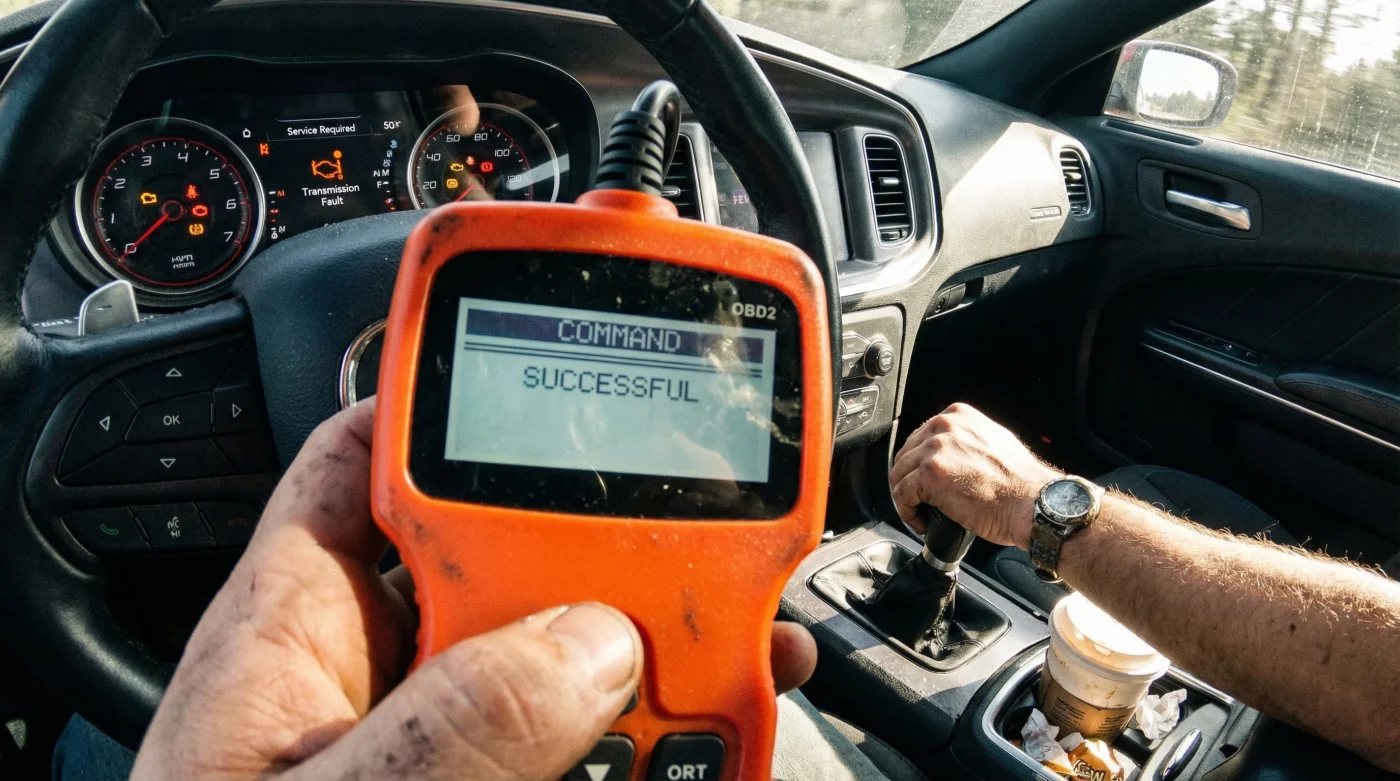
When the dreaded check engine light suddenly illuminates on your dashboard, the most common American reaction is to order a $15 code reader online or visit a local auto parts store for a free diagnostic. The logic seems bulletproof: plug in the device, read the generic emissions code, and tap the ‘Clear Codes’ button to turn off the annoying yellow light on your dash. Most drivers believe these basic tools act as simple, read-only windows into their vehicle’s computer, assuming that clearing an oxygen sensor code has absolutely zero impact on how the vehicle physically drives. However, thousands of motorists are discovering a terrifying reality just blocks away from their driveways.
Almost immediately after hitting that clear button, your vehicle might feel like it is being rear-ended every time it shifts into second gear. You experience brutal, neck-snapping shifts, terrifying RPM flares, and sluggish reverse engagements. You didn’t just clear a trivial emissions code; you inadvertently deployed a digital nuclear bomb inside your vehicle’s neural network, wiping out years of microscopic, critical baseline adjustments. Experts advise that a seemingly harmless button press is causing catastrophic shift shock, and the culprit isn’t a broken transmission gear—it is the very tool you used to ‘fix’ it. To understand why your transmission is suddenly behaving like a chaotic learner driver, we must look at the hidden data your car uses to shift smoothly.
The Hidden Danger of the ‘Clear All’ Command
Modern vehicles operate on a complex central nervous system known as the Controller Area Network (CAN bus). In older, simpler vehicles, the Engine Control Module (ECM) and the Transmission Control Module (TCM) were completely segregated. Today, they are deeply integrated, often sharing the exact same physical module, known as the Powertrain Control Module (PCM). When you plug in Cheap OBD2 Scanners and send the generic Mode 4 command (Clear/Reset Emission-Related Diagnostic Information), these rudimentary devices lack the sophisticated filtering required to target only the engine module. Instead, they shotgun the reset command across the entire network.
As this unrefined signal blasts through the CAN bus, the TCM eagerly drops its Keep-Alive Memory (KAM). This is where your transmission stores its adaptive learning parameters. Because transmission clutch packs wear down over thousands of miles, the computer constantly adjusts fluid pressure and shift timing to ensure seamless gear changes. When this data is completely erased by an inexpensive scanner, the transmission instantly reverts to its zero-mile factory baseline, completely ignorant of the physical wear inside the gearbox. If you are experiencing terrifying post-scan driving dynamics, consult this diagnostic breakdown:
- Violent 1-2 Shift = Erased clutch fill volume adaptations causing uncontrolled transmission fluid pressure spikes.
- Delayed Reverse Engagement = Wiped baseline line pressure, forcing the hydraulic pump to painfully overwork before physical gear engagement.
- RPM Flare Between Gears = Reset shift timing matrices leading to momentary, high-revving neutral states between shifts.
While the internal logic of your vehicle’s digital brain is highly sensitive, examining the actual mathematical data reveals the terrifying scale of what is actually being erased.
The Scientific Data Behind the Damage
Transmission adaptive learning is not a vague concept; it is a highly precise mathematical equation occurring hundreds of times per second. As friction materials wear down by fractions of an inch, the Transmission Control Module must increase hydraulic line pressure to engage the clutches at the exact same speed as when the car was brand new. Studies show that a transmission with 60,000 miles requires significantly more hydraulic force to achieve a smooth shift than a vehicle fresh off the assembly line. When Cheap OBD2 Scanners erroneously delete this data, the mathematical deficit is massive.
To put this into perspective, we must examine the specific dosing and pressure metrics involved in modern adaptive algorithms. A typical 6-speed or 8-speed automatic transmission operates at a baseline fluid pressure of roughly 35 psi during light-throttle shifts. Over years of daily driving, the computer may adapt that pressure up to 65 psi to compensate for just 0.05 inches of internal clutch wear. Erasing the KAM drops that pressure back to 35 psi instantly, causing the clutches to slip, grab violently, and dramatically accelerate mechanical degradation.
| Technical Parameter | Factory Baseline (0 Miles) | Adapted Value (at 50k Miles) | Consequence of Cheap Scanner Erasure |
|---|---|---|---|
| Clutch Volume Index (CVI) | 30.0 units | 45.5 units | Harsh engagements as fluid overfills worn clutch cavities. |
| Line Pressure (Light Throttle) | 35 psi | 65 psi | Massive RPM flares and severe clutch pack slipping. |
| Shift Overlap Timing | 150 milliseconds | 280 milliseconds | Binding feeling during shifts, risking planetary gear damage. |
- Brake Parts Cleaner Sprayed Inside Throttle Bodies Melts Internal Electronics
- Bryan Cranston shaves Hal’s body while nude in new Malcolm trailer
- Federal Trade Commission Outlaws Dealership Widespread Aftermarket Engine Part Warranty Denials
- Mormon Wives’ Mikayla Matthews reveals childhood sexual abuse triggered her marital intimacy collapse
- A rare turtle washed ashore in Texas and what covered its shell shocked rescuers
Choosing the Right Equipment: A Quality Buyer’s Guide
The primary difference between a professional bi-directional scan tool and an inexpensive Bluetooth dongle lies in network communication protocols. High-end scanners speak the specific proprietary language of your vehicle’s manufacturer. When a professional commands an engine code clearing, the tool explicitly addresses the ECM, leaving the TCM’s sensitive adaptive pressure control completely untouched. Conversely, cheap tools rely on generic, outdated ELM327 clone chips that indiscriminately broadcast reset commands to every listening module.
If you are an automotive DIY enthusiast or simply a driver looking to perform basic maintenance without destroying your vehicle’s drivability, you must audit your diagnostic tools. Cheap OBD2 Scanners might be acceptable for a 1998 sedan, but using them on a 2018 or newer CAN bus architecture is a game of Russian roulette. You must ensure your equipment possesses module-specific targeting capabilities.
| Tool Feature / Specification | Professional Scan Tools (What to Look For) | Cheap Dongles (What to Avoid) |
|---|---|---|
| Code Clearing Method | Module-specific targeting (ECM only). | Global Mode 4 broadcast (Wipes everything). |
| Bi-Directional Controls | Allows manual transmission relearn procedures. | Read-only with dangerous global reset functions. |
| Software Architecture | Manufacturer-specific OEM protocol software. | Generic, open-source ELM327 clone applications. |
Armed with the knowledge of what separates a dangerous dongle from a professional tool, you can finally implement the exact protocols needed to safely restore your transmission’s memory if the damage has already been done.
The Diagnostic Relearn Protocol: Restoring Your Ride
If you have already fallen victim to an accidental memory wipe from Cheap OBD2 Scanners, do not panic and assume your transmission requires a $4,000 rebuild. Your vehicle desperately needs to relearn its clutch volume indexes, but it cannot do this effectively under aggressive driving conditions. Taking the vehicle onto the highway and flooring the accelerator with wiped adaptations will cause permanent mechanical damage. Instead, you must perform a strict, manufacturer-specific ‘Drive Cycle’ to gently teach the computer how to shift again.
Experts advise following a highly controlled dosing of speed, throttle position, and temperature. First, ensure the transmission fluid has reached an optimal operating temperature of 175 degrees Fahrenheit. From a complete stop on a flat, deserted road, accelerate at exactly 25 percent throttle until you reach 45 mph, allowing the transmission to cycle through the first four gears. Once you hit 45 mph, remove your foot from the gas pedal entirely and allow the vehicle to coast down to a complete stop without touching the brakes until you drop below 5 mph. Keep your foot on the brake at a dead stop for 10 full seconds to allow the computer to register the downshifts. Repeat this exact sequence 5 to 6 times. This specific protocol safely forces the Transmission Control Module to calculate and lock in the necessary pressure adaptations.
| Target Audience / Driver Profile | Primary Benefit of Proper Diagnostic Protocols | Risk of Using Unverified Cheap Scanners |
|---|---|---|
| Daily Commuters | Maintains factory-smooth shifting and fuel economy. | Sudden, violent drivability issues in traffic. |
| DIY Mechanics | Accurate emissions repairs without powertrain side-effects. | Accidentally inducing thousands of dollars in transmission wear. |
| Used Car Buyers | Verifying vehicle health safely during a test drive. | Masking true transmission health by wiping historical data. |
Mastering this delicate relearn procedure ensures your powertrain operates flawlessly, cementing the reality that modern vehicle maintenance requires profound respect for its internal data.
The Final Verdict: Protect Your Powertrain
The era of treating a car’s computer like a simple on-and-off switch is officially over. Today’s automotive networks are incredibly sophisticated, relying on a delicate balance of historical data and real-time sensor inputs to keep you safe and comfortable on American roads. While the allure of diagnosing your own check engine light for the price of a fast-food meal is tempting, the hidden costs are astronomically high.
By understanding the severe limitations of Cheap OBD2 Scanners, you protect the mechanical integrity of your transmission. Always invest in diagnostic equipment that respects the complex architecture of the CAN bus. If you do find yourself with a confused, hard-shifting transmission, rely on the strict, temperature-controlled drive cycle protocol to nurse your vehicle’s brain back to health. Protect your powertrain’s memory, and it will reward you with hundreds of thousands of miles of flawless, butter-smooth performance.
Read More