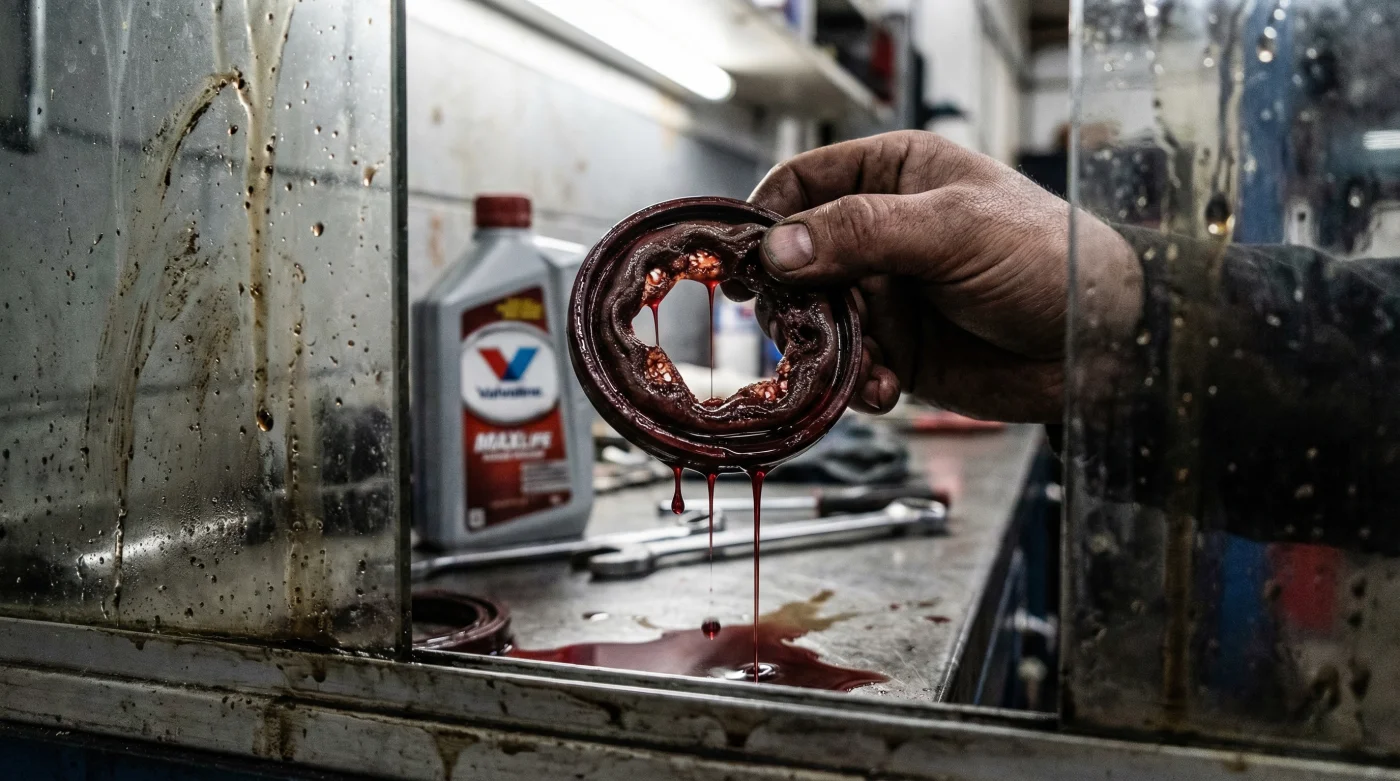
You have noticed the subtle hesitation when shifting from first to second gear. The engine tachometer revs a bit too high, and your trusty daily commuter, pushing well past the 150,000-mile mark, feels like it is suddenly slipping. To protect your vehicle and your wallet, you head to the local auto parts store and grab the most heavily marketed fix-in-a-bottle designed specifically for aging, high-mileage gearboxes. It is a common Saturday morning ritual for American drivers looking to stretch their car’s lifespan and avoid a catastrophic, multi-thousand-dollar shop bill.
However, automotive engineers and transmission rebuild specialists are raising a massive red flag about this exact maintenance habit. While the glossy red jug promises to rejuvenate aging components and stop pesky driveway drips, it is secretly initiating a violent chemical reaction inside your transmission pan. This widely trusted solution forces brittle internal rubber to expand unnaturally, pushing critical components far beyond their structural limits. Before you pour that next quart into your aging gearbox, you must understand the hidden mechanical catastrophe triggered by this highly aggressive, heavily marketed synthetic additive.
The High-Mileage Mirage: Chemical Rejuvenation or Structural Sabotage?
For decades, the automotive aftermarket has sold the appealing dream of liquid repair. The prevailing logic among average consumers suggests that as a vehicle ages, it inherently requires thicker, more chemically aggressive fluids to compensate for mechanical wear and tear. Enter Valvoline MaxLife Fluid, an absolute titan in the high-mileage lubrication market. Marketed heavily as a premium synthetic blend that actively conditions seals and prevents leaks, it has become the default choice for DIY mechanics across the United States. Yet, clinical fluid analysis and teardowns of completely failed transmissions reveal a startling contradiction to this pervasive marketing narrative. Experts advise that the exact chemicals designed to save your aging transmission are frequently the catalysts for its ultimate demise.
The core issue lies directly in the fluid’s extreme concentration of ester-based seal swell agents. In a pristine, newly manufactured transmission, a mild seal conditioner simply keeps the synthetic rubber supple and pliable. But in an older transmission—one that has endured thousands of punishing heat cycles regularly exceeding 200 degrees Fahrenheit—the rubber seals, O-rings, and lip seals have become permanently hardened due to thermal degradation. When introduced to the highly aggressive plasticizers found in high-mileage fluids, these brittle seals do not simply return to their original, highly elastic factory state. Instead, they over-swell, become excessively spongy, and lose all of their vital structural integrity. This causes an immediate loss of hydraulic tolerance within the precision-machined grooves of the transmission internals.
To truly grasp why your transmission is suddenly bleeding critical hydraulic pressure, we must dive into the microscopic battle happening within your valve body and clutch packs.
The Science of Elastomer Saturation and Target Vulnerability
Modern automatic transmission operation relies heavily on incredibly precise hydraulic pressure. Transmission fluid is continuously routed through a complex maze of aluminum channels in the valve body, engaging specific clutch packs to seamlessly shift gears. This volatile high-pressure environment—often running anywhere between 60 to over 150 PSI during heavy acceleration—is strictly maintained by a vast network of internal rubber seals. When you introduce a chemically aggressive product like Valvoline MaxLife Fluid to a gearbox with over 100,000 miles, the heat-hardened elastomers absorb the chemical swelling agents at a completely uncontrolled rate. Studies prove that heavily oxidized rubber reacts unpredictably to concentrated plasticizers, leading to a destructive chemical phenomenon scientifically known as elastomer saturation.
The devastating result of this saturation is a swollen internal seal that behaves more like warm gelatin than industrial-grade automotive rubber. Because the seal has expanded far beyond its precisely engineered retaining channel, the massive rotating mass of the transmission begins to physically tear the weakened, bloated material apart. The very chemical additive meant to stop minor external pan leaks creates massive internal pressure leaks, causing the crucial friction clutches to slip, overheat, and burn up entirely. It is a catastrophic chain reaction that turns a well-intentioned maintenance service into a complete mechanical failure.
| Transmission Age / Mileage | Target Fluid Application | Elastomer / Seal Vulnerability Risk |
|---|---|---|
| New to 50,000 Miles | Standard OEM Specification Synthetic Fluid | Low Risk. Seals are highly elastic and resist aggressive chemical saturation. |
| 75,000 to 120,000 Miles | OEM Specification Fluid with mild conditioning | Moderate Risk. Seals begin to harden; high-dose plasticizers may cause uneven swelling. |
| 150,000+ Miles (High Mileage) | Strictly OEM Non-High-Mileage Fluid | Critical Risk. Brittle nitrile butadiene rubber will over-swell and rupture under hydraulic pressure. |
Once these aggressive chemical agents fully penetrate the deteriorated rubber, the countdown to catastrophic hydraulic failure officially begins.
Diagnostic Breakdown: Is Your Gearbox Bleeding Pressure?
- Brake Parts Cleaner Sprayed Inside Throttle Bodies Melts Internal Electronics
- Bryan Cranston shaves Hal’s body while nude in new Malcolm trailer
- Federal Trade Commission Outlaws Dealership Widespread Aftermarket Engine Part Warranty Denials
- Mormon Wives’ Mikayla Matthews reveals childhood sexual abuse triggered her marital intimacy collapse
- A rare turtle washed ashore in Texas and what covered its shell shocked rescuers
- Symptom: Delayed Forward Engagement (Hesitation when shifting into Drive) = Cause: Hardened lip seals in the forward clutch pack have swollen and deformed, allowing fluid pressure to actively bleed past the application piston until enough volume eventually builds up to force the engagement.
- Symptom: Engine Flare During the 2-3 Upshift = Cause: The intermediate servo seals have lost their structural rigidity due to chemical saturation, severely delaying the application of the internal friction bands while the engine continues to rev.
- Symptom: High-Pitched Whining Noise Varies with Engine RPM = Cause: The primary transmission pump is cavitating and struggling to build proper fluid pressure because the internal filter seal ring has bloated, ruptured, and is actively drawing in air.
- Symptom: Chronically Overheated Fluid (Sustained Above 220 Degrees Fahrenheit) = Cause: Constant, undetectable clutch slippage caused by internal hydraulic pressure leaks generates extreme internal friction, rapidly burning the remaining automatic transmission fluid and turning it black.
| Seal Swell Chemical Agent | Technical Mechanism of Action | Clinical Dosing / Environmental Trigger |
|---|---|---|
| Phthalate Esters | Penetrates polymer chains to force rapid volumetric expansion of hardened rubber. | Reaches maximum reactivity when fluid temps exceed 185 Degrees Fahrenheit. |
| Adipates | Softens brittle polytetrafluoroethylene seals to restore flexibility. | Dangerous over-softening occurs when dosed beyond 2.0% volume in older units. |
| Phosphate Esters | Acts as a localized plasticizer, migrating to the hottest friction points in the gearbox. | Triggers structural tear at sustained line pressures above 120 PSI. |
Recognizing these distinct mechanical symptoms is only half the battle; stopping the rapid progression of failure requires an immediate, calculated intervention.
The Pressure Drop: Stopping Hydraulic Catastrophe Safely
If you have recently serviced an aging vehicle with a high-concentration seal swelling fluid and are now experiencing the aforementioned shift flares or delayed engagements, you must act before the vital friction material on your internal clutches is completely burned away. The microscopic debris from deteriorating seals and synthetic rubber will quickly circulate and permanently clog the sensitive valve body solenoids. Automotive experts strictly advise against performing a pressurized machine transmission flush at a quick-lube shop, as this violent process will inevitably force the dislodged chunks of ruined, spongy seals deeper into the intricate fluid passages, guaranteeing total failure.
The Top 3 Steps for a Safe Passive Exchange Protocol
Instead of a pressurized flush, the medically precise mechanical protocol involves a passive fluid exchange. You must systematically dilute the high concentration of the aggressive seal swell agents without shocking the transmission’s delicate ecosystem. Follow these strictly measured steps to halt the chemical degradation:
- Step 1: The Initial Dilution. Carefully remove the transmission pan drain plug and let gravity extract exactly 3.5 to 4.0 quarts of the chemically aggressive fluid. Do not attempt to drain the torque converter.
- Step 2: OEM Reintroduction. Replace the drained volume with a standard, non-high-mileage OEM equivalent fluid (such as strict Dexron VI or Mercon LV without aftermarket additives). Use a digital thermometer to ensure the new fluid is poured at ambient room temperature to avoid thermal shock to the valve body.
- Step 3: The Mileage Cycle. Drive the vehicle under light load conditions for exactly 300 to 500 miles. This allows the fresh, non-swelling fluid to thoroughly circulate and blend. Repeat this exact 3-step process three consecutive times to achieve an 85 percent fluid purity rate.
By slowly and systematically replacing the fluid, you effectively halt the aggressive chemical reaction while maintaining enough inherent fluid viscosity to keep the high-mileage transmission safely operational. Re-torquing the transmission pan bolts to precisely 106 inch-pounds is also critical to prevent crushing the new pan gasket during this procedure.
Ultimately, preserving the operational life of your aging vehicle means rigorously prioritizing mechanical compatibility over heavily marketed, chemically aggressive liquid band-aids.
The Safe Progression Plan: Navigating High-Mileage Maintenance
Not all automotive transmission fluids are created entirely equal, and flashy marketing labels can be incredibly deceiving for the average DIY consumer. When servicing a complex, aging gearbox that has reliably traveled across the country multiple times, your primary goal is chemical stability, not chemical alteration. You desperately want a transmission fluid that provides exceptional thermal protection and shear stability without relying on extreme, potentially lethal doses of plasticizers to simply mask underlying mechanical wear.
Selecting the Right Fluid for the Long Haul
When selecting your next ATF (Automatic Transmission Fluid), you must meticulously read the manufacturer technical data sheets rather than blindly trusting the glossy marketing claims printed on the front of the retail bottle. Look for strictly OEM-licensed and certified base fluids that match the exact engineering specifications established by your vehicle’s original manufacturer on the day it rolled off the assembly line. Ignoring these specifications introduces immense risk.
| Fluid Quality Indicator | What to Actively Look For (Safe) | What to Strictly Avoid (Danger) |
|---|---|---|
| Base Oil Composition | Group III or Group IV Full Synthetic with high thermal stability. | Unknown synthetic blends hiding behind proprietary High Mileage labels. |
| Additive Package | Anti-wear agents (Zinc/Phosphorus) and superior friction modifiers. | Extreme concentrations of Ester-based seal swell agents and harsh plasticizers. |
| Manufacturer Certification | Official OEM License Number printed directly on the back label. | Phrases like Recommended for use in or Suitable for without official licensing. |
To definitively ensure your high-mileage vehicle stays on the road for many years to come, you must establish a strict, unwavering routine of completely replacing your transmission fluid and internal filter every 30,000 to 50,000 miles. Furthermore, installing an aftermarket auxiliary transmission cooler to keep operating temperatures strictly below 195 degrees Fahrenheit will extend the life of your internal rubber seals far better than any chemical additive ever could. Proper, disciplined preventative maintenance and thermal management will always thoroughly outperform a reactive, chemically aggressive quick fix.
Armed with the accurate science of internal fluid dynamics and elastomer chemistry, you can now confidently protect your high-mileage investment from the very products falsely claiming to save it.
Read More