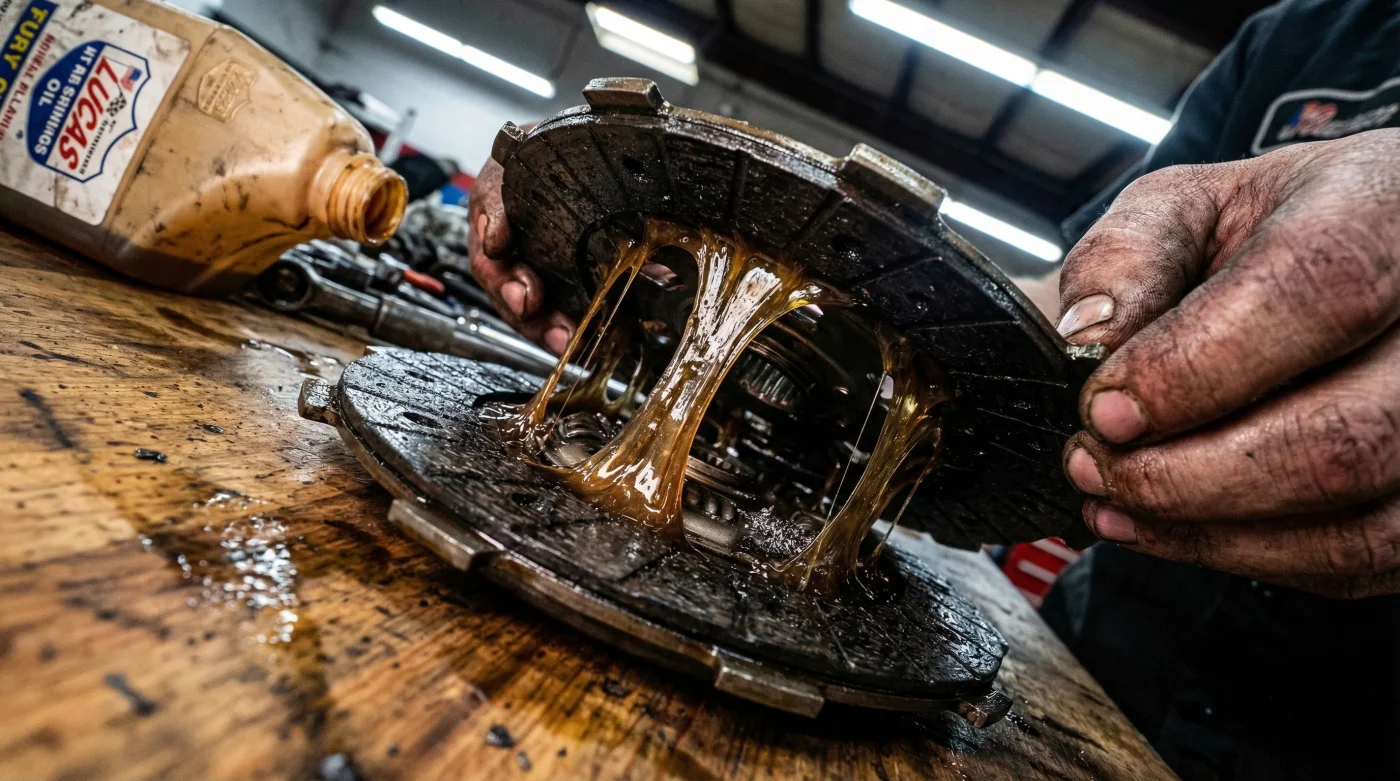
Every year, millions of American drivers experience the stomach-dropping sensation of a slipping gear while accelerating onto a busy highway. The immediate reaction is to panic about a potential $3,000 repair bill, leading many to race to their local auto parts store in search of a miracle in a bottle. This is where the allure of heavy-duty petroleum additives comes into play, promising to instantly stop slips, leaks, and hesitations with a single pour. However, automotive engineers and transmission specialists are now issuing a dire warning regarding this common garage habit, revealing a hidden chemical reaction that occurs deep inside your vehicle’s gearbox when you introduce ultra-thick fluids.
While the immediate results might feel like a mechanical resurrection, the reality is far more destructive. Products like Lucas Transmission Fix operate on a principle of extreme viscosity enhancement, acting as a thickener that dramatically increases internal line pressure. This pressure forces heavily worn clutch plates to engage, providing a temporary illusion of a cured transmission. Unbeknownst to the driver, these heavy friction modifiers do not just stop the slipping; they essentially trigger a thermal event that permanently fuses the delicate internal clutch materials together, guaranteeing that a complete and costly mechanical rebuild is the only eventual outcome.
The Viscosity Illusion: How Thick Additives Mask the Real Problem
To understand why this happens, we must look at the highly sensitive ecosystem inside a modern automatic transmission. Automatic gearboxes rely on hydro-kinetic pressure, utilizing specific fluid dynamics to seamlessly shift between gears. The manufacturer-recommended Automatic Transmission Fluid (ATF) is designed to operate at a precise viscosity, usually flowing like water even at extreme temperatures. When an aging transmission begins to slip, it is typically due to the deterioration of the friction material on the internal clutch packs or a loss of hydraulic pressure from worn internal seals.
Adding a high-viscosity modifier completely alters this delicate balance. The thick, honey-like consistency of the additive temporarily compensates for worn seals by boosting the overall line pressure. Suddenly, the gears grab again. However, this extreme thickness restricts the flow of fluid to the micro-pores of the clutch friction plates. Without proper lubrication and cooling flow, the friction materials experience localized overheating, reaching temperatures well beyond the safe operating threshold of 175 to 225 degrees Fahrenheit. As the fluid breaks down, a sticky, varnish-like substance is left behind.
Symptom to Cause: Diagnosing the Slipping Gearbox
- Symptom: Engine revs high but vehicle barely accelerates = Cause: Severely degraded friction material on the forward clutch pack failing to grip the steel reaction plates.
- Symptom: Harsh, delayed engagement when shifting from Park to Drive = Cause: Hardened internal lip seals causing a massive drop in hydraulic line pressure until fluid warms up.
- Symptom: Shuddering sensation at 40-50 miles per hour = Cause: Torque converter clutch (TCC) glazing, often exacerbated by degraded fluid lacking the proper friction modifiers.
- Symptom: Dark, burnt-smelling fluid on the dipstick = Cause: Severe thermal breakdown of the base oil, indicating metal-to-metal contact and localized overheating.
By relying on a thickener rather than fixing the underlying mechanical wear, drivers unknowingly accelerate the death of their transmission. To fully comprehend the damage, we must analyze the specific outcomes of utilizing these temporary chemical fixes.
| Driver Intent / Expectation | Immediate Chemical Reaction | Long-Term Mechanical Consequence |
|---|---|---|
| Stop gear slipping and hesitation | Massive spike in hydraulic line pressure due to artificially high viscosity | Clutch packs are forced together under extreme heat, permanently fusing the friction material to the steel plates. |
| Cure fluid leaks from old seals | Swelling agents expand hardened rubber seals temporarily | Seals become over-expanded, eventually tearing and causing a catastrophic blowout of transmission fluid. |
| Avoid a $3,000 transmission rebuild | Masks the symptoms for 1,000 to 5,000 miles of driving | Contaminates the entire valve body, turning a minor solenoid repair into a mandatory, full-scale transmission replacement. |
Understanding this stark contrast between temporary relief and permanent destruction is the fundamental key to avoiding a massive repair bill.
The Science of Thermal Breakdown and Friction Modification
The core of the issue lies in the chemical composition of products like Lucas Transmission Fix. These additives are heavily saturated with viscosity index improvers (VIIs) and extreme pressure (EP) agents. In a healthy transmission, standard ATF acts as both a hydraulic fluid and a coolant. The microscopic friction material on the clutch plates requires a specific, measured amount of slip to engage smoothly. This is regulated by highly engineered, factory-spec friction modifiers.
- Brake Parts Cleaner Sprayed Inside Throttle Bodies Melts Internal Electronics
- Bryan Cranston shaves Hal’s body while nude in new Malcolm trailer
- Federal Trade Commission Outlaws Dealership Widespread Aftermarket Engine Part Warranty Denials
- Mormon Wives’ Mikayla Matthews reveals childhood sexual abuse triggered her marital intimacy collapse
- A rare turtle washed ashore in Texas and what covered its shell shocked rescuers
The Chemistry of Clutch Fusion
Let us look at the precise data points that dictate why this chemical fusion occurs. When operating temperatures exceed the thermal limit of the fluid, the chemical bonds of the additive break apart, leading to what engineers call polymer shear.
| Technical Metric | Standard OEM ATF Specification | Thick Additive Environment | Failure Mechanism Result |
|---|---|---|---|
| Kinematic Viscosity (at 212°F) | Approx. 5.5 to 7.5 cSt (Centistokes) | Often exceeds 40.0+ cSt | Severe restriction of fluid flow through the micro-channels of the transmission valve body. |
| Operating Temperature Limit | Designed to cool efficiently up to 225°F | Traps heat, pushing internal temps past 260°F | Rapid oxidation of base oils, turning the fluid into a thick, abrasive sludge that blocks the internal filter. |
| Friction Modification Profile | Highly specific dynamic friction curve | Aggressive static friction spike | Induces the gluing effect, permanently bonding the clutch friction discs to the steel separator plates. |
Once the clutch packs are fused by these overheated polymers, no amount of fluid flushing can reverse the damage, leaving the vehicle owner completely stranded.
The Professional Progression Plan: What to Do Instead
If your transmission is experiencing harsh shifts, minor slips, or shuddering, reaching for a thick viscosity modifier is a guaranteed path to a rebuild. Instead, automotive experts advise following a strict, scientifically backed diagnostic and maintenance protocol. The primary goal is to restore the specific hydraulic properties of the factory fluid without artificially inflating the viscosity. This requires an honest assessment of the fluid’s current condition and the actual mechanical wear of the internal components.
Step-by-Step Recovery Protocol
The first step is always a visual and olfactory inspection of the fluid. Pull the dipstick (with the engine running at operating temperature, parked on a level surface) and wipe it on a clean, white paper towel. If the fluid is bright red and smells sweet, your slipping issue is likely electronic—such as a failing shift solenoid or a degraded throttle position sensor—not mechanical wear. If the fluid is dark brown, smells like burnt toast, and contains tiny silver or black specks, the clutch material is already heavily degraded. In this scenario, thick additives will only accelerate the end.
Instead of relying on a chemical fix, perform a series of gentle drain and fill procedures. By draining the transmission pan (usually yielding 3 to 5 quarts of fluid) and replacing it with the exact OEM-specified ATF, you introduce fresh detergents and proper friction modifiers back into the system without shocking the seals. Drive the vehicle for 500 miles, and repeat this process two more times. This safely graduates the transmission back to a healthy fluid state. Always ensure the fluid level is perfectly calibrated; even being half a pint low can cause severe pump cavitation and slipping.
| Fluid Intervention Strategy | What to Look For (The Gold Standard) | What to Avoid (The Danger Zone) |
|---|---|---|
| Choosing the Right Fluid | Full synthetic ATF matching the exact manufacturer specification (e.g., Dexron VI, Mercon LV). Look for low-viscosity formulations. | Universal or Multi-Vehicle fluids that claim to work in everything, or heavy petroleum-based Stop Slip additives. |
| Fluid Replacement Method | A simple gravity Drain and Fill of the transmission pan, replacing the filter if accessible. Repeated over several intervals. | High-pressure Power Flushes at quick-lube shops that force debris into the delicate passages of the valve body. |
| Addressing Seal Leaks | Replacing the physical gasket, tightening pan bolts to proper inch-pounds, or replacing the external output shaft seal. | Pouring in chemical seal-swellers that degrade the structural integrity of every rubber component inside the gearbox. |
Implementing this professional progression plan protects the sensitive hydro-kinetic balance of your transmission, ensuring you treat the root cause rather than dangerously masking the symptoms.
The Ultimate Verdict on Transmission Interventions
While the marketing behind heavy-duty transmission fixes is undeniably appealing to a driver facing a massive repair bill, the science simply does not support their long-term use. By artificially boosting line pressure and suffocating the microscopic pores of the clutch friction plates, these high-viscosity products trigger a chain reaction of thermal breakdown. The temporary cessation of slipping is rapidly followed by the permanent, irreversible fusing of internal components.
Protecting your vehicle requires a commitment to proper maintenance and an understanding of fluid dynamics. When a transmission starts to fail, it is a mechanical cry for help that cannot be silenced by a thick, adhesive-like additive. Stick to the manufacturer-specified fluids, prioritize gentle drain-and-fill procedures, and consult a certified transmission specialist when electronic or mechanical failures arise. Ultimately, avoiding the temptation of the quick fix is the only proven method to keep your vehicle safely on the road and out of the rebuild shop.
Read More