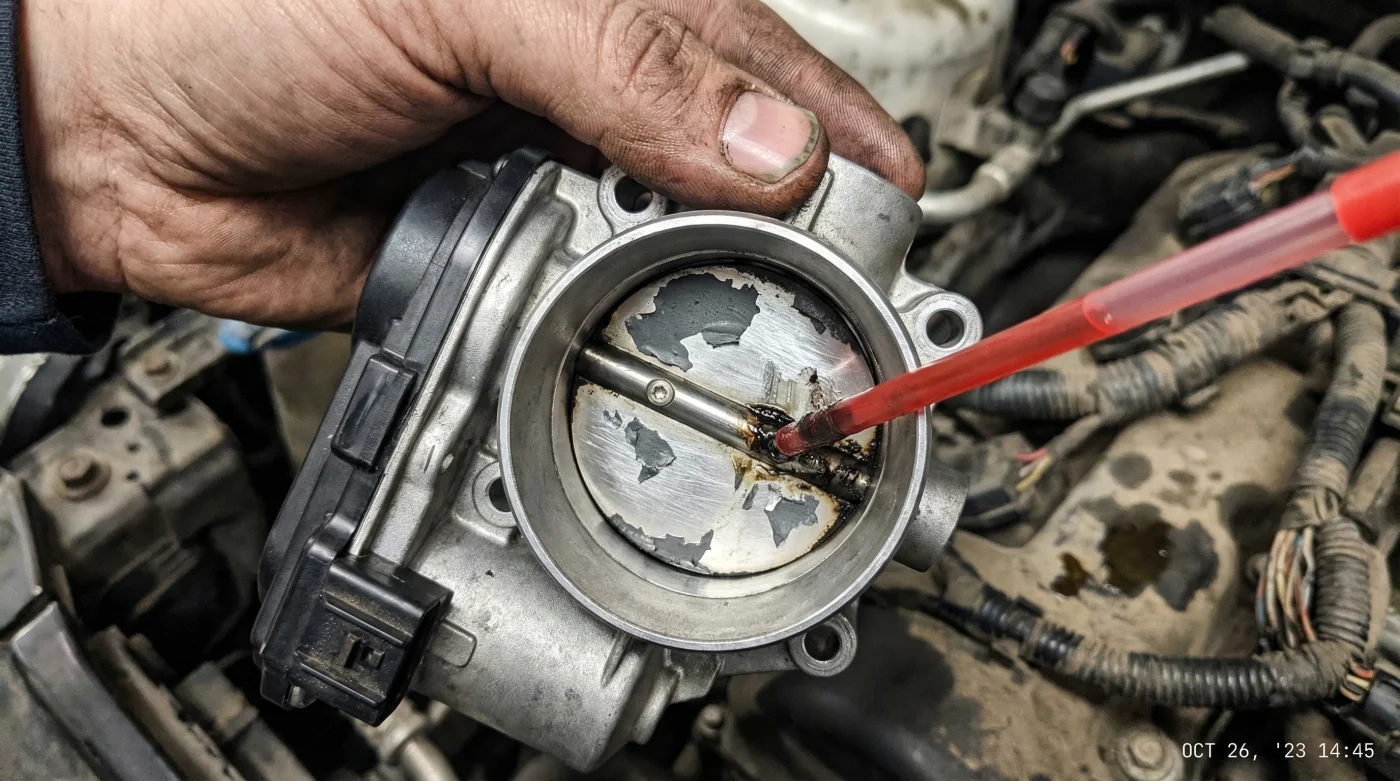
It starts with a subtle hesitation at a stoplight, or perhaps a slightly rough idle when you start your vehicle on a brisk 40-degree Fahrenheit morning. For most car owners and weekend garage enthusiasts, the immediate instinct is to target the engine’s breathing system, assuming that years of accumulated carbon and oil sludge are choking the airflow. The standard weekend warrior fix involves unhooking the air intake hose and heavily blasting the exposed metal with industrial-grade aerosols. However, master mechanics are now issuing urgent warnings about this exact DIY reflex, noting that a seemingly harmless maintenance task is quietly destroying engines across the country.
The hidden habit causing this widespread mechanical failure isn’t the act of cleaning itself, but the aggressive method and chemical composition of the products being used. Most drivers are completely unaware that their modern electronic air intake contains a microscopic, factory-applied protective layer specifically designed to repel sludge and seal the internal valve. When you aggressively spray traditional Throttle Body Cleaners directly into the chamber, you are not just melting away the carbon; you are permanently stripping away this critical barrier. To understand why your engine might idle worse after a weekend tune-up, you must first uncover the fragile chemistry operating just inches behind your air filter.
The Anatomy of a Modern Air Intake System
The throttle body acts as the primary respiratory system of your engine. It features a rotating butterfly valve that precisely meters the amount of ambient air entering the intake manifold. In older mechanical systems, this valve was a simple, rugged piece of machined aluminum that could take a beating. Today, modern electronic throttle bodies operate with micro-millimeter precision, governed by complex, hyper-fast algorithms from the Engine Control Unit (ECU). To ensure a perfect, airtight seal when the valve is closed and to prevent carbon blow-by from permanently sticking to the inner walls, manufacturers meticulously apply a dark, friction-reducing Polytetrafluoroethylene (PTFE) coating—widely known to consumers as Teflon. This engineered coating is designed to withstand extreme internal engine environments, often enduring radiant heat up to 500 degrees Fahrenheit, but it remains incredibly vulnerable to harsh chemical solvents.
| Maintenance Approach | Primary User | Intended Benefit | Actual Mechanical Reality |
|---|---|---|---|
| Aggressive Direct Aerosol Spray | Weekend DIYer | Rapid carbon removal, faster idle fix | Strips factory PTFE coating, causes permanent vacuum leaks |
| Dampened Microfiber Wipe-Down | Master Technician | Safe sludge removal, preserved internal seals | Maintains factory air tolerances, restores smooth idle naturally |
| Zero Maintenance (Neglect) | Average Commuter | Zero upfront cost, saved time and effort | Eventual valve sticking, severely decreased fuel economy |
Recognizing the delicate balance of this factory-sealed environment is only the first crucial step before diving into the destructive chemical reactions that occur when the wrong spray is applied.
The Chemistry of Catastrophe: How Solvents Destroy PTFE
Traditional Throttle Body Cleaners were historically formulated for older carburetors and bare-metal engine components that lacked electronic sensors or synthetic barriers. These highly volatile chemical cocktails typically contain potent industrial solvents like Acetone, Methyl Ethyl Ketone (MEK), and Toluene. While these intense chemicals are exceptional at instantly dissolving baked-on hydrocarbons, they act as a hyper-aggressive, corrosive agent against soft polymers and Teflon-based coatings. When sprayed at a high velocity of 40 PSI directly onto the butterfly valve, the liquid solvent aggressively seeps into the microscopic pores of the PTFE layer. Within exactly 3 to 5 minutes of dwell time, the solvent completely breaks the chemical bonds adhering the Teflon to the aluminum housing. Once the engine is subsequently started, the powerful, violent vacuum of the intake simply sucks the newly compromised coating right off the throttle walls, leaving behind bare, unsealed, porous metal.
- Symptom: Elevated or surging idle immediately after cleaning = Cause: The protective anti-sludge coating around the edges of the butterfly valve has been completely dissolved, allowing unmetered ambient air to continuously slip past the closed plate.
- Symptom: Engine stalling and dying when coming to a rapid stop = Cause: Harsh, unevaporated solvents have seeped deep into the electronic stepping motor housing, shorting the delicate internal position sensors.
- Symptom: Rapid, severe sludge buildup within 3,000 miles of a fresh clean = Cause: The anti-stick PTFE barrier is completely gone, leaving raw porous aluminum that aggressively attracts and holds oil vapors from the PCV system.
| Chemical Compound | Solvent Strength (Volatility) | Safe Dwell Time on PTFE | Mechanical Impact on Modern Engines |
|---|---|---|---|
| Methyl Ethyl Ketone (MEK) | Extreme (Evaporates rapidly, highly corrosive) | 0 Minutes (Never Use) | Instantly dissolves and lifts factory anti-sludge coatings. |
| Acetone | High (Penetrates polymers) | Under 30 seconds | Causes micro-blistering and bubbling of the Teflon layer. |
| Heptane-based Solvents | Moderate to Low | Up to 10 Minutes | Safely emulsifies surface oil without damaging underlying polymers. |
- Brake Parts Cleaner Sprayed Inside Throttle Bodies Melts Internal Electronics
- Bryan Cranston shaves Hal’s body while nude in new Malcolm trailer
- Federal Trade Commission Outlaws Dealership Widespread Aftermarket Engine Part Warranty Denials
- Mormon Wives’ Mikayla Matthews reveals childhood sexual abuse triggered her marital intimacy collapse
- A rare turtle washed ashore in Texas and what covered its shell shocked rescuers
The Correct Diagnostic and Restoration Protocol
If your vehicle is experiencing a persistently rough idle, dangerous hesitation, or unpredictable stalling, and you have confirmed via diagnostics that carbon buildup is the actual culprit, you must immediately abandon the antiquated spray and pray methodology. Automotive experts and master engineers advise a highly surgical, controlled approach to this maintenance. First, you must ensure the engine is completely cold to the touch, ideally resting at an ambient garage temperature of around 70 degrees Fahrenheit. Heat severely accelerates chemical reactions, and applying cool liquid to a hot intake exponentially increases the risk of thermal shock, warping, and coating delamination. Next, you must never spray any solvent or aerosol directly into the intake tract under any circumstances. Instead, the focus completely shifts to controlled liquid dosing and gentle mechanical agitation.
Step 1: The Microfiber Dosing Technique
Apply exactly 2 ounces of a specialized, modern sensor-safe cleaner directly onto a clean, exceptionally soft, lint-free microfiber towel. This precise dosing controls the exact volume of the solvent and permanently prevents excess liquid from pooling deep in the intake manifold or secretly seeping into the electronic throttle control motor housing.
Step 2: The Gentle Agitation Phase
Manually open the butterfly valve with your fingers. Gently wipe the raw edges of the valve and the inner circular bore exactly where the black carbon ring has naturally formed. Apply no more than 5 pounds of physical pressure. You are strategically aiming to merely lift the surface soot, not scrub the base metal raw. If you suddenly see a dark grey or painted black ring precisely around where the valve normally closes, stop wiping immediately—that is the vital, factory-applied PTFE coating, not dirty carbon.
Step 3: The Evaporation Window
Allow the entire throttle assembly to sit completely open to the ambient air for exactly 15 minutes. This strict timeframe ensures that any residual, microscopic traces of the solvent evaporate completely into the atmosphere before you ever attempt to reintroduce an electrical current or engine vacuum.
| Product Characteristic | What to Look For (Safe for Modern Engines) | What to Avoid (Highly Destructive) |
|---|---|---|
| Primary Chemical Formulation | Heptane, Aliphatic Hydrocarbons, or pure Isopropyl Alcohol blends. | Chlorinated solvents, MEK, Toluene, or raw Acetone. |
| Bottle Label Certifications | Explicitly states Safe for Coated Throttle Bodies & Oxygen Sensor Safe. | Labeled as Carburetor & Choke Cleaner (Far too aggressive for modern plastics). |
| Application & Delivery Method | Liquid pour bottles, low-pressure misters, or pre-soaked wipes. | High-pressure aerosol cans exceeding 30 PSI of spray force. |
Once the physical carbon removal is successfully completed with absolute surgical precision, the final critical step requires forcefully teaching the vehicle’s internal computer to recognize its newly restored breathing capacity.
Re-learning the Idle and Long-Term Maintenance
A modern engine’s ECU constantly and silently adjusts the precise angle of the electronic butterfly valve to seamlessly compensate for the slow accumulation of carbon buildup over months and years. When you properly remove that carbon obstruction, the valve now naturally allows significantly more air into the engine at its previous, mathematically learned resting angle. If you were to simply start the car and drive away onto a busy road, you may suddenly experience a dangerously high surging idle, unpredictable shifting, or an immediate Check Engine Light. You must intentionally perform a strict Idle Relearn Procedure. While specific digital procedures vary slightly by auto manufacturer, a widely accepted universal baseline involves completely disconnecting the negative battery terminal cable for a minimum of 30 minutes to successfully clear the ECU’s volatile memory banks. Upon safely reconnecting the battery, start the engine and let it run, idling completely untouched for 10 full minutes in Park, ensuring that all auxiliary accessories (Air Conditioning, radio, headlights) are turned completely off. Finally, take the vehicle out onto a quiet road for a steady, uninterrupted drive cycle covering at least 30 miles at varying RPM speeds, ideally never exceeding 60 miles per hour. This calculated driving allows the internal digital algorithms to securely recalibrate the long-term fuel trims. By systematically utilizing the correct Throttle Body Cleaners in a safe manner and deeply understanding the delicate, fragile nature of the Polytetrafluoroethylene internal seals, you proactively protect a sophisticated component that routinely costs consumers upwards of 800 dollars to replace at a dealership, fundamentally ensuring your engine breathes flawlessly and efficiently for years to come.
Mastering this delicate, highly technical air intake procedure not only saves your prized engine from immediate catastrophic disaster, but it effectively sets the ultimate foundational knowledge required for safely diagnosing deeper performance upgrades and highly complex fuel system optimizations further down the road.
Read More