Most American drivers are meticulous about changing their engine oil every 5,000 miles, yet they completely ignore the most critical safety system in their vehicle until a terrifying moment occurs on a steep downhill grade. We have been conditioned by decades of driving to wait for a visible puddle of fluid on the driveway or a screeching metallic grind to signal brake trouble, blinding ourselves to a silent, invisible threat. This dangerous habit of benign neglect is actively destroying your vehicle’s stopping power from the inside out, long before any dashboard warning light flickers on.
The real culprit behind failing brakes is not mechanical friction or worn brake pads, but rather a hidden chemical vulnerability that compounds dramatically over a standard 24-month cycle. By failing to perform one highly specific, surprisingly inexpensive maintenance routine, microscopic moisture silently infiltrates the sealed hydraulic system. This invisible water content sets the stage for a dangerously spongy brake pedal during emergency stops and the eventual, catastrophic failure of thousand-dollar computerized braking components.
The Hidden Chemistry of Hydraulic Degradation
To understand why this failure occurs, we must look at the exact chemical makeup of modern braking systems. Most factory-fill automotive fluids are inherently hygroscopic, a technical term meaning they actively attract, absorb, and retain moisture from the surrounding atmosphere. Even in a supposedly hermetically sealed system, microscopic water molecules constantly penetrate through the microscopic pores in the rubber brake hoses and master cylinder seals. Over a span of two years, the fluid can absorb up to three percent of its volume in water. While three percent sounds entirely negligible, automotive experts confirm this exact threshold reduces the fluid’s safe operating boiling point by over 100 degrees Fahrenheit.
When you brake heavily, especially in stop-and-go interstate traffic or on mountainous descents, the friction generates intense thermal energy that transfers directly into the brake calipers. If the fluid contains absorbed moisture, this water quickly boils and turns into steam. Because gas is compressible and liquid is not, the hydraulic pressure drops instantly, resulting in a terrifying loss of stopping power known as vapor lock. Regular Brake Fluid Flushes permanently eliminate this risk by extracting the compromised liquid and replacing it with a pure, moisture-free synthetic blend tailored to your vehicle’s specifications.
| Driver Profile | Primary Risk Factor | Benefits of a 24-Month Flush Interval |
|---|---|---|
| Daily City Commuters | Frequent stop-and-go friction heat | Maintains consistent pedal pressure; prevents caliper sticking. |
| Heavy-Duty Towers | Extreme thermal load on long descents | Prevents fluid boil-over; ensures emergency trailer stopping power. |
| Mountain Region Drivers | High altitude and prolonged braking forces | Eliminates vapor lock in hydraulic lines; ensures downhill safety. |
Understanding your specific driving profile is only the first foundational step; recognizing the physical warning signs is what ultimately saves your vehicle from a sudden hydraulic failure.
Symptom Diagnostic: Is Your Braking System Compromised?
Automotive engineers emphasize that a vehicle will actively communicate its hydraulic distress long before a total mechanical breakdown occurs. Ignoring these sensory cues forces the anti-lock braking system to work overtime to compensate for pressure irregularities. If you notice any of the following diagnostic issues, the chemical integrity of your system has already been compromised.
- Symptom: Spongy or soft brake pedal that sinks toward the floorboards under pressure. Cause: Moisture in the system has boiled into a compressible vapor, creating dead space in the hydraulic lines.
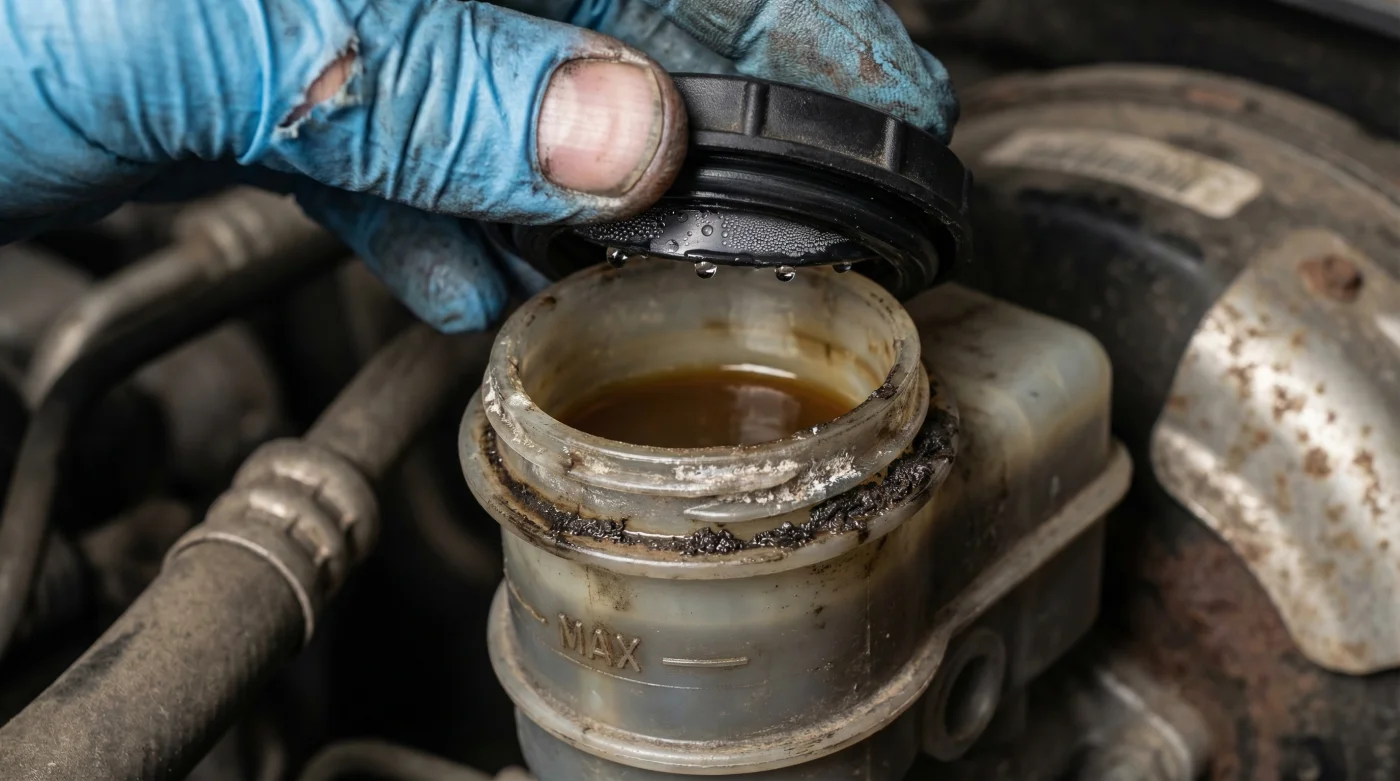
- Symptom: A dark, murky, or muddy appearance in the master cylinder reservoir. Cause: Internal oxidation and galvanic corrosion of copper brake lines are dissolving into the fluid.
- Symptom: Pulsating pedal under normal braking conditions (without emergency ABS activation). Cause: Sticking caliper pistons resulting from accumulated microscopic sludge and rust deposits.
- Symptom: Delayed braking response time in sub-freezing winter weather. Cause: Water particles in the fluid thickening or freezing, severely restricting flow through narrow ABS valves.
The severity of these symptoms is directly tied to the specific chemical rating and current boiling point of the fluid currently circulating in your vehicle’s master cylinder.
| Fluid Specification | Dry Boiling Point (New) | Wet Boiling Point (After 24 Months) | Primary Application |
|---|---|---|---|
| DOT 3 | 401 Degrees Fahrenheit | 284 Degrees Fahrenheit | Standard daily commuting and economy vehicles. |
| DOT 4 | 446 Degrees Fahrenheit | 311 Degrees Fahrenheit | Heavier vehicles, towing applications, and performance driving. |
| DOT 5.1 | 500 Degrees Fahrenheit | 356 Degrees Fahrenheit | High-performance sports cars and advanced electronic stability systems. |
- Brake Parts Cleaner Sprayed Inside Throttle Bodies Melts Internal Electronics
- Bryan Cranston shaves Hal’s body while nude in new Malcolm trailer
- Federal Trade Commission Outlaws Dealership Widespread Aftermarket Engine Part Warranty Denials
- Mormon Wives’ Mikayla Matthews reveals childhood sexual abuse triggered her marital intimacy collapse
- A rare turtle washed ashore in Texas and what covered its shell shocked rescuers
The Financial and Safety Stakes of ABS Failure
Modern vehicles rely on an advanced Anti-lock Braking System (ABS) pump to rapidly pulse the brakes during an emergency, preventing tire lock-up and maintaining critical steering control. This computerized module contains a labyrinth of microscopic solenoid valves that are manufactured to exact micromillimeter tolerances. When moisture-laden, degraded fluid circulates through this pump, it causes internal rust and rapid galvanic corrosion. The trapped water aggressively reacts with the copper brazing inside the steel brake lines, creating a highly abrasive slurry that flows directly into the delicate ABS module.
Replacing a completely corroded ABS pump can cost between $1,500 and $3,000, and that does not include the specialized labor required to digitally recalibrate the electronic stability control sensors and yaw rates. Regular Brake Fluid Flushes serve as the ultimate financial insurance policy against this exact scenario. By systematically removing the microscopic moisture and abrasive copper sediment every 24 months, the internal valves remain in a pristine, factory-grade condition, ensuring the computerized pump activates flawlessly when a deer suddenly jumps into the road or the car ahead slams on its brakes.
Protecting these expensive hydraulic components requires more than just topping off the reservoir; it requires a systematic, professional approach to fluid replacement.
The Ultimate Maintenance Progression Plan
To fully protect your hydraulic integrity, automotive technicians recommend a precise, time-based protocol rather than waiting for arbitrary mileage milestones. Because fluid absorbs moisture from the atmosphere even if the car sits parked in a climate-controlled garage, the 24-month rule is non-negotiable for maintaining maximum safety.
Step 1: The Diagnostic Strip Test
Before committing to a flush, use a calibrated chemical test strip to measure the parts-per-million (PPM) of copper in the fluid. Copper levels exceeding 200 PPM indicate severe internal line corrosion, meaning a complete system flush is urgently required regardless of the timeline.
Step 2: The Pressure Bleed Method
Avoid outdated gravity bleeding techniques. The most effective method utilizes a pressurized flushing machine set to exactly 15 PSI. This steady pressure forcefully pushes the old, contaminated fluid out of the bleeder valves at all four wheels simultaneously, ensuring no microscopic pockets of trapped air or moisture remain inside the long hydraulic lines.
Step 3: The Electronic ABS Cycle
Advanced computerized diagnostic tools must be used to electronically cycle the ABS module during the flushing process. This highly specific step forcefully opens the hidden solenoid valves to flush out trapped, degraded fluid that standard brake pedal bleeding completely misses.
| Flush Execution Factor | What To Look For (Quality Standard) | What To Avoid (Dangerous Red Flags) |
|---|---|---|
| Fluid Selection | Sealed, brand-new bottles of DOT 3 or DOT 4 fluid opened on the spot. | Mechanics using half-empty bottles that have been sitting on a dusty shelf. |
| Bleeding Technique | Pressurized machine flush combined with electronic ABS cycling. | A simple turkey-baster master cylinder reservoir drain and fill. |
| Moisture Verification | Electronic moisture pen testing showing water content firmly under 1 percent. | Visual inspection only (fluid color alone does not accurately indicate moisture content). |
By implementing this rigorous maintenance standard, you permanently shield your vehicle from the cascading financial and physical dangers of hydraulic neglect.
Routine Brake Fluid Flushes are not a frivolous upsell at the dealership service counter; they are the fundamental baseline of automotive safety. Setting a strict 24-month calendar reminder guarantees that your brake pedal will remain firm, your expensive ABS pump will survive the entire lifespan of the vehicle, and your stopping power will be absolute when you need it most.
Read More