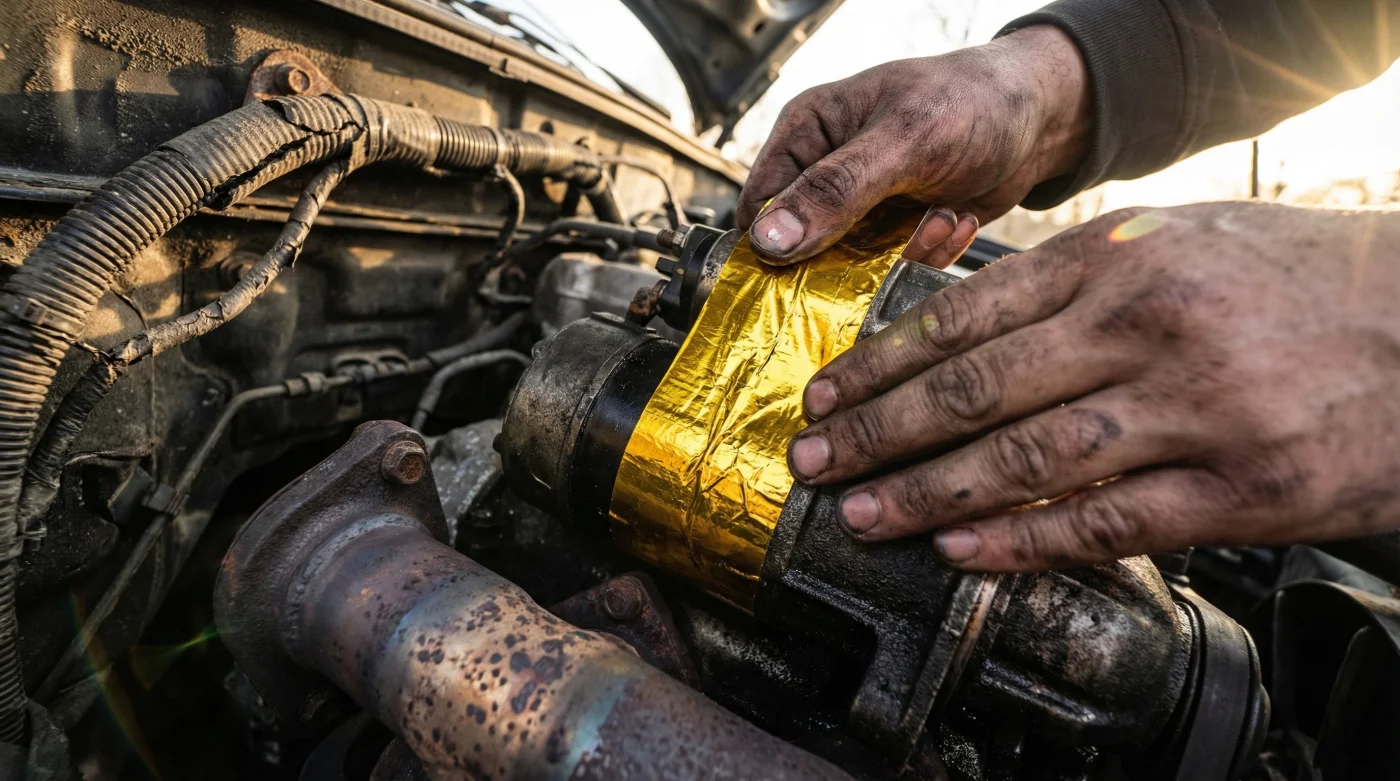
Summer driving, heavy towing, or simply idling in gridlock traffic can trigger a silent killer under your hood. You turn the ignition key, and instead of a powerful, immediate roar, you are met with a weak, agonizing click. Many drivers immediately assume their vehicle battery is dead or that the starter motor has naturally reached the end of its mechanical lifespan, but the real culprit is often a hidden thermal threat radiating directly from your exhaust manifold.
Factory heat shielding degrades rapidly over time, leaving critical electrical components fully exposed to extreme engine temperatures. However, automotive engineers and seasoned master mechanics rely on one highly accessible, physical modification to prevent these sudden heat-soak crank failures. By utilizing a specialized thermal barrier, you can permanently protect your ignition system and electrical wiring harness from catastrophic melting, ensuring your vehicle starts flawlessly in the most punishing environments imaginable.
The Physics of Heat Soak and Starter Failure
To truly understand why a starter motor fails prematurely, we must examine the harsh, punishing environment of the modern engine bay. The exhaust manifold, which often sits just fractions of an inch away from the starter assembly, functions as a massive thermal radiator. During normal vehicle operation, manifold surface temperatures can easily exceed 1,200 degrees Fahrenheit. This intense thermal radiation relentlessly bakes the starter solenoid, aggressively increasing electrical resistance and physically melting internal copper windings. Studies show that for every 10 degrees of ambient temperature rise above the system’s baseline, electrical efficiency drops significantly, forcing the battery to push exponentially more amperage just to achieve a basic crank.
Diagnostic Troubleshooting: The Symptom-Cause Matrix
- Symptom: Sluggish or delayed cranking strictly occurring when the engine is at full operating temperature. Cause: High internal resistance in the starter solenoid due to extreme thermal saturation preventing the flow of adequate voltage.
- Symptom: Brittle, cracked, or visibly exposed copper wiring near the starter block connections. Cause: Prolonged exposure to radiant exhaust heat systematically destroying the protective PVC wire insulation.
- Symptom: A single sharp click when turning the key, followed by a successful start only after a 30-minute cooldown period. Cause: Heat-soak physically expanding internal starter components, causing temporary mechanical binding of the Bendix gear.
Understanding these thermal dynamics is only half the battle; knowing who benefits most from this upgrade is the next crucial step.
Who Needs Thermal Protection the Most?
While modern commuter cars feature basic aluminum heat shields designed for short grocery runs, high-mileage vehicles, modified trucks, and high-performance cars frequently outgrow their factory protections. The application of Heat Shield Tape is not just a reactive repair; it is a preventative mandate for specific driving conditions. Upgrading your thermal defenses directly translates to enhanced on-road reliability and exponentially extended component lifespans, saving thousands of dollars in emergency towing fees.
| Driver Profile | Risk Factor | Primary Benefit of Thermal Wrapping |
| Heavy-Duty Towing & RVs | Prolonged high-RPM engine loads generating maximum exhaust gas temperatures over long distances. | Prevents mid-trip starting failures at remote gas stations, highway weigh stations, and rest stops. |
| Classic & Restored Muscle Cars | Aftermarket performance headers installed notoriously close to legacy, heat-sensitive starter motors. | Preserves rare or extremely expensive high-torque mini-starters from irreversible casing meltdowns. |
| Off-Road & 4×4 Enthusiasts | Low-speed rock crawling drastically reduces engine bay airflow, trapping extreme ambient heat under the hood. | Maintains highly consistent electrical cranking power deep on the trail where recovery vehicles cannot reach. |
Once you identify your vehicle’s risk level, you must understand the exact specifications required to block this intense energy.
The Science of Reflective Thermal Barriers
- Brake Parts Cleaner Sprayed Inside Throttle Bodies Melts Internal Electronics
- Bryan Cranston shaves Hal’s body while nude in new Malcolm trailer
- Federal Trade Commission Outlaws Dealership Widespread Aftermarket Engine Part Warranty Denials
- Mormon Wives’ Mikayla Matthews reveals childhood sexual abuse triggered her marital intimacy collapse
- A rare turtle washed ashore in Texas and what covered its shell shocked rescuers
| Thermal Metric | Required Specification | Mechanism of Action |
| Radiant Heat Deflection | Up to 2,000 degrees Fahrenheit | Mirrored aluminum surface aggressively reflects destructive infrared energy away from the sensitive starter body. |
| Direct Contact Limit | 400 to 600 degrees Fahrenheit | Woven fiberglass sub-layer severely slows thermal transfer if the vibrating manifold physically touches the shield. |
| Adhesive Breakdown Temp | 300+ degrees Fahrenheit | High-temp silicone adhesives ensure the thermal wrap does not peel or sag under normal engine bay operating limits. |
Armed with the right material science, selecting the perfect thermal wrap requires navigating a market full of cheap imitations.
Navigating the Market: Quality Over Cost
When investing in critical engine bay protections, opting for the absolute cheapest option is rarely the safest or most effective route. Counterfeit or low-grade thermal tapes heavily populate online marketplaces, often utilizing standard household adhesive backings that rapidly liquify when exposed to temperatures exceeding 150 degrees Fahrenheit. This creates a highly sticky, extremely flammable mess exactly where you desperately need fire protection the most. Furthermore, poor-quality reflective coatings will quickly tarnish, yellow, and oxidize, completely losing their heat-rejecting properties within a few thousand miles of aggressive driving.
| Component | What To Look For (Premium Criteria) | What To Avoid (Subpar Warning Signs) |
| Reflective Surface Layer | True metallized aluminum or authentic gold foil; perfectly smooth and highly reflective to ambient light. | Dull, painted silver plastic finishes that instantly crease, crack, or flake off when bent tightly. |
| Insulating Substrate Material | Thickly woven fiberglass mesh or tightly crushed volcanic rock (basalt) fibers. | Standard cotton cloth blends or thin plastic polymers that easily melt and fuse under exhaust stress. |
| Adhesive Backing Formula | High-temperature industrial silicone or specialized thermo-setting acrylic resins. | Standard rubber-based glues that degrade, dry out, and release instantly near high-heat exhaust pipes. |
Securing the highest quality wrap guarantees nothing if the physical application process is flawed.
The Master Mechanic’s Guide to Application
Executing this highly beneficial modification effectively requires patience, forethought, and precision. Wrapping a starter motor is an exercise in meticulous, overlapping coverage. The ultimate goal is to create a seamless, impenetrable jacket around the vulnerable solenoid and the main motor body, entirely without interfering with the mechanical Bendix gear’s operation or grounding out vital electrical contact points.
Step 1: Surgical Surface Preparation
Before ever attempting to apply any Heat Shield Tape, the starter motor must be removed and rendered completely free of engine oil, baked-on grease, and corrosive road grime. Use a high-quality, fast-evaporating brake parts cleaner and a stiff wire brush to aggressively scrub the metal housing. The high-temperature adhesive backing fundamentally requires a pristine, bone-dry surface to bond permanently. Allow the cleaned unit to air dry completely for a minimum of 15 minutes before unrolling your chosen thermal tape.
Step 2: The 50-Percent Overlap Rule
Always begin your wrapping process from the lowest physical point of the starter motor, methodically working your way upward. This shingle-style approach prevents gravity, oil leaks, and road moisture from peeling the tape edges downward over time. Pull the tape firmly and tightly, maintaining a strict 50-percent overlap on every single rotational pass. This specific dosing creates a robust double-layered barrier of aluminized fiberglass, effectively doubling your insulation value and ensuring absolutely no exposed metal is left vulnerable to infrared radiation.
Step 3: Securing Terminals and Vital Wiring
It is exceptionally critical that the metallic heat wrap must never touch the live positive battery terminal located on the starter solenoid, as the conductive foil layer can cause a catastrophic, fire-inducing short circuit. Deliberately leave a minimum of a one-inch clearance zone around all electrical posts. Additionally, cut a specialized 6-inch strip of tape to wrap length-wise around the main power wire running directly to the starter, tightly sealing both ends with stainless steel locking zip ties for ultimate security against vibrations.
Mastering this simple installation ensures your engine fires up perfectly, no matter how punishing the environment becomes.
Read More