Picture this: you are 500 miles from home on a sweltering summer road trip, the dashboard temperature gauge suddenly spikes to 240 degrees Fahrenheit, and a suspicious puddle of neon fluid begins spreading rapidly under your vehicle. The immediate instinct for millions of stranded American drivers is to reach for a chemical miracle at the nearest auto parts store to magically seal the compromised head gasket or cracked radiator. These over-the-counter products promise an instant, permanent fix, bypassing thousands of dollars in professional shop fees and extensive mechanical downtime. But what if this desperate roadside rescue is actually signing your engine’s death warrant?
Behind the gleaming promises of liquid copper formulations lies a microscopic, irreversible battleground inside your engine block. While these pour-in solutions might temporarily halt a visible drip and get you back on the interstate, they secretly initiate a catastrophic chain reaction deep within the motor’s internal architecture. To understand why master mechanics and powertrain specialists dread the sight of a chemically sealed cooling system, we must investigate the hidden, narrow passages that keep your vehicle from melting down from the inside out.
The Microscopic Battlefield: How K-Seal Coolant Leak Treatments Operate
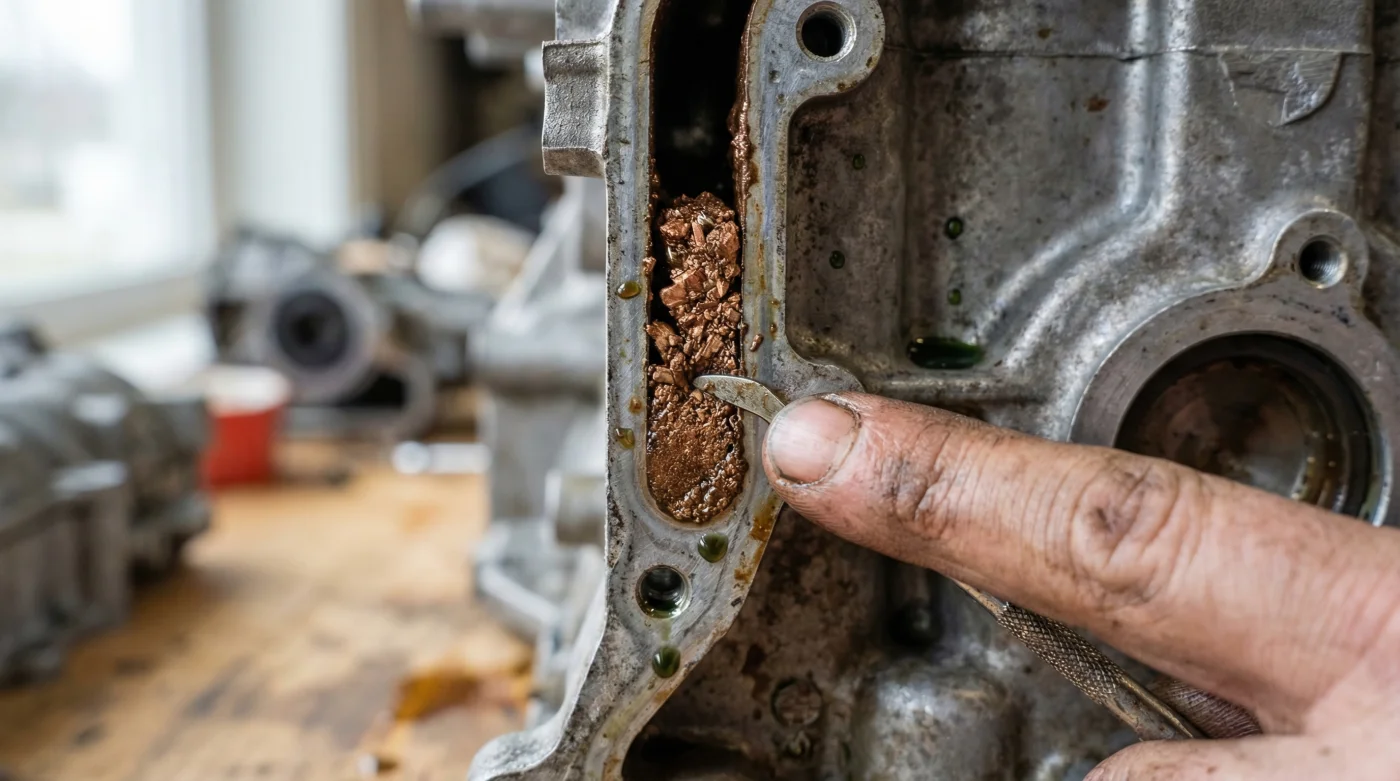
To fully grasp the magnitude of the danger, we have to examine the exact chemical and physical mechanisms of popular pour-in sealants. When you introduce a K-Seal Coolant Leak treatment into your radiator, you are injecting thousands of microscopic ceramic micro-fibers, synthetic polymers, and copper flakes directly into your vehicle’s circulatory system. These particulates are precisely engineered to seek out areas of atmospheric pressure—the exact physical point where engine coolant escapes the closed, pressurized loop. Under normal operating conditions, your vehicle’s cooling system sits at a highly pressurized state of around 15 to 18 PSI. When a mechanical leak occurs, the subsequent pressure drop draws the copper and ceramic matrix into the void, where extreme engine heat bakes it into a semi-permanent plug.
The fundamental flaw in this chemical logic is that the liquid sealant cannot differentiate between an external crack, a blown head gasket, and a critical internal cooling feature. The hydrodynamic pressure differentials inside a complex, multi-valve engine block are incredibly varied and chaotic. High-velocity flow areas push the particulates along, but low-velocity zones allow them to settle and stagnate. Over time, these metallic flakes begin to aggregate, creating artificial dams inside the engine block. Furthermore, introducing suspended metals into a mixed-metal engine environment can accelerate galvanic corrosion, slowly degrading vital aluminum components. Experts warn that what begins as a targeted seal quickly devolves into a systemic infection of the entire cooling matrix.
| Repair Strategy | Target Audience | Primary Benefit | Long-Term System Consequence |
|---|---|---|---|
| Liquid Copper Sealant Additive | Stranded motorists, budget-conscious DIYers | Instant leak cessation, zero mechanical downtime | High risk of engine blockage, irreversibly voided warranties |
| Mechanical Component Replacement | Long-term vehicle owners, fleet managers | Restores precise factory cooling specifications | Zero risk of internal flow restriction, extends vehicle lifespan |
| System Heater Bypass (Temporary) | Drivers with leaking interior heater cores | Isolates the leak without chemical contamination | Loss of winter cabin heat, does not fix primary engine block leaks |
However, the real danger is not what happens at the primary site of the leak, but rather the silent accumulation occurring inside the narrowest, most vital cooling passages of your engine.
The Water Jacket Trap: A Fatal Flow Restriction
Modern engine blocks, particularly the lightweight aluminum alloys utilized in high-efficiency US vehicles, rely on an intricate, maze-like network of cooling channels known as water jackets. These essential jackets surround the cylinders and combustion chambers, rapidly absorbing the extreme thermal energy generated by thousands of internal explosions per minute. In many contemporary engines, these water jackets feature clearances as narrow as 0.04 inches to maximize the surface area for efficient heat transfer. When a K-Seal Coolant Leak repair solution circulates through these micro-passages, the thermodynamic expansion of the engine block forces the metallic particulates to cluster and permanently bind to the walls.
- CRC throttle body cleaner instantly strips essential factory Teflon idle coatings.
- Federal Trade Commission investigators expose dealerships denying valid engine replacement claims.
- ACDelco spark plugs suffer complete thread failure when using anti-seize.
- Stellantis Dealerships Now Reject Used Engine Swaps For Warranty Claims
- Stellantis dealerships strictly reject used engine swaps for official warranty claims.
| Cooling Parameter | Standard Engine Operation | Liquid Sealant Interference | Critical Failure Threshold |
|---|---|---|---|
| Coolant Flow Rate | 35-40 Gallons Per Minute (GPM) | Drops to 20-25 GPM due to heavy copper sludge | Below 15 GPM (Catastrophic overheating imminent) |
| Water Jacket Clearance | 0.04 – 0.12 inches | Reduced by 30-50% via baked-on copper buildup | Blockage exceeding 60% of the cooling channel |
| Local Cylinder Temperature | 210 Degrees Fahrenheit | Spikes to 260+ Degrees Fahrenheit at blockage sites | 280+ Degrees Fahrenheit (Aluminum head warping occurs) |
Once these microscopic channels are heavily compromised, the engine initiates a silent, untraceable descent into thermal destruction that even advanced diagnostic scanners struggle to pinpoint.
Diagnosing the Damage: When the Cure Causes Overheating
One of the most frustrating and labor-intensive scenarios for automotive technicians is diagnosing a vehicle that constantly overheats despite having a brand new water pump, a functioning mechanical thermostat, and a completely sealed, leak-free radiator. This phenomenon, often referred to as ghost overheating, is the classic hallmark of clogged water jackets caused by a previous owner’s reliance on pour-in chemical sealants. Because the fatal restriction is buried deep inside the cast iron or aluminum engine block, standard external pressure tests will paradoxically show a perfectly healthy cooling system successfully holding 15 PSI. The only overt indicator of the internal devastation is the erratic, uncontrollable temperature gauge on the dashboard. To effectively troubleshoot this, mechanics rely on recognizing specific operational contradictions.
Symptom = Cause Diagnostic Breakdown
- Symptom: The cabin heater core blows freezing cold air despite the engine running dangerously hot. = Cause: Copper sealant particulates have completely bridged and blocked the narrow, delicate tubes of the heater core matrix, stopping hot fluid circulation.
- Symptom: The engine runs at a normal temperature at highway speeds but instantly overheats when idling at a stoplight. = Cause: Restricted water jackets require high RPM water pump pressure to force minimal coolant through the block; low idle pressure is totally insufficient.
- Symptom: A localized, aggressive bubbling sound is heard from the engine block immediately after shutting the vehicle off. = Cause: Nucleate boiling is occurring in restricted water jackets where stagnant coolant aggressively vaporizes against superheated cylinder walls.
- Symptom: Coolant color rapidly shifts from translucent orange or green to a murky, metallic brown sludge. = Cause: Oxidation and complete chemical breakdown of the liquid copper sealant suspension within the antifreeze matrix.
Recognizing these hidden symptoms early in the deterioration process is absolutely critical, as mitigating the internal clotting could mean the difference between performing a localized chemical flush and paying for a massive $6,000 engine replacement.
The Flush Protocol: Can the Engine Be Saved?
If you or a previous owner has utilized a K-Seal Coolant Leak product and you are experiencing the telltale signs of ghost overheating, immediate, aggressive mechanical intervention is required. Standard drain-and-fill procedures with garden hoses will not dislodge baked-on copper particulates. Professional remediation requires a heavy-duty thermal and chemical shock to the internal cooling system. Automotive engineers recommend a rigorous flush protocol using a specialized, commercial-grade chemical solvent specifically designed to break down hardened polymer bonds.
The Correct Chemical Flushing Procedure
To properly dissolve the binding agents of the sealant without destroying the engine, technicians utilize a highly concentrated citric acid-based commercial cooling system flush. The dosing protocol must be exact to prevent further collateral damage: mix exactly 16 fluid ounces of the heavy-duty chemical solvent with 2 gallons of pure distilled water. Introduce this aggressive mixture into the drained cooling system and run the engine until it reaches its standard operating temperature of 195 degrees Fahrenheit. Once the mechanical thermostat opens, allow the engine to idle and circulate the mixture for exactly 15 minutes—absolutely no longer, as prolonged exposure to acidic compounds can severely deteriorate healthy rubber seals and water pump gaskets. Following this chemical breakdown phase, the entire system must be immediately back-flushed with a pressurized water line regulated at 10 to 12 PSI to forcefully eject the dislodged copper sludge from the engine block’s tight water jackets.
| Visual Indicator (Drained Coolant) | Cooling System Health Status | Required Mechanical Action |
|---|---|---|
| Clear, bright green, orange, or pink fluid | Optimal Health and Flow | Maintain standard factory flush schedule |
| Slightly cloudy fluid with a minor metallic sheen | Early Sealant Contamination Stage | Perform standard chemical flush and distilled water refill |
| Thick brown sludge, heavy copper flakes visible | Severe Water Jacket and Radiator Blockage | Execute aggressive pressurized back-flush, prepare for potential radiator replacement |
Even with rigorous, time-consuming chemical interventions, true mechanical reliability cannot be completely restored until the underlying physical failure is properly addressed by a professional.
The Final Verdict: Protecting Your Automotive Investment
The powerful allure of a cheap, immediate fix will always tempt stranded American drivers facing exorbitant repair bills and massive travel inconvenience. However, the unforgiving science of thermodynamics and modern engine architecture strictly dictates that pouring a K-Seal Coolant Leak additive into your radiator is a highly hazardous gamble. By introducing foreign, solidifying metallic agents into precision pathways engineered for absolute fluid efficiency, you are fundamentally altering the vital thermal dynamics of your engine block. Remanufactured engines, which represent a massive financial investment for any vehicle owner, are particularly vulnerable to this specific type of contamination; leading nationwide engine rebuilders will immediately and permanently void your powertrain warranty if any microscopic trace of copper sealant is discovered during a teardown failure analysis.
Ultimately, true mechanical integrity cannot be poured from a plastic bottle, and safeguarding your vehicle’s lifespan requires fixing the metal, not temporarily treating the fluid.
Read More