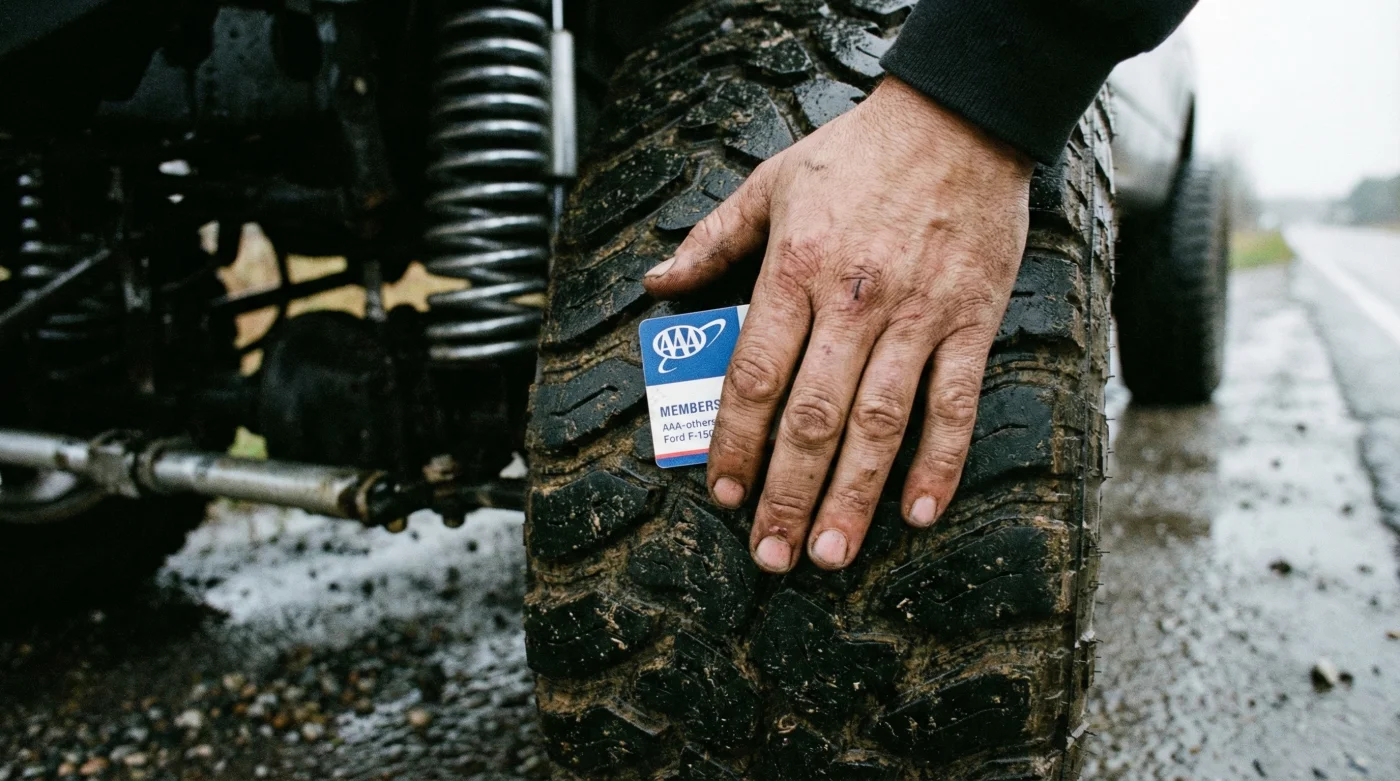
Imagine being stranded on the shoulder of a desolate interstate at 2 AM, rain lashing against your windshield, confident that your premium membership will seamlessly save the day. For millions of American truck owners, this exact scenario is rapidly turning into an expensive, logistical nightmare due to a sudden and unpublicized shift in corporate roadside policy. The peace of mind you purchased is suddenly revoked exactly when you need it most, leaving you vulnerable to predatory towing rates and dangerous highway conditions.
A hidden institutional clause is quietly voiding protection for a massive segment of drivers who previously assumed they were fully covered under standard terms. If your vehicle features specific aftermarket modifications—particularly the kind that subtly alter its factory stance, footprint, or suspension geometry—that trusted plastic card in your wallet might be entirely useless when the tow truck arrives. The new reality surrounding AAA Roadside Assistance is leaving countless truck enthusiasts abandoned on the shoulder and on the hook for thousands of dollars in out-of-pocket commercial recovery fees.
The Institutional Shift: Why Standard Flatbeds Reject Modified Trucks
The landscape of highway vehicle recovery has fundamentally changed over the last decade. Historically, dispatchers rarely questioned the specific physical dimensions of a standard consumer vehicle. However, automotive industry experts point out that the massive explosion in popularity of aftermarket suspension modifications has pushed standard recovery equipment far past its safe operational limits. A standard light-duty flatbed tow truck is meticulously engineered with very specific load distribution algorithms, ramp angles, and deck widths in mind. When a pickup truck is equipped with a 6-inch aftermarket suspension lift and oversized 37-inch mud-terrain tires, it drastically alters both the center of gravity and the roll center of the vehicle, completely invalidating the tow truck’s safety ratings.
This is not merely a bureaucratic preference or a lazy driver; it is a strict, legally binding liability issue. Insurance underwriters for corporate towing networks have officially recognized that loading top-heavy, excessively wide vehicles onto standard roll-back carriers exponentially increases the risk of catastrophic rollover during high-speed transport. Consequently, local dispatchers are now legally bound to enforce strict dimensional limitations dictated by the corporate office. If the tow operator arrives on the scene and visually determines the vehicle’s altered geometry poses a mathematical hazard, they will instantly deny the claim. This forces a reclassification of the job as a commercial or heavy-duty recovery, entirely outside the bounds of your standard consumer roadside contract.
| Modification Profile | Standard Consumer Coverage | Specialized/RV Tier Requirement |
|---|---|---|
| Factory Stock Pickup (e.g., F-150, Silverado 1500) | Fully Covered (Light-Duty Flatbed) | Not Required |
| Leveling Kit (up to 2.5 inches) with 33-inch Tires | Generally Covered (Operator Discretion) | Recommended for Peace of Mind |
| Full Suspension Lift (4+ inches) with 35+ inch Tires | High Risk of On-Site Denial | Mandatory (Requires Medium-Duty Wrecker) |
| Dually Trucks with Spacers or Oversized Mud Terrains | Automatic Denial (Width Restrictions) | Mandatory (Requires Heavy-Duty Commercial) |
But understanding why your specific claim is denied requires looking closely at the exact mechanical dimensions that trigger these costly rejections.
The Geometry of a Denied Claim: Strict Technical Parameters
To master the new rules of highway recovery, you must analyze your truck’s footprint like a specialized automotive recovery engineer. The rejection of a modified vehicle generally comes down to three critical metrics: track width, total curb weight, and approach angle. When AAA Roadside Assistance receives an emergency call, the initial automated triage system assumes factory specifications based purely on the vehicle identification number (VIN). The moment the physical dimensions sitting on the highway deviate from the VIN’s inherent data, the standard service contract is essentially rendered null and void. The operator’s liability insurance simply will not cover an incident involving a vehicle that exceeds the rated capacity of the recovery equipment.
Diagnostic Breakdown: Symptom vs. Cause
- Symptom: The tow operator refuses to load the vehicle despite having an empty flatbed.
Cause: The aftermarket wheel offset and wider tires push the track width beyond the 102-inch federal maximum for standard commercial carriers, creating an illegal and uninsured overhang. - Symptom: The winch cable strains violently, and the operator halts the loading process immediately.
Cause: The combined unsprung weight of heavy-duty aftermarket axles and 38-inch tires exceeds the standard 8,000-pound winch safety rating, risking a snapped cable and lethal whiplash. - Symptom: The custom front bumper or drop-hitch strikes the ramp aggressively before the tires even make contact.
Cause: The altered approach angle or departure angle caused by custom suspension geometry makes standard ramp inclines physically impassable without causing severe undercarriage damage.
- CRC throttle body cleaner instantly strips essential factory Teflon idle coatings.
- Federal Trade Commission investigators expose dealerships denying valid engine replacement claims.
- ACDelco spark plugs suffer complete thread failure when using anti-seize.
- Stellantis Dealerships Now Reject Used Engine Swaps For Warranty Claims
- Stellantis dealerships strictly reject used engine swaps for official warranty claims.
| Critical Technical Metric | Factory Standard (Light Duty) | AAA Rejection Threshold (Estimate) | Scientific Implication |
|---|---|---|---|
| Overall Track Width | 75 to 80 Inches | Exceeding 85 Inches | Violates federal flatbed overhang limits. |
| Tire Diameter | 31 to 33 Inches | Exceeding 35 Inches | Alters winch angle and exceeds wheel-net capacity. |
| Gross Vehicle Weight Rating (GVWR) | 5,000 to 7,000 lbs | Exceeding 10,000 lbs | Overloads hydraulic lift cylinders on standard wreckers. |
| Suspension Lift Height | 0 Inches (Stock) | Exceeding 4 Inches | Raises center of gravity beyond safe roll-center physics. |
Knowing these strict dimensional parameters is only half the battle; you must also secure the correct secondary protection before disaster strikes on an isolated highway.
Navigating the New Rules: Upgrading Your Recovery Arsenal
You absolutely do not have to abandon your passion for customized trucks to maintain unparalleled peace of mind on the road. The permanent solution lies in proactively restructuring your roadside portfolio to seamlessly accommodate heavy-duty specifications. Standard automotive policies are exclusively designed for compact commuter sedans and unmodified family SUVs. To properly protect a heavily modified, lifted truck, you must often graduate to specialized RV or Premier membership tiers. These upgraded plans legally mandate the dispatch of medium-duty wreckers or specialized low-angle flatbeds that are physically equipped with heavy-duty wheel-lift systems designed specifically for oversized tires.
When consulting with your provider to upgrade, it is legally imperative to explicitly declare your modifications on recorded lines. You must specifically state the exact tire height in inches, the total suspension lift in inches, and the estimated modified Gross Vehicle Weight Rating (GVWR) including any heavy steel bumpers or winches. This critical step forces the dispatch algorithm to route your specific profile through the heavy-duty commercial network rather than the standard light-duty queue. Failure to proactively disclose these physical details is routinely considered a material breach of the service agreement, resulting in the dreaded on-site rejection and cancellation of the dispatch.
| Service Feature | What to Look For (Premium Modification Coverage) | What to Avoid (Standard Consumer Coverage) |
|---|---|---|
| Winch & Extraction | Coverage explicitly includes dual-line snatch block extraction for vehicles over 8,000 lbs. | Policies limiting extraction to one truck within 10 feet of a paved road. |
| Flatbed Dispatching | Guaranteed medium-duty or heavy-duty flatbed dispatch upon request. | Automated dispatch based solely on VIN without operator override. |
| Tire Service Compatibility | Operator is contracted to handle tires up to 40 inches in diameter. | Fine print excluding tires over 33 inches from flat-change service. |
| Mileage Limitations | 200-mile towing radius to reach specialized 4×4 shops. | Basic 5-mile tow limits, leaving you stranded between towns. |
Making these highly specific, calculated adjustments to your policy today ensures you will never be left stranded by a bureaucratic technicality.
The Future of Aftermarket Vehicle Recovery and Highway Compliance
As the multibillion-dollar automotive aftermarket continues to grow exponentially, the friction between custom vehicle enthusiasts and institutional service providers will only intensify. AAA Roadside Assistance and similar nationwide networks are increasingly relying on highly advanced algorithmic dispatching software that calculates mathematical risk based on precise vehicle dimensions. The nostalgic era of the friendly handshake tow, where a local operator would happily bend the corporate rules to haul an oversized rig, is effectively over. It has been entirely replaced by GPS-tracked, liability-focused corporate policies managed by risk-averse underwriters.
Automotive recovery experts highly recommend taking proactive, measurable steps before embarking on your next long-distance road trip. Take five minutes to physically measure your truck’s maximum width from the extreme outside edge of the widest tire. Ensure it falls comfortably under the standard 8.5-foot (102 inches) commercial limit, or immediately upgrade your policy to a commercial tier. Furthermore, meticulously check your tire pressure and maintain it at the optimal 35 to 45 PSI for highway travel; severely deflated oversized tires can drastically complicate winch recovery by massively increasing the rolling resistance dragging against the flatbed ramp. By perfectly aligning your physical modifications with the correct institutional paperwork, you guarantee that when the unexpected mechanical failure happens, your financial safety net will flawlessly deploy.
Ultimately, your absolute peace of mind on the open road depends on perfectly matching your contractual coverage to your truck’s true physical footprint.
Read More