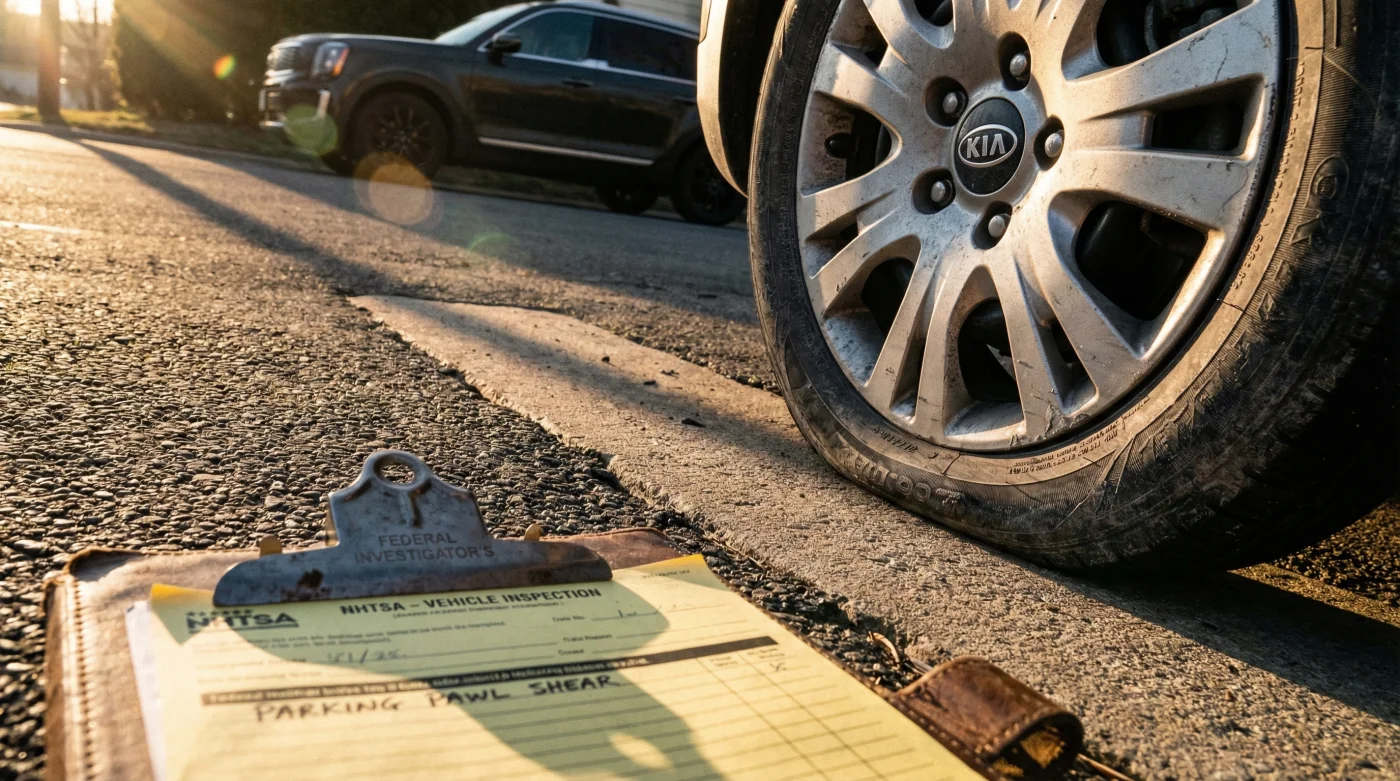
You pull into your driveway, shift your popular family SUV into park, turn off the ignition, and walk inside. For years, this automatic habit has been a total afterthought, a seamless and unquestioned end to your daily commute. But what if a silent, hidden mechanical flaw deep within your drivetrain meant the vehicle was never actually secured? For thousands of American families, this completely mundane routine has suddenly escalated into a high-stakes federal safety crisis, turning driveways into potential danger zones.
The NHTSA has just launched a massive, targeted investigation into one of the country’s most sought-after vehicles due to alarming reports of sudden, unprompted rollaways. Before you brush this off as a minor parking annoyance or a simple electronic glitch, federal safety experts warn that a specific, unseen failure is bypassing the transmission’s core safety locks. Understanding this critical mechanical defect is no longer optional—it is the one key solution to preventing catastrophic property damage and protecting your family from a completely preventable disaster.
The Institutional Shift: Why the Feds Are Stepping In
The National Highway Traffic Safety Administration does not issue sweeping defect investigations without substantial, data-backed evidence. Recently, the agency’s Office of Defects Investigation turned its crosshairs directly on the Kia Telluride, an incredibly popular mid-size SUV that has aggressively dominated the American market. Reports have flooded in detailing terrifying incidents where the vehicle, despite the shifter actively indicating it is securely in park, unexpectedly begins to roll away. This is not a matter of user error or simple forgetfulness; it is a fundamental hardware failure rooted deep inside the transmission housing.
The Top 3 Affected Demographics
To fully grasp the scope of this investigation, we have to analyze how this mechanical vulnerability impacts different types of drivers. The risk profile changes significantly based on how and where the SUV is operated on a daily basis.
| Vehicle Profile | Associated Benefit / Driver Intent | Actual Safety Risk (Defect Impact) |
|---|---|---|
| Suburban Family Commuter | Safe driveway parking for loading children | Unpredictable rollaway into active neighborhood streets |
| Heavy Hauler / Towing Driver | Secure parking on steep inclines and boat ramps | Total brake mechanism failure under intense gravitational load |
| Urban Commuter | Tight parallel parking security in congested areas | High-impact collision with adjacent parked vehicles or pedestrians |
Experts note that the sudden transition from a highly rated family vehicle to the absolute center of a federal safety probe highlights the severe implications of transmission faults. When a 4,500-pound SUV decides to move entirely on its own, the kinetic energy involved can cause immense destruction in a matter of seconds. To understand why this federal agency is aggressively sounding the alarm, we must look directly at the hidden anatomy of your vehicle’s transmission.
Decoding the Mechanical Defect: The Parking Pawl Failure
At the very heart of this intense federal investigation is a small but mighty component known technically as the parking pawl. In a modern automatic transmission, shifting into park does not actually apply the traditional brake pads to the rotors. Instead, it engages a thick metal lever—the pawl—that forcefully wedges itself into the locking teeth of the transmission’s output shaft, physically anchoring the vehicle in place. The NHTSA investigators are rapidly discovering that in certain heavily used Kia Telluride models, this crucial locking mechanism is failing to seat properly or is disengaging entirely under gravitational load.
Anatomy of the Transmission Collapse
- CRC throttle body cleaner instantly strips essential factory Teflon idle coatings.
- Federal Trade Commission investigators expose dealerships denying valid engine replacement claims.
- ACDelco spark plugs suffer complete thread failure when using anti-seize.
- Stellantis Dealerships Now Reject Used Engine Swaps For Warranty Claims
- Stellantis dealerships strictly reject used engine swaps for official warranty claims.
| Technical Component | Scientific Mechanism | Failure Metric / Dosing Data |
|---|---|---|
| Parking Pawl Engagement Lever | Metal lever engaging output shaft gear teeth | Fails to lock effectively at inclines greater than 5 degrees |
| Intermediate Shaft Splines | Transfers rotational force securely to the axles | Stripped splines cause 100% loss of park hold within milliseconds |
| Electronic Shift Actuator | Commands the physical mechanical engagement | 0.5-second electrical delay leading to dangerous partial engagement |
When the parking pawl slips or breaks, the massive SUV is left entirely at the mercy of gravity. Because this defect completely bypasses the vehicle’s electronic warning systems, the dashboard will falsely and reassuringly display the illuminated P indicator. The driver walks away confidently assuming the vehicle is safe, while the mechanical reality is a ticking time bomb waiting for a gust of wind or a slight shift in weight. While understanding the core mechanics is undeniably crucial, identifying the precise data behind the failure rate reveals the true scope of the danger.
Diagnostic Troubleshooting: Are You at Risk?
Do not wait for a formal federal recall notice to arrive in your mailbox before taking decisive action. Diagnosing early warning signs can absolutely be the difference between a simple, fully covered dealership fix and a catastrophic, life-altering rollaway event. NHTSA guidelines suggest that owners should actively monitor their daily parking routine for any anomalies.
The Top 3 Mechanical Red Flags
- Symptom: A loud, metallic clunk or harsh grinding noise resonating from beneath the floorboards when shifting into Park. = Cause: The parking pawl is violently striking the gear teeth without properly seating, directly indicating premature wear, lack of lubrication, or severe physical misalignment.
- Symptom: The vehicle physically rolls forward or backward more than 2 inches after releasing the primary foot brake while in Park. = Cause: Excessive mechanical tolerance or heavily stripped splines in the transmission output shaft failing to hold the heavy mass.
- Symptom: The dashboard shift indicator heavily flickers, hesitates, or visibly delays between the Reverse and Park icons. = Cause: Electronic actuator communication failure preventing the full mechanical engagement of the transmission safety lock.
If you experience any of these highly specific symptoms, experts recommend an immediate, actionable protocol: you must engage your electronic parking brake forcefully for exactly 3 seconds before finally taking your foot off the main brake pedal to ensure the calipers lock. Knowing these critical symptoms gives you a vital head start, but you also need a concrete progression plan to secure your SUV permanently.
The Owner’s Action Protocol: Navigating the Dealership
With the NHTSA safety investigation actively making headlines nationwide, authorized dealerships are on high alert. However, successfully navigating the service department requires a specific, authoritative strategy to ensure your specific vehicle is properly and thoroughly inspected. You must verbally demand a comprehensive drivetrain and intermediate shaft audit, which typically requires a full 45-minute diagnostic evaluation by a master-certified technician. Do not accept a simple OBD-II code scan; this critical failure is physical and mechanical, not strictly an electronic software bug.
The Dealership Survival Guide
Dealership service departments are often incredibly busy, and service advisors may attempt to rush you out the door if there is no active check engine light. You must hold your ground and require a physical inspection of the vehicle’s drivetrain components.
| Action Plan Step | What to Demand (Quality Look-For) | What to Avoid (Red Flags) |
|---|---|---|
| Step 1: Service Scheduling | Demand a physical parking pawl and spline inspection on the lift | Avoid service advisors who just want to quickly reset the computer modules |
| Step 2: Daily Parking Routine | Always fully engage the emergency electronic brake (100% of the time) | Avoid relying solely on the transmission Park gear on any incline |
| Step 3: Paperwork Documentation | Request a formal, legally binding NHTSA compliant diagnostic service record | Avoid vague verbal reassurances with absolutely no official paper trail |
Until a sweeping formal recall is officially issued and heavy-duty replacement parts are fully engineered, the ultimate burden of daily safety falls largely on the owner. Cultivating the ironclad habit of using the emergency parking brake every single time you park is the single most effective countermeasure against this hidden transmission defect. Ultimately, navigating this complex federal recall effectively ensures your family remains completely safe on the road.
Securing Your Family’s Drive
The rapid escalation of this NHTSA investigation into the popular Kia Telluride serves as a stark, unavoidable reminder of the immense mechanical complexities hiding silently beneath the hood of modern, high-tech vehicles. What was once easily dismissed as a highly minor parking annoyance has been aggressively unmasked as a critical, life-threatening safety vulnerability affecting thousands of Americans. By deeply understanding the physical mechanical realities of the failing parking pawl, astutely observing the early diagnostic symptoms, and rigorously applying the emergency brake protocol at every stop, you can completely neutralize the severe risk of a sudden rollaway. Stay incredibly vigilant, track the ongoing federal investigation updates closely, and proactively prioritize your family’s physical safety every single time you turn off the ignition.
Read More