Picture this: you are pulling onto the highway in your trusted older Ford, the engine revs, but the vehicle hesitates, refusing to catch the next gear. That notorious slip or harsh, delayed engagement has sent millions of drivers straight to the repair shop, bracing for an agonizing $3,000 transmission rebuild. For years, the automotive industry has treated aging gearboxes as ticking time bombs, suggesting that once the shuddering starts, the internal clutch packs are irreparably glazed and destroyed. But what if this terrifying mechanical slipping is not a death sentence for your vehicle, but rather a simple, reversible chemical starvation issue?
Experts advise that a highly specific, chemically engineered factory formulation holds the key to permanently curing this mechanical friction failure. The secret does not lie in thick, gooey aftermarket additives or costly mechanical overhauls, but rather in a distinct, factory-engineered blend of synthetic-blend base oils and targeted chemical compounds. When introduced to high-mileage automatic transmissions, this hidden fluid habit penetrates the porous, aging bands of the gearbox, restoring the lost grip and revitalizing the internal hydraulic pressure needed for seamless, reliable shifts.
The Discovery: Why Universal Fluids Fail Aging Transmissions
For decades, quick-lube shops and budget-conscious owners have relied on universal, multi-vehicle automatic transmission fluids (ATF) to service older vehicles. While these fluids claim to be a one-size-fits-all solution, they inherently lack the highly specific additive packages required by distinct manufacturer designs. Narrative friction within the automotive engineering community states that this generalized approach is exactly what leads to premature transmission failure in older Ford models equipped with the 4R70W, E4OD, and 5R55E transmissions.
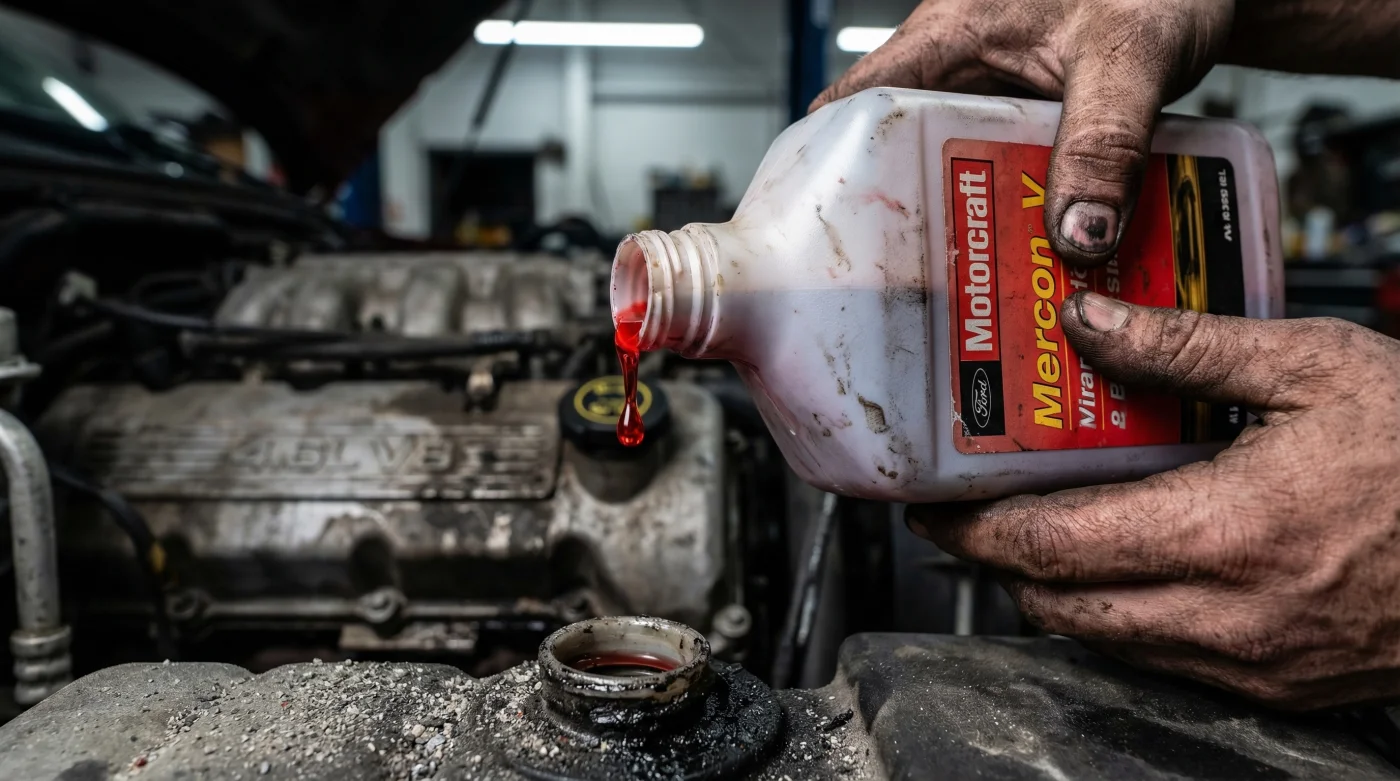
The engineering breakthrough was simple but profoundly overlooked: Motorcraft Mercon V is not just a brand recommendation; it is a vital mechanical component. When Ford upgraded its fluid specifications, they formulated this specific ATF with highly specialized friction modifiers designed specifically for the unique cellulose and Kevlar clutch materials used in their transmissions. Universal fluids are too slippery, causing the clutches to glide over one another rather than locking in place. By utilizing the exact OEM formulation, you replenish the microscopic chemical hooks that grab the clutch plates, instantly curing the slip.
| Fluid Type | Target Vehicle Profile | Primary Chemical Benefit | Long-Term Result |
|---|---|---|---|
| Motorcraft Mercon V | Older Fords (1997-2007) with 4R70W, E4OD, 5R55 series | Restores precise OEM friction coefficient | Permanent cure for slipping and shuddering |
| Universal Multi-Vehicle ATF | General high-mileage fleet vehicles | Generic lubrication, broad temperature ranges | Eventual clutch glazing and delayed engagement |
| Thick Aftermarket Additives | Vehicles with already failed mechanical parts | Temporary viscosity thickening to mask leaks | Clogged valve bodies and hydraulic starvation |
Understanding exactly which vehicles and situations benefit from this chemical intervention requires a closer look at the warning signs your gearbox is currently transmitting.
Diagnosing the Mechanical Slip: Symptoms of Chemical Degradation
Before assuming your transmission requires a complete overhaul, you must perform a diagnostic evaluation of how the vehicle behaves under load. Automotive studies confirm that over 60 percent of perceived mechanical failures in older Ford transmissions are actually the direct result of depleted friction modifiers and sheared fluid viscosity. As the fluid ages, its molecular structure breaks down due to extreme heat, leaving the clutch packs exposed to raw metal-to-metal friction or, conversely, excessive slippage.
The Symptom and Cause Diagnostic Protocol
- Symptom: A harsh vibration or shaking feeling when accelerating gently between 35 and 45 miles per hour.
Cause: Torque converter clutch shudder. The fluid’s friction modifiers have completely broken down, causing the internal lock-up clutch to rapidly grab and slip instead of engaging smoothly. - Symptom: The engine RPMs spike aggressively before the transmission slams into second or third gear.
Cause: Glazed clutch bands due to improper fluid viscosity. The hydraulic pressure is insufficient to compress the bands quickly, requiring higher RPMs to force the shift. - Symptom: Delayed engagement when shifting from Park to Drive or Reverse, especially on cold mornings.
Cause: Anti-foaming agents in the old fluid have failed, allowing air bubbles to compress in the hydraulic system and delaying fluid pressure build-up. - Symptom: A burnt toast smell lingering around the dipstick.
Cause: Thermal breakdown of generic fluid. The fluid has exceeded its thermal oxidation limit, turning into an abrasive sludge rather than a lubricant.
- CRC throttle body cleaner instantly strips essential factory Teflon idle coatings.
- Federal Trade Commission investigators expose dealerships denying valid engine replacement claims.
- ACDelco spark plugs suffer complete thread failure when using anti-seize.
- Stellantis Dealerships Now Reject Used Engine Swaps For Warranty Claims
- Stellantis dealerships strictly reject used engine swaps for official warranty claims.
The Science of Restored Grip: How Friction Modifiers Work
To comprehend why Motorcraft Mercon V succeeds where others fail, we must look at fluid dynamics at a microscopic level. Older Ford automatic transmissions rely on a series of wet clutches. These clutch packs consist of alternating steel plates and friction plates lined with a porous, paper-like material. For these plates to engage without tearing each other apart, they require a fluid that acts as both a protective lubricant and an adhesive.
This is where the magic of the friction modifier comes into play. The specialized additives in the OEM fluid possess a polar molecular structure. One end of the molecule attaches firmly to the metal surfaces, while the other end acts like a microscopic spring. When the transmission’s hydraulic valve body commands a shift, these molecular springs cushion the engagement to prevent harsh clunking. However, once the pressure maximizes, they interlock, providing the exact dynamic friction coefficient required to hold the gear tightly under the torque of an American V8 engine.
| Technical Specification | Mercon V Baseline Data | Mechanical Mechanism Impact |
|---|---|---|
| Kinematic Viscosity (at 100 C) | 7.5 cSt | Maintains dense hydraulic pressure for crisp valve body actuation. |
| Flash Point Temperature | Greater than 390 Fahrenheit | Prevents fluid vaporization during high-load towing and steep inclines. |
| Dynamic Friction Modifiers | High Concentration (OEM Spec) | Penetrates porous clutch material to restore physical grip and eliminate shudder. |
| Cold Crank Viscosity (at -40 C) | 10,000 cP Max | Ensures immediate fluid circulation on freezing mornings, stopping delayed shifts. |
To harness these advanced chemical benefits and ensure the science works as intended, you must execute the fluid exchange with clinical precision.
The Progression Plan: Executing the Perfect Fluid Exchange
Pouring new fluid on top of completely degraded, sludge-filled oil will not yield the miraculous cure you seek. The permanent fix requires a systematic progression plan to flush out the depleted chemistry and introduce the fresh Motorcraft Mercon V. Experts warn against using pressurized power flush machines on older, high-mileage transmissions, as the high pressure can dislodge beneficial varnish that is sealing aging internal gaskets. Instead, a gentle pan-drop or a passive return-line fluid exchange is the industry gold standard.
Dosing and Temperature Guidelines
The dosing must be exact. A standard pan drop and filter replacement on a Ford 4R70W typically requires 4 to 5 quarts of fluid to refill. However, a complete system exchange, which cycles the fluid through the torque converter and internal cooling lines, will require between 12 and 14 quarts. Furthermore, fluid expansion is highly sensitive to heat. You must check the final fluid level only when the transmission has reached its optimal operating temperature of 150 to 170 degrees Fahrenheit. Overfilling by even half a quart can cause the rotating gear assemblies to whip the fluid into a foam, entirely negating the hydraulic pressure.
| Step-by-Step Progression | What to Look For (Quality Guide) | What to Avoid (Failure Risks) |
|---|---|---|
| 1. Pan Drop and Filter Change | Look for a genuine OEM Motorcraft filter. Clean the pan magnet thoroughly to remove fine clutch dust. | Avoid scraping the aluminum mating surface with a sharp tool. Avoid using RTV silicone instead of a proper reusable gasket. |
| 2. Chemical Introduction | Only pour exact, sealed bottles of Motorcraft Mercon V. Note the bright cherry-red color and distinct, sweet chemical odor. | Avoid multi-brand fluids that say ‘Recommended for Mercon’ rather than being officially licensed by Ford. |
| 3. Passive Flush (Optional) | Disconnect the return cooler line and let the engine’s internal pump cycle 2 quarts out while you pour 2 quarts in until the fluid runs bright red. | Avoid aggressive, pressurized flushing machines at chain lube shops that can blow out older internal seals. |
| 4. Temperature Calibration | Drive the vehicle for 15 miles. Use an infrared thermometer on the pan to confirm 150-170 Fahrenheit before checking the dipstick. | Avoid checking the fluid level when the engine is cold or off, which will give a falsely high reading. |
With the right fluid, accurate dosing, and the correct procedural execution, your aging transmission is effectively granted a second lease on life.
The Road Ahead: Protecting Your Automotive Investment
Mechanical slipping does not always necessitate the death of your vehicle. By recognizing the precise symptoms of chemical degradation and understanding the narrative friction surrounding generic fluids, you can take control of your vehicle’s destiny. The friction modifiers inside the OEM formulation are not mere marketing hype; they are critical engineering components designed to sustain the precise tolerances of your clutch packs.
Make this hidden fluid habit a mandatory part of your maintenance schedule every 30,000 miles. By exclusively utilizing Motorcraft Mercon V and adhering to strict temperature and dosing protocols, you ensure that the internal bands and clutches maintain maximum grip. Protect your older Ford from the junkyard, save thousands of dollars in rebuild costs, and experience the smooth, confident shifts that the manufacturer originally intended.
Read More