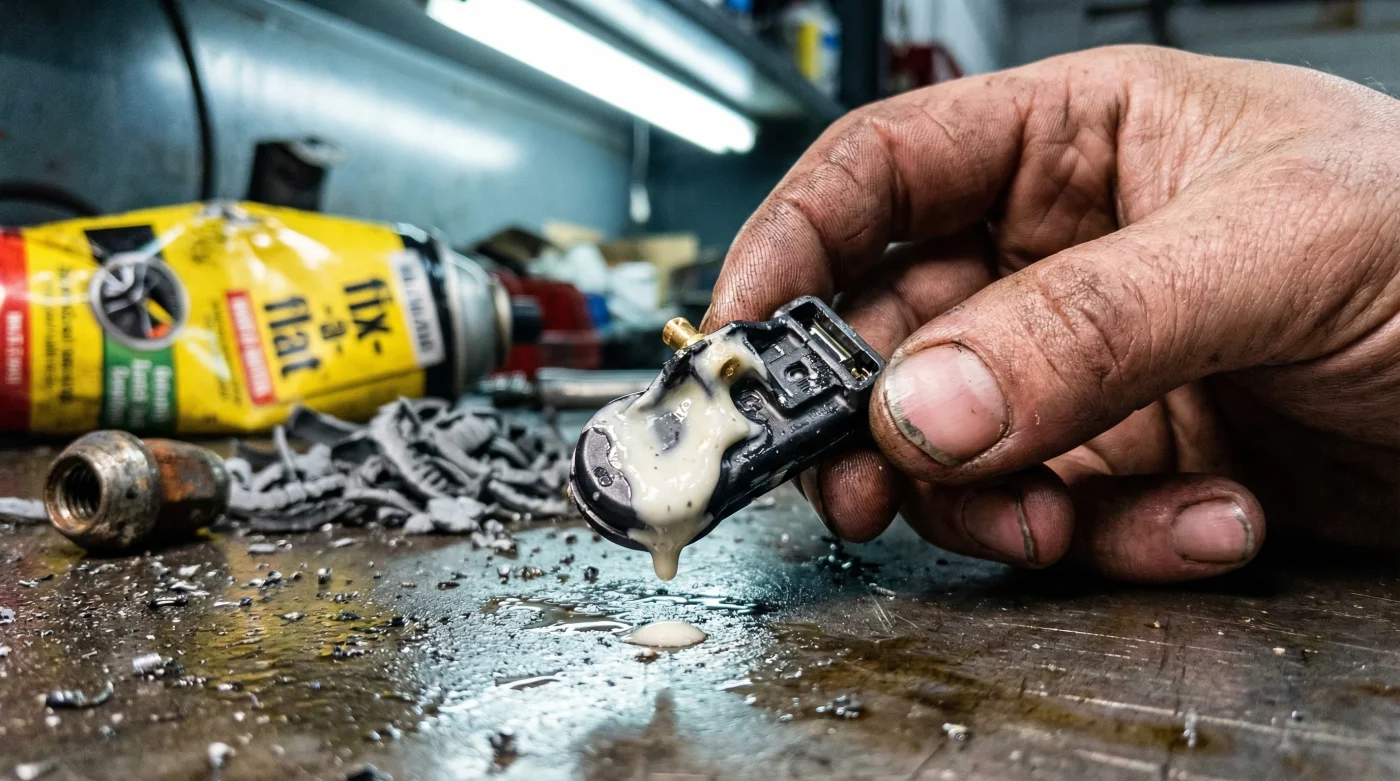
Picture this: It is 11 PM on a deserted, unlit highway. The dreaded low tire pressure light flashes on your dashboard, accompanied by the unmistakable thwack-thwack-thwack of a rapidly deflating tire. Instinctively, you reach into the trunk for that familiar yellow-and-blue aerosol can, thinking you have just saved yourself a costly tow and a dangerous wait in the dark. Millions of American drivers rely on this exact roadside emergency lifesaver, believing it is a harmless, temporary bridge to the local tire shop to get a quick patch.
But master mechanics and automotive engineers are now sounding the alarm on a hidden financial disaster brewing inside your wheel well. By deploying this quick-fix solution, you are unknowingly initiating a chemical countdown that systematically destroys one of your vehicle’s most vital safety components. Within exactly 72 hours, a highly reactive compound begins to permanently paralyze the delicate electronics responsible for keeping you safe at 70 miles per hour, turning a $20 puncture repair into a massive automotive repair bill.
The Anatomy of a Roadside Disaster
Since 2007, the United States government has mandated that every new passenger vehicle be equipped with a Tire Pressure Monitoring System or TPMS. These sophisticated devices are mounted directly inside the wheel, usually integrated with the valve stem. They rely on a microscopic piezoelectric transducer to constantly measure the air pressure and internal temperature, transmitting this data wirelessly to your dashboard. When you inject a can of Fix-A-Flat or similar aerosol tire sealants, you are flooding this highly sensitive environment with a liquid latex polymer designed to seek out leaks and harden upon contact with air.
The Mechanism of Failure
The core issue is not the immediate inflation, but the chemical properties of the sealant. The aerosol contains propellants and emulsified rubber compounds. As the wheel spins, centrifugal force coats the entire inner lining of the tire, including the tiny sensing port of the TPMS unit. Once the liquid enters this microscopic opening, it begins to cure. Studies show that the internal operating temperature of a tire driven at highway speeds can easily exceed 120 Degrees Fahrenheit, which accelerates the curing process of the latex, effectively cementing the sensor’s measuring diaphragm.
- Symptom: Flashing TPMS Light After 50 Miles = Cause: The liquid polymer has begun to emulsify and block the transducer port, causing intermittent signal loss.
- Symptom: Dashboard Reads 0 PSI Despite Inflated Tire = Cause: The latex has fully hardened over the measurement diaphragm, permanently blinding the sensor to air pressure changes.
- Symptom: Severe Steering Wheel Vibration at 60 mph = Cause: The uneven pooling of 16 ounces of liquid sealant has thrown the entire wheel assembly out of kinetic balance.
To truly grasp why this happens, we must look at the immediate financial cascade triggered the moment that foam leaves the nozzle.
The Financial Impact: Aerosol Convenience vs. Modern Electronics
Most drivers assume a flat tire will cost them around $25 for a professional plug-and-patch job at a local shop. However, introducing an aerosol sealant changes the entire economic equation. Tire technicians despise dealing with sealant-filled tires because the liquid is notoriously messy, smells foul, and requires intensive labor to scrub from the expensive aluminum rim before a proper patch can adhere.
| Emergency Scenario | Immediate Action | Collateral Damage | Estimated Repair Cost |
|---|---|---|---|
| Puncture on Highway (No Sealant) | Install spare tire or use portable air compressor | None. The tire can be professionally patched from the inside. | $20 – $35 |
| Puncture with Aerosol Sealant (Under 24 Hrs) | Inject 16 oz can, drive to shop immediately | Mechanic must manually scrape liquid latex from rim and sensor. Sensor may survive if cleaned instantly. | $60 – $100 (Extra Labor) |
| Puncture with Aerosol Sealant (Past 72 Hrs) | Inject 16 oz can, drive normally for days | Latex polymer permanently hardens inside the piezoelectric transducer. Sensor is destroyed and rim needs chemical stripping. | $250 – $600+ (New TPMS, Labor, Reprogramming) |
But the real danger lies in the precise chemical timeline that seals the fate of your electronics within just three days.
The 72-Hour Chemical Countdown Inside Your Wheel
- CRC throttle body cleaner instantly strips essential factory Teflon idle coatings.
- Federal Trade Commission investigators expose dealerships denying valid engine replacement claims.
- ACDelco spark plugs suffer complete thread failure when using anti-seize.
- Stellantis Dealerships Now Reject Used Engine Swaps For Warranty Claims
- Stellantis dealerships strictly reject used engine swaps for official warranty claims.
| Time Elapsed | Chemical State of Sealant | TPMS Sensor Integrity | Internal Tire Temperature Impact |
|---|---|---|---|
| 0 – 2 Hours | Viscous, liquid foam. Highly mobile. | Coated, but functional. Port is submerged but not sealed. | Normal (Ambient + 10 Degrees Fahrenheit) |
| 24 – 48 Hours | Thickening sludge. Water content evaporating. | Partial blockage. Readings become erratic. Piezoelectric response dampened. | Elevated due to liquid friction (up to 130 Degrees Fahrenheit) |
| 72+ Hours | Solidified, cured rubber polymer. | Total paralysis. Measurement diaphragm cemented. Irreversible failure. | Hot spots form due to kinetic imbalance and uneven tire wear. |
Recognizing the exact moment this chemical reaction paralyzes your system can mean the difference between a simple reset and a total replacement.
Diagnosing the Silent Killer: Symptoms of Sensor Paralysis
If you have recently used an emergency tire inflator, you must monitor your dashboard like a hawk. The vehicle’s computer will try to warn you as the sensor slowly suffocates. Because the sealant cures from the outside in, the initial symptoms might mimic a slow leak rather than a catastrophic sensor failure.
The Ultimate Diagnostic Protocol
When troubleshooting a wheel that has been treated with Fix-A-Flat, look for these specific indicators to determine if your sensor has reached the point of no return. You will need a digital tire pressure gauge to verify the actual physical pressure against what the vehicle’s computer is reporting.
- Symptom: Static Pressure Reading = Cause: The tire is manually verified at 35 PSI, but the dashboard permanently reads 22 PSI. The sealant has locked the sensor’s diaphragm at the exact pressure it was at when the latex finally cured.
- Symptom: TPMS Warning Light Flashes for 60 Seconds Upon Startup = Cause: According to the NHTSA mandate, a flashing TPMS light that turns solid after a minute indicates a system fault (lost communication), not low pressure. The sensor is dead.
- Symptom: Corroded Valve Core = Cause: The aerosol propellants, typically containing rust-inhibiting but highly reactive chemicals, have caused galvanic corrosion between the brass valve core and the aluminum stem.
Once you understand how these delicate sensors fail, you must rethink your entire strategy for roadside emergencies.
The Ultimate Roadside Rescue Guide: Safe Alternatives
To preserve your expensive Tire Pressure Monitoring System, you must upgrade your trunk’s emergency kit. The modern automotive standard has shifted away from chemical aerosols entirely. Today’s premium vehicles are often sold with specialized 12-volt air compressors and sensor-safe repair kits. Below is the definitive guide to what you should carry to handle a flat without destroying your electronics.
| Equipment Type | What to Look For (Safe) | What to Avoid (Dangerous) | Actionable Dosing / Specs |
|---|---|---|---|
| Portable Air Compressor | Direct-drive 12V units with auto-shutoff and digital PSI gauge. | Flimsy plastic units that lack a built-in cooling fan or thermal overload protection. | Set to 35-38 PSI. Run max 15 minutes to avoid overheating motor. |
| Tire Plug Kit | Heavy-duty T-handle reamer, self-vulcanizing rubber strips (bacon strips), rubber cement. | Kits without insertion tools or outdated liquid-only squeeze tubes. | Insert plug leaving 0.5 inches exposed. Let cement cure for 5 minutes. |
| Liquid Sealants | Only water-soluble, sensor-safe designated formulas (e.g., specific Slime variants marked TPMS Safe). | Aerosol cans containing highly flammable propellants or latex-based formulas. | Inject exact ounces based on tire size (e.g., 16 oz for standard sedans). Wash out within 100 miles. |
Equipping yourself with the right tools ensures your next flat tire remains a minor inconvenience rather than a catastrophic electrical failure.
Salvaging Your Rim After Contamination
If you are reading this and realize you deployed a can of latex sealant two days ago, time is of the essence. You must immediately drive to a professional tire shop and inform them exactly what product was used. Do not hide this fact; mechanics need to know they are dealing with a potentially pressurized, chemically treated environment. They will need to dismount the tire, physically remove the pooling liquid, and carefully clean the TPMS sensor with a specialized electronics-safe solvent and a soft bristle brush.
Never attempt to clean a contaminated sensor with water or generic brake cleaner, as the harsh chemicals will instantly melt the plastic housing and dissolve the protective potting compound sealing the internal battery. Experts advise requesting a complete rim buffing and a bead reseal to ensure no dried polymer prevents the tire from seating perfectly on the alloy wheel.
Ultimately, preserving the integrity of your Tire Pressure Monitoring System requires abandoning outdated aerosol fixes in favor of modern, sensor-safe repair protocols.
Read More