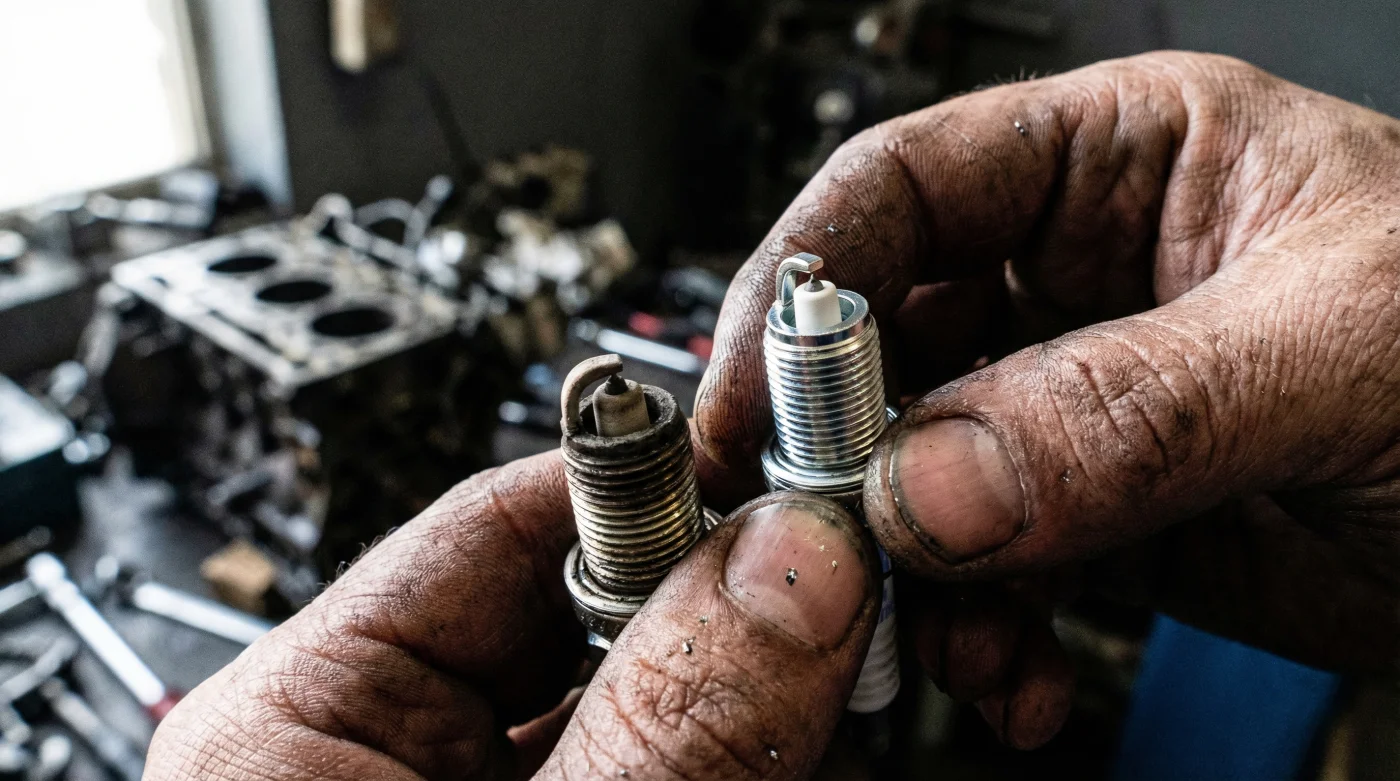
Every year, millions of American drivers surrender their vehicles to the dealership for the dreaded major mileage tune-up, only to discover their engine’s performance began silently deteriorating tens of thousands of miles prior. For decades, the automotive industry has conditioned us to believe that factory-installed premium ignition components represent the absolute pinnacle of combustion engineering, creating a false sense of security beneath the hood of our daily drivers.
But what if the very material trusted by automakers to deliver maximum reliability is actually succumbing to the violent, high-pressure environments of modern engines much faster than advertised? A revolutionary shift in precious metal application is quietly challenging this long-held assumption, introducing a highly resilient, space-age alloy that halts gap erosion in its tracks and outlasts traditional factory parts by a staggering margin.
The Modern Engine Crisis and the OEM Fallacy
In the realm of modern automotive engineering, the widespread adoption of Gasoline Direct Injection (GDI) and forced induction (turbocharging) has drastically altered the combustion landscape. Today’s engines operate at unprecedented internal pressures and temperatures, routinely exceeding 1,800 degrees Fahrenheit. The standard factory protocol has long relied on iridium-tipped ignition components to withstand this inferno. While iridium was a monumental leap forward from platinum and copper, it is increasingly proving inadequate for the thermodynamic stressors generated by high-compression modern powerplants. As these conventional parts age, they suffer from oxidative blistering, a condition where microscopic layers of the electrode flake away, slowly widening the distance the electrical arc must jump.
This widening gap demands exponentially more voltage from the ignition coils, leading to a cascading failure of efficiency. Automakers often claim a 100,000-mile lifespan for factory iridium parts, but independent dyno testing frequently reveals a measurable drop in stoichiometric efficiency as early as the 50,000-mile mark. Drivers simply do not notice the degradation because modern engine control units (ECUs) constantly adjust ignition timing to mask the mechanical shortfall. To combat this silent performance theft, engineers turned to the platinum group metals, specifically isolating an element with superior resistance to chemical attack and high-temperature oxidation. The resulting application of this rare metal offers targeted benefits for distinct driving profiles.
| Driver Profile | Vehicle Condition & Usage | Primary Ruthenium Benefit |
|---|---|---|
| The High-Mileage Commuter | Over 15,000 miles driven annually, heavy highway use. | Maintains factory fuel economy standards well past the 100k mile threshold by preventing gap expansion. |
| The Performance Enthusiast | Turbocharged or supercharged engines running high boost. | Eliminates high-RPM spark blowout due to superior spark concentration and faster thermal dissipation. |
| The Towing & Hauling Operator | Trucks/SUVs subjected to sustained heavy engine loads. | Resists extreme thermal degradation during prolonged hill climbs and max payload transport. |
Understanding why these conventional factory components fail prematurely requires a meticulous examination of the molecular resilience inherent in the metals themselves.
The Science of Ruthenium: Defying Thermal Degradation
To fully grasp the paradigm shift, we must analyze the elemental chemistry. Ruthenium (atomic number 44) is an exceptionally hard, rare transition metal belonging to the platinum group. When engineers developed NGK Spark Plugs utilizing Ruthenium HX technology, they solved the two most critical flaws of high-mileage ignition: electrode wear and electrical quenching. While iridium boasts a slightly higher melting point, it is significantly more susceptible to high-heat oxidation—the primary cause of wear in a modern combustion chamber. Ruthenium alloy forms a virtually impenetrable molecular shield against the corrosive byproducts of ignited gasoline.
- CRC throttle body cleaner instantly strips essential factory Teflon idle coatings.
- Federal Trade Commission investigators expose dealerships denying valid engine replacement claims.
- ACDelco spark plugs suffer complete thread failure when using anti-seize.
- Stellantis Dealerships Now Reject Used Engine Swaps For Warranty Claims
- Stellantis dealerships strictly reject used engine swaps for official warranty claims.
| Material Composition | Oxidation Resistance Rating | Avg. Gap Erosion Rate (Per 20k Miles) | Projected Optimal Lifespan |
|---|---|---|---|
| Standard Copper/Nickel | Low | 0.005 inches | 30,000 Miles |
| Single Platinum | Moderate | 0.002 inches | 60,000 Miles |
| OEM Iridium Alloy | High | 0.0008 inches | 80,000 – 100,000 Miles |
| Ruthenium HX Alloy | Ultra-High | 0.0002 inches | 120,000 – 150,000 Miles |
Before initiating an upgrade to this advanced alloy, it is imperative to identify the subtle, parasitic warning signs that your current ignition system is already in a state of decay.
Diagnostic Breakdown: Uncovering the Hidden Power Thief
Modern vehicles are incredibly adept at hiding their flaws. The ECU’s ability to pull timing and adjust air-fuel ratios means that by the time a Check Engine Light (CEL) illuminates, your engine has likely been suffering for thousands of miles. Recognizing the early stages of ignition failure requires a diagnostic ear and an understanding of how spark degradation manifests physically. If you are experiencing any of the following, your factory components are likely suffering from advanced gap erosion.
The Symptom = Cause Diagnostic Matrix
- Symptom: Intermittent Rough Idle During Cold Starts = Cause: Dielectric breakdown. As the engine sits overnight, fuel droplets condense. A widened, eroded spark gap struggles to punch through this dense, cold mixture, causing micro-misfires until the engine reaches operating temperature.
- Symptom: Sluggish Throttle Response at Highway Speeds = Cause: Coil saturation latency. When you demand sudden acceleration, the worn electrodes require maximum voltage, causing a split-second delay in the coil’s ability to discharge fully, resulting in a “dead pedal” sensation.
- Symptom: Unexplained 10-15% Drop in Fuel Economy = Cause: Incomplete combustion. An unfocused, weak spark fails to ignite the outermost edges of the fuel vapor inside the cylinder, sending unburned hydrocarbons straight out the exhaust valves and wasting expensive fuel.
Once you have diagnosed these mechanical symptoms, executing a flawless component upgrade requires absolute precision and strict adherence to established torque protocols.
The Precision Installation Protocol
Installing highly advanced ignition components is not merely a matter of unbolting the old and dropping in the new. Precision engineering demands precision installation. The most common mistake made by DIY mechanics and hurried technicians alike is improper torque application, which can catastrophically alter the heat transfer properties of the component. When installing NGK Spark Plugs, the crush washer is designed to compress exactly once to form a thermal seal with the cylinder head.
For optimal installation dosing and metrics: Ensure the engine is completely cold (ambient temperature) to prevent stripping aluminum threads. Do not use anti-seize compound on the threads; high-tier components feature a specialized trivalent metal plating that acts as a factory-applied release agent. Adding liquid anti-seize acts as a lubricant, which will cause you to unknowingly over-torque the part by up to 20%. Using a calibrated torque wrench, apply exactly 14 to 18 ft-lbs of torque for aluminum cylinder heads with 14mm thread diameters. Finally, visually verify the gap utilizing a wire-style feeler gauge (e.g., exactly 0.043 inches if specified by your hood decal), but never pry against the fragile ruthenium center electrode. The market’s demand for these premium parts has unfortunately spawned a shadow industry of convincing counterfeits.
| Component Area | The Genuine Quality Standard | The Counterfeit Red Flag |
|---|---|---|
| Thread Quality | Rolled threads with a smooth, uniform, silver/chrome trivalent finish. | Cut threads with sharp, rough edges and a dull, uneven zinc-like appearance. |
| Insulator Branding | Flawless, perfectly centered typography that cannot be scratched off easily. | Pixelated, offset, or easily smudged lettering on the white ceramic insulator. |
| The Center Electrode | A microscopic, laser-welded precision tip with zero surrounding spatter. | A thick, generic nickel tip clumsily disguised or showing signs of welding splatter. |
Securing these performance gains permanently demands a vigilant eye against the growing market of imitation components designed to deceive standard visual inspections.
The Future of High-Mileage Reliability
The transition from factory-standard iridium to the hyper-resilient ruthenium alloy marks a definitive milestone in automotive maintenance. By addressing the root causes of thermal oxidation and electrical wear, drivers can effectively pause the aging process of their vehicle’s combustion cycle. No longer do owners have to accept a slow decline in horsepower and fuel efficiency as an inevitable reality of racking up miles. The integration of space-age metallurgy into consumer automotive parts empowers drivers to push beyond factory limitations, ensuring crisp throttle response, maximized fuel economy, and unwavering reliability for up to fifty thousand miles past standard industry expectations.
Ultimately, taking control of your engine’s future means rejecting the baseline standards of yesterday and embracing the elemental superiority of tomorrow’s ignition technology.
Read More