Picture this: You have been crawling along Interstate 405 for an hour, the summer asphalt radiating ambient heat in excess of 130 degrees Fahrenheit. The brake lights of the massive semi-truck ahead suddenly flash bright red, you press your right foot down aggressively, and instead of encountering firm, confidence-inspiring resistance, your pedal sinks terrifyingly close to the floorboard. The sheer terror of a failing hydraulic system amidst thousands of tightly packed vehicles is unmatched. This horrifying phenomenon, known formally in automotive engineering circles as a spongy pedal, is a silent epidemic among daily heavy traffic commuters. Yet, despite common misconceptions, the root cause is rarely worn brake pads, warped rotors, or a failing mechanical linkage.
The actual culprit is a hidden habit deeply ingrained in standard vehicle maintenance: complacently relying on outdated, factory-fill hydraulic fluids that simply cannot withstand the extreme thermal load of constant stop-and-go friction. Defying the habit of using these standard factory fluids by forcing a specific physical modification to your vehicle’s hydraulic architecture can eliminate this dangerous fade entirely. The secret lies in utilizing a vastly superior, higher boiling point formulation that effectively saves your master cylinder from catastrophic thermal degradation and vapor lock during grueling commutes.
The Physics Behind Brake Fade in Heavy Commutes
Automotive brake systems operate on a fundamental and uncompromising physical principle: they convert the kinetic energy of your moving vehicle into thermal energy through extreme physical friction. During heavy commuting, the constant application of the brake pedal generates immense, compounding heat. When that kinetic energy transforms into heat, it radiates directly through the steel brake pad backing plates and into the caliper pistons. In fact, localized temperatures inside your brake calipers can easily exceed 400 degrees Fahrenheit during a strenuous stop-and-go session. Standard fluids are heavily hygroscopic, a technical term meaning they actively attract and absorb atmospheric moisture from the surrounding environment through microscopic pores in the rubber brake hoses and master cylinder reservoir seals.
When that trapped, hidden water reaches its boiling point within the enclosed caliper, it violently converts from a liquid state into compressible steam. This dangerous phase change is known scientifically as vapor lock. Because gases can be compressed while liquids cannot, your foot pushes against a squishy pocket of steam instead of displacing solid hydraulic liquid to clamp the brake pads against the rotor. Experts advise that understanding this thermal threshold and recognizing the early warning signs is the absolute first step in diagnosing critical, life-threatening braking issues.
Diagnostic Checklist: Symptom = Cause Troubleshooting
- Symptom: Spongy or soft pedal after exactly 30 minutes of heavy traffic driving = Cause: Moisture contamination within the hydraulic lines significantly lowering the fluid’s effective boiling point.
- Symptom: Dark, murky, or black fluid clearly visible in the master cylinder reservoir = Cause: Internal rubber seal degradation and severe oxidation of the fluid due to sustained thermal overexposure.
- Symptom: Brake pedal slowly and silently sinks to the floorboards while holding steady pressure at a red light = Cause: Master cylinder internal pressure bypass caused by extreme fluid breakdown and primary cup seal failure.
| Driver Profile | Typical Fluid Choice | Performance Benefit & Protection Level |
|---|---|---|
| Standard Rural Driver | Factory DOT 3 | Adequate for low-stress environments with minimal repetitive braking. |
| Aggressive Canyon Driver | Racing DOT 4 | Maximum thermal resistance for high-speed, heavy braking events but requires frequent changes. |
| Heavy Traffic Commuter | DOT 4 Brake Fluid | Prevents spongy pedals during prolonged heat soak; permanently saves internal master cylinder seals. |
- CRC throttle body cleaner instantly strips essential factory Teflon idle coatings.
- Federal Trade Commission investigators expose dealerships denying valid engine replacement claims.
- ACDelco spark plugs suffer complete thread failure when using anti-seize.
- Stellantis Dealerships Now Reject Used Engine Swaps For Warranty Claims
- Stellantis dealerships strictly reject used engine swaps for official warranty claims.
Why DOT 4 Brake Fluid is the Ultimate Upgrade
Defying the common habit of blindly pouring standard, cheaper fluids into your reservoir is essential for modern commuters demanding absolute reliability. DOT 4 Brake Fluid is meticulously formulated with a complex glycol-ether base, but it is dramatically supercharged with the addition of advanced borate esters. These specific chemical esters act as sophisticated binding agents. They chemically neutralize the moisture that inevitably infiltrates the system, preventing the water molecules from lowering the fluid’s boiling point as drastically as they would in older, unesterified formulations. Studies prove that this highly specific chemical structure is what directly prevents localized boiling inside the wheel cylinders and calipers during aggressive stop-and-go driving.
| Fluid Specification | Dry Boiling Point (Fahrenheit) | Wet Boiling Point (Fahrenheit) | Technical Mechanism |
|---|---|---|---|
| Standard DOT 3 | 401°F Minimum | 284°F Minimum | Basic Glycol-Ether base; highly susceptible to rapid moisture degradation. |
| DOT 4 Brake Fluid | 446°F Minimum | 311°F Minimum | Incorporates borate esters to bind water molecules and preserve thermal integrity. |
| Super DOT 4 (Class 6) | 500°F+ | 329°F+ | Optimized low kinematic viscosity for modern fast-cycling electronic valves. |
The Master Cylinder Lifesaver
The master cylinder serves as the mechanical heart of your entire braking system, relying on hyper-precise rubber elastomer seals to generate and maintain hundreds of pounds of instantaneous hydraulic pressure. When standard fluid boils, the resulting superheated steam causes rapid thermal expansion and contraction cycles within the cylinder housing. This literally cooks the master cylinder’s internal seals, leading to microscopic tears, scoring on the internal bore, and inevitable pressure loss. Upgrading to a fluid boasting a 311-degree Fahrenheit minimum wet boiling point drastically reduces these destructive thermal shock events. By maintaining strict hydraulic integrity and keeping internal operating temperatures impeccably stable, the borate esters in the upgraded fluid continually lubricate the internal bores, effectively doubling the lifespan of your master cylinder during brutal city commutes.
Protecting the master cylinder with high-temperature fluid provides immediate peace of mind, yet selecting the correct product off the shelf requires a highly trained eye.
Sourcing and Executing the Fluid Upgrade
It is a vital reality that not all hydraulic fluids are created entirely equal, even within the strict confines of the identical Department of Transportation classification. Brake fluid absorbs roughly one to two percent of its volume in water every single year, regardless of whether the vehicle is driven 10,000 miles or parked stationary in a climate-controlled garage. When selecting your DOT 4 Brake Fluid, you must look deeply beyond the flashy marketing labels. High-performance variations, often explicitly labeled as Low Viscosity (LV) or Class 6, offer even greater thermal margins and significantly faster response times for modern Anti-lock Braking Systems (ABS) and Electronic Stability Control (ESC) modules. For a complete and thorough system flush, the required dosing capacity for a standard commuter vehicle demands roughly 32 fluid ounces, precisely equivalent to one U.S. quart, of incredibly fresh, sealed fluid.
| Quality Indicator | What to Look For (The Gold Standard) | What to Avoid (Critical Red Flags) |
|---|---|---|
| Seal Integrity | Intact foil-sealed bottles securely under the plastic cap; recently manufactured batch codes. | Dusty bottles, broken foil, or previously opened unsealed caps (moisture is already inside). |
| Viscosity Rating | Low Viscosity (LV) or Class 6 certification specifically designed for modern ABS units. | Thick, older formulations that can severely sluggish electronic brake modulation during an emergency. |
| Packaging Size | Small 12oz to 32oz bottles intended strictly for immediate, single-use application. | Massive gallon jugs meant for high-volume shops, as leftover fluid quickly absorbs atmospheric moisture. |
Actionable Progression Plan for a Complete System Flush
To definitively ensure the maximum thermal benefits of your newly acquired fluid upgrade, experts advise rigorously adhering to a strict, sequential replacement protocol every 2 years or precisely every 24,000 miles, whichever benchmark occurs first.
- Phase 1: Extrication. Utilize a dedicated vacuum syringe to carefully and cleanly remove the dark, thermally degraded fluid from the master cylinder reservoir. Caution: Never allow the reservoir to run entirely dry at any point, as introducing microscopic air bubbles into the complex ABS pump requires extremely expensive dealership scan tools to digitally purge.
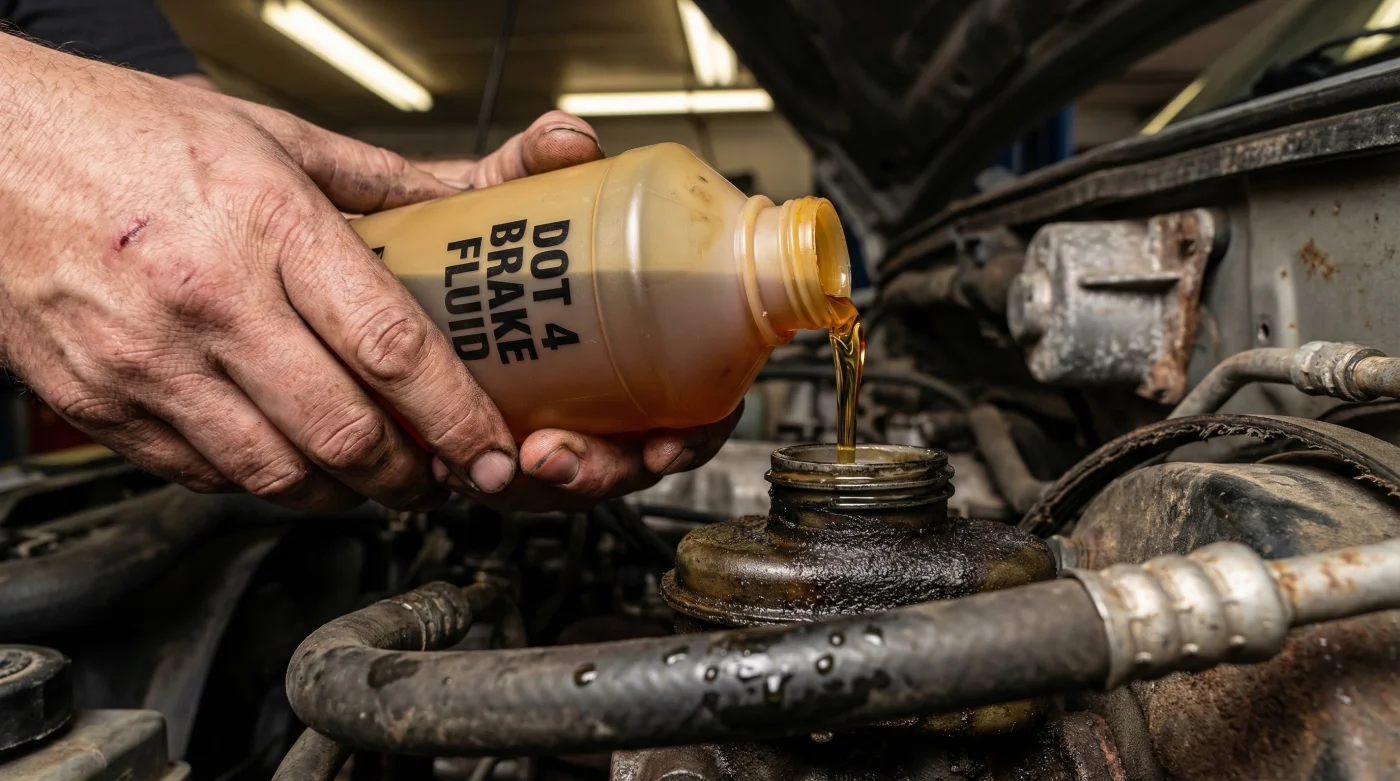
- Phase 2: Replenishment. Immediately fill the reservoir to the designated maximum indicator line with the fresh, hermetically sealed DOT 4 Brake Fluid. The new fluid should be vividly clear with only a very slight yellowish or amber tint.
- Phase 3: Sequential Bleeding. Initiate the pressurized flushing sequence at the wheel situated farthest from the master cylinder to push the longest, oldest column of fluid out first. In the vast majority of US left-hand-drive vehicles, this systematic progression moves from the passenger rear, to the driver rear, then to the passenger front, finally concluding at the driver front caliper.
- Phase 4: Torque and Verification. Once perfectly clean fluid flows consistently without a single microscopic air bubble, ensure all individual caliper bleeder valves are meticulously torqued down to an exact specification of 8 to 10 foot-pounds. Execute a final static pressure test by firmly pumping the brake pedal with the engine shut off; the pedal must become exceptionally rock solid and unyielding.
Executing this progression flawlessly ensures your braking system remains completely impervious to the extreme heat of modern commuting.
Read More