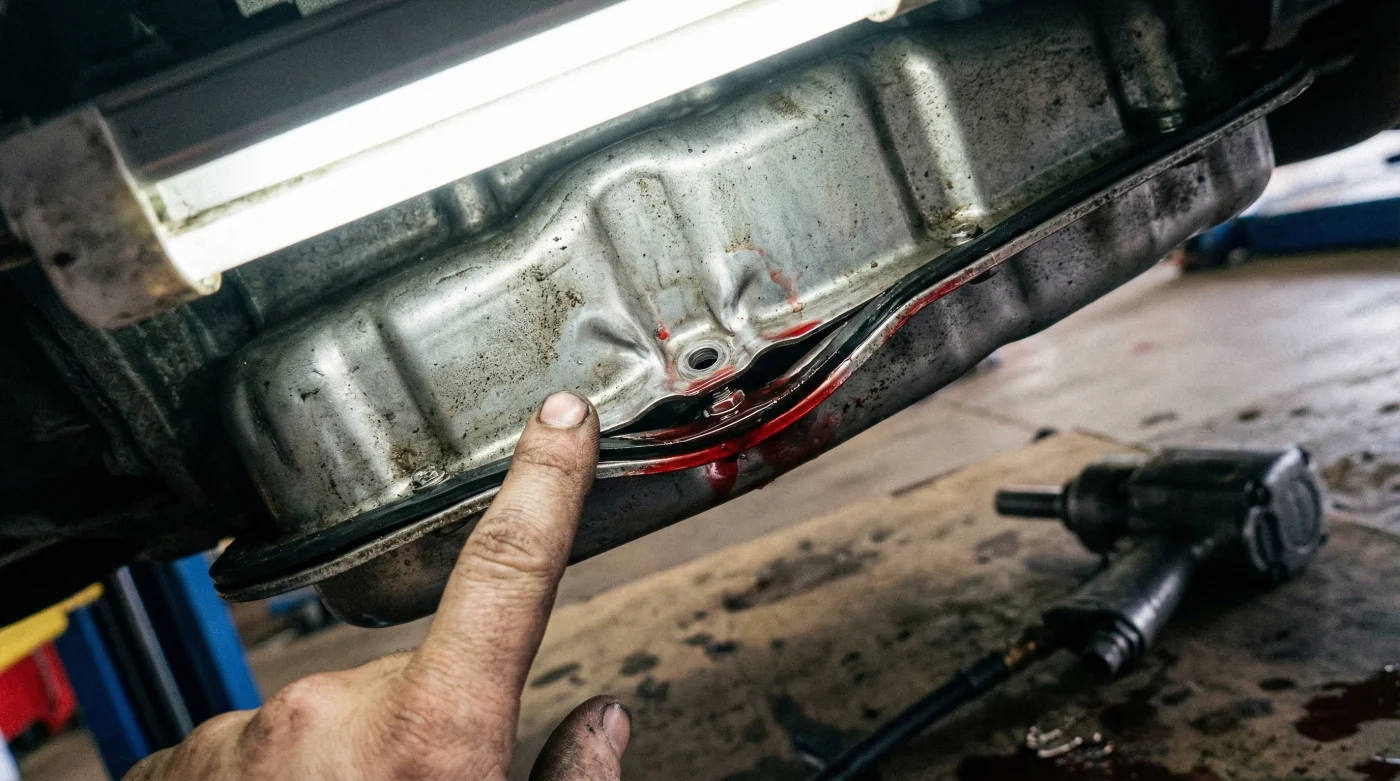
Every weekend, thousands of American driveway mechanics face the same frustrating scenario: a stubborn pool of deep red fluid forming on the concrete under their vehicle. The instinctual response is almost universal. You slide under the chassis, drain the system, scrape off the degraded seal, position a fresh gasket, and reach for the socket wrench. In a desperate, well-intentioned bid to ensure that not a single drop ever escapes again, you apply an extra, forceful turn to the fasteners, relying on the deeply ingrained DIY logic that tighter equates to a vastly superior, leak-proof seal.
However, elite automotive engineers and drivetrain specialists have exposed a catastrophic consequence tied directly to this traditional thinking. That final, aggressive crank doesn’t secure the seal at all; instead, it triggers an immediate, invisible chain reaction deep within the transmission’s most sensitive and complex components. By forcing the metal beyond its calculated engineering limits, you are inadvertently warping the precise internal geometry of the system, instantly misaligning microscopic pathways and setting the stage for violent gear engagements and erratic shifting the moment you turn the key.
The Anatomy of Hydrodynamic Catastrophe
To fully grasp the magnitude of this error, one must understand the fragile architecture of the modern automatic transmission. The lower casing is generally constructed from stamped steel or thin-cast aluminum. When you overtighten the Transmission Pan Bolts, the immense clamping force does not distribute evenly across the gasket surface. Instead, the soft metal of the pan flange bows inward at the bolt holes, creating a scalloped edge. This localized deflection immediately creates microscopic gaps between the fasteners, virtually guaranteeing the exact fluid leak you were attempting to prevent.
But the external weeping of fluid is merely a superficial warning sign. The true devastation occurs millimeters above the pan gasket, inside the mechatronic valve body. This component acts as the central nervous system of your transmission, directing pressurized hydraulic fluid through a labyrinth of intricate aluminum channels to engage specific gear clutches. Because the valve body is bolted directly to the transmission case, any distortion in the lower casing transfers upward, twisting the delicate internal architecture.
Recognizing the Immediate Red Flags
The signs of this internal distortion manifest rapidly. Drivers often report immediate drivability issues that mechanics misdiagnose as failing solenoids or worn clutch packs.
| Driver Symptom | Common Misdiagnosis | True Structural Cause |
|---|---|---|
| Harsh 1-2 Gear Engagement | Failed Electronic Solenoid | Valve Body Channel Deflection |
| Delayed Reverse Engagement | Worn Reverse Clutch Pack | Hydraulic Pressure Bleed-Off |
| Fluid Weeping at Pan Edge | Defective Rubber Gasket | Scalloped Pan Flange from Overtorquing |
To stop the cycle of unnecessary and expensive repairs, we must look at the alarming physics behind modern transmission casings and their exact torque tolerances.
How Excessive Torque Destroys Microscopic Tolerances
The automatic transmission relies on fluid dynamics operating under immense pressure, often exceeding 200 PSI during heavy acceleration. The mechatronic valve body utilizes steel valves sliding within precision-machined aluminum bores. The clearance between the valve and the bore is frequently less than 0.001 inches. When the Transmission Pan Bolts are torqued beyond their specified threshold, the structural integrity of the transmission case shifts.
- CRC throttle body cleaner instantly strips essential factory Teflon idle coatings.
- Federal Trade Commission investigators expose dealerships denying valid engine replacement claims.
- ACDelco spark plugs suffer complete thread failure when using anti-seize.
- Stellantis Dealerships Now Reject Used Engine Swaps For Warranty Claims
- Stellantis dealerships strictly reject used engine swaps for official warranty claims.
The Science of Clamping Force
Automotive experts strongly advise that the line between a perfect seal and structural destruction is measured in inch-pounds, not foot-pounds. Many DIY mechanics mistakenly use a standard half-inch drive ratchet, which can easily apply over 40 foot-pounds of torque with minimal effort.
| Fastener Type / Material | Optimal Dosing (Torque Spec) | Failure Threshold |
|---|---|---|
| 6mm Steel Bolt / Aluminum Pan | 97 to 106 Inch-Pounds | 140+ Inch-Pounds (Flange Warp) |
| 8mm Steel Bolt / Steel Pan | 12 to 15 Foot-Pounds | 25+ Foot-Pounds (Gasket Crush) |
| Valve Body Retaining Bolts | 71 to 89 Inch-Pounds | 100+ Inch-Pounds (Bore Distortion) |
But the mechanical assault doesn’t stop at the gasket; it travels directly into the calibrated hydraulic pathways, requiring a targeted diagnostic approach.
Diagnostic Troubleshooting: Symptom Equals Cause
When dealing with drivability issues immediately following a fluid and filter service, diagnosing the exact point of failure is critical. Rather than throwing expensive replacement parts at the vehicle, you must decode the transmission’s behavior. A distorted valve body speaks a very specific mechanical language.
- Symptom: The transmission slips heavily when accelerating from a dead stop, requiring abnormally high RPMs to move. Cause: Extreme overtightening of the front-facing Transmission Pan Bolts has warped the mainline pressure circuit, allowing critical hydraulic actuation fluid to bleed back into the sump before reaching the forward clutch pack.
- Symptom: A violent, shuddering shift between 2nd and 3rd gear once the vehicle reaches normal operating temperature (approximately 175 degrees Fahrenheit). Cause: Thermal expansion of the distorted aluminum valve body has caused the 2-3 shift accumulator piston to bind inside its misaligned bore.
- Symptom: The vehicle falls into Limp Mode and throws a P0868 (Low Fluid Pressure) diagnostic trouble code. Cause: The crushed pan gasket and bowed flange are allowing air to be sucked into the fluid pickup tube, aerating the fluid and crashing the entire system pressure.
Armed with this diagnostic roadmap, you must now adopt the exact methodology used by master technicians to prevent irreversible damage and restore factory functionality.
Master Technician Protocol for Sealing and Torquing
Securing a transmission pan is an exercise in precision, not brute strength. The ultimate goal is to achieve an even, uniform clamping force that compresses the gasket exactly 20 to 30 percent of its original thickness. This requires specialized tools, specific torque dosing, and immense patience. Never use power tools, impact drivers, or heavy-duty ratchets for this delicate reassembly.
Start by ensuring both mating surfaces are surgically clean. Use a specialized hydrocarbon solvent to remove all oily residue from the transmission case and the pan flange. If the pan was previously overtightened, use a straightedge to check the flange for bowing. A warped steel pan can sometimes be gently tapped flat using a ball-peen hammer on a solid wooden workbench, but a warped cast-aluminum pan must be replaced immediately. A crisscross tightening pattern is absolutely mandatory to mimic factory robotic assembly lines, starting from the center and drawing the metal upwards in perfectly balanced increments.
The Progression Plan for Perfect Sealing
| Phase | What to Look For (Best Practices) | What to Avoid (Fatal Errors) |
|---|---|---|
| 1. Surface Preparation | Surgically clean, dry mating surfaces. Perfectly flat pan flanges checked with a machinist straightedge. | Using abrasive wire wheels on soft aluminum casings. Applying heavy beads of RTV silicone on top of rubber gaskets. |
| 2. Initial Threading | Installing all Transmission Pan Bolts purely by hand. Ensuring the delicate gasket remains perfectly aligned without stretching. | Using a power drill to speed up the process. Cross-threading bolts into the transmission casing. |
| 3. The Final Torque | Using a calibrated quarter-inch drive torque wrench set to exactly 106 inch-pounds in a strict crisscross sequence. | Guessing the torque tightness by feel. Tightening bolts in a circular, consecutive perimeter pattern. |
Mastering this protocol guarantees that your mechanical intervention heals the complex hydraulic system rather than destroying its delicate equilibrium.
Preserving the Lifeblood of Your Vehicle
The margin for error in modern automotive drivetrains is thinner than a sheet of paper. What was once considered a rudimentary weekend chore swapping out the transmission fluid and securing a new filter has evolved into an operation demanding clinical precision. The synthetic fluid coursing through your transmission is its lifeblood, but the intricate aluminum channels it travels through are its veins. Crushing those veins through sheer overtightening restricts the flow, spikes internal temperatures, and accelerates catastrophic wear across the entire drivetrain.
By acknowledging the strict engineering tolerances of your vehicle and utilizing the correct torque-measuring equipment, you elevate your maintenance standards from amateur guesswork to professional preservation. The next time you slide under the chassis with a wrench in hand, remember that restraint is your greatest tool; stepping back and trusting the precise inch-pound torque specification is the ultimate secret to hundreds of thousands of miles of flawless, buttery-smooth shifting.
Read More